




How Trucking is Addressing the Diesel Technician Shortage
Associations, schools and fleets are hard at work to attract young people, train technicians, and retain the techs they have.
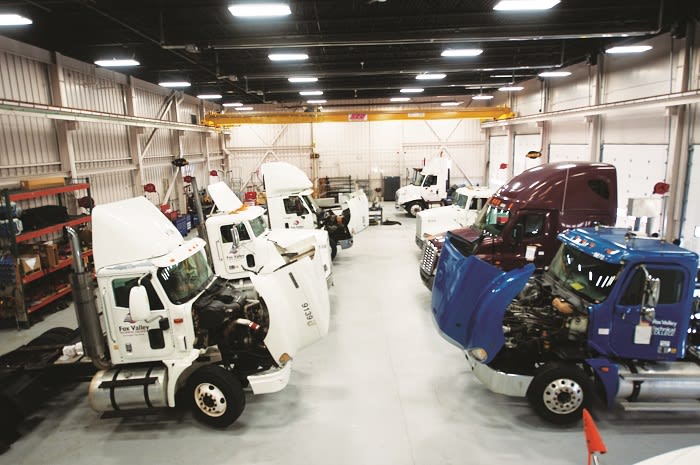
Fox Valley Technical College has found that technician students respond to a mix of classroom, tactile, hands-on, and even augmented reality training. Photo: Ronnie Garrett
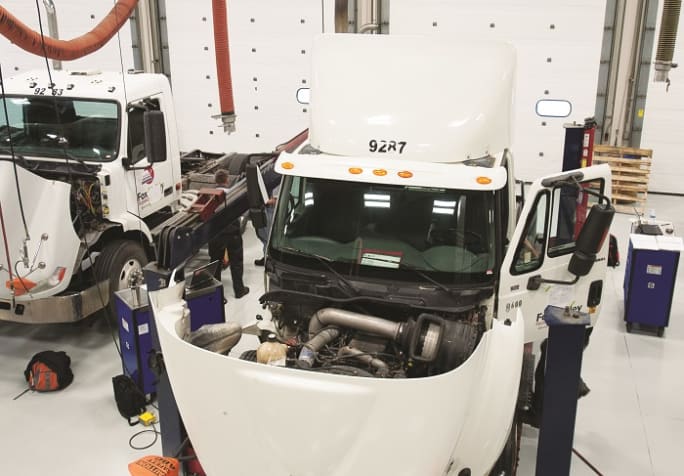
Fox Valley Technical College in Appleton, Wisconsin, has 60 diesel-powered tractors, giving diesel tech students plenty of chances for hands-on learning. Photo: Ronnie Garrett
Ed Chipalowsky is a diesel technology instructor for Monroe Career and Technical Institute in Bartonsville, Pennsylvania. Though at first blush, the words technical institute imply the school solely caters to post high school graduates, Chipalowsky teaches in its high school program aimed at training diesel technicians.
MCTI is part of a growing number of schools, industry organizations and fleet operations at work to address the escalating technician shortage by reaching kids early, mentoring them throughout high school and tech school, then following through with continuing education at the industry level. As an instructor in the first tier of this educational process, Chipalowsky is a big proponent of this new approach. “More schools are seeing the advantages of reaching kids at younger ages and are beginning to make changes in their curriculum to provide pathways to technical education,” he says.
And, he says, the approach is working. “One of our students, during his junior year, completed a certification program with Volvo/Mack. He later applied for a job at a Volvo/Mack dealership in Allentown,” he says. “The woman at the counter considered his age and said, ‘We only hire certified technicians.’ The young man opened his book and showed her his certifications.”
The company hired him on the spot, and the student worked there the summer between his junior and senior year. He was hired full-time upon graduation at $23 an hour to start, says Chipalowsky. “Plus, they gave him a sign-on-bonus.”
Chipalowsky’s tale is an example of what can happen when the trucking industry bands together to promote and further technician training and advancement.
Unfortunately, the industry is “only willing to invest in something that can get them a tech tomorrow,” says Jennifer Maher, CEO and executive director of TechForce Foundation, a nonprofit focused on “Driving Tomorrow’s Workforce of Technicians.”
On the surface, when you need a technician in your shop now, investing in a middle school or high school student appears senseless when the payoff is three to five years away. But as the trucking industry faces a sobering reality — that it will need an estimated 28,300 new entrant diesel techs by 2024 — Maher maintains schools from the elementary to post-secondary levels must march in time with the industry to meet the growing need.
Work has already begun, but Maher suggests more is needed. She recommends a three-pronged effort that partners associations, educational institutions, and fleet operations in a joint effort to meet growing demands.
“No one entity can fix the qualified technician shortage problem,” she says. “We all must row in the same direction. The big problem right now is that everybody is sitting on the sidelines and waiting for someone to fix the problem, but that isn’t going to happen.”
Start early
In January, Fresno Unified School District broke ground on a $9 million, state-of-the-art trades facility for high schoolers to gain workplace experience before graduation. The facility, located on the campus of Duncan Polytechnical, will include a heavy truck maintenance and construction shop.
FUSD Superintendent Bob Nelson says this facility will help students get certified to work on diesel trucks upon graduation. “Here, students can immediately leave our facility ready for work,” he says.
The Fresno project is similar to what MCTI has been doing for some time. Its Diesel Technology Program is designed to prepare students to apply technical knowledge and skills to the specialized maintenance and repair of trucks, buses, and other commercial and industrial vehicles. Students leave the National Automotive Technicians Education Foundation (NATEF)-certified program armed with the skills needed to work on diesel engines, suspension and steering, brake systems, electrical and electronic systems, drivetrains, HVAC systems, and auxiliary equipment installation and repair.
Students in the MCTI program spend half of their day attending legacy education courses, such as algebra or biology, and the other half of their day in the tech program. The school will graduate 10 students in May. Upon graduation, four students are heading to post-secondary schools, two are heading to the military, three are entering the workforce, and one student remains undecided.
The program addresses the needs of tactile learners and introduces them to technical jobs — work they may not have considered as a career. “Too often, parents and educators are telling them, ‘Go to college. Go to college. Go to college,’ ” Chipalowsky says. “We are trying to show parents, teachers and students that there are other alternatives.”
Maher believes that more tech training opportunities like this are needed at the middle school and high school levels. “Schools are teaching only to the eyes and ears, but that’s not how all people learn, and it’s not how all people want to work. We need to stand up for the tactile intelligence of a huge population of our kids and provide them with learning opportunities.”
Chipalowsky laments, however, that the success of programs like MCTI’s is tied to industry partnerships, which can sometimes be lacking. Penske, he says, has helped the MCTI program by donating equipment and hiring its graduates.
“If Penske can do that, why can’t others?” he wonders. “Companies have to step forward. They must start investing in career and technical education. There are some great companies already doing this, but it’s not enough. It is simply not enough.”
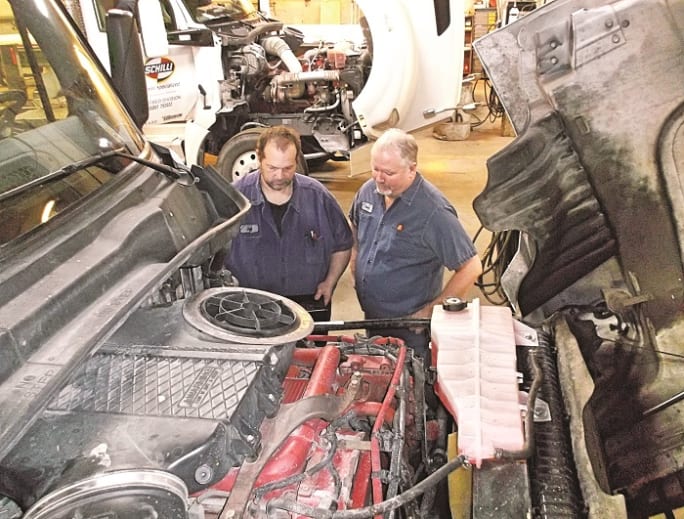
From left, Jeff Rickey, a Tier 5 senior truck technician, and David Northcut, shop manager, diagnose an engine control module on one of the company’s trucks at the Schilli NationaLease shop in Remington, Indiana. Photo: Schilli
Grow your own
Some companies have taken it upon themselves to fill their own technician gaps, such as Schilli NationalLease, based in Remington, Indiana, which provides maintenance, long-term leases and daily rentals to the company’s trucking operation, Schilli Transportation Services, as well as to other fleets. The company employs 78 technicians with a combined 780 years of tenure, knowledge and experience, but many of its technicians are considering their retirement options over the next few years.
After recognizing a need to attract qualified technicians to replace retiring techs, and a growing need to retain the technicians it already has, Schilli launched an initiative to evaluate its compensation, benefits, and training programs. After surveying shop managers, the company established two different pay scales, one for tractors and one for trailers, and crafted a training program for each to help technicians master new skills and increase their pay. Each pay scale has several different tiers based on skills and proficiency, and each tier has a salary range to provide managers flexibility in rewarding and incentivizing technicians.
The firm also started a mechanic helpers’ program to pique interest in the trucking industry among high school students and young adults. “This program brings in people who may not have the tools or the skillsets to hit the ground running,” says Jake Rudisill, general manager of leasing and maintenance for Schilli NationaLease.
The entry-level position serves as a stepping stone to tech-level positions. In this role, young people grab parts for technicians, clean up the work area and the shop, do parts runs and more. “But what they are really gaining is experience,” says Rudisill, who explains that not only are they figuring out if the work is for them, but they also are learning the lingo of the trade. For example, they might learn that a brake chamber is also referred to as a 3030 or a Maxi, or when a truck blows a tire, a driver might talk about recaps or gators.
“There are different terminologies that mean the same thing, and they need to know these things,” Rudisill explains. “Communication is the No. 1 thing we use every single day. Without clear communication, we can’t get anything done.”
Shop managers monitor the progress of mechanics’ helpers and over time might move them into one of the company’s tiered growth paths. “We move them to a Tier 1 role in either the truck or the trailer program, then we continue their education,” Rudisill says. “The mechanic’s helper program is designed to take someone with little to no experience and put them on a path to becoming a technician.”
Once on a tiered training path, Schilli technicians can earn increases in pay by adding to their skills and increasing their proficiency. The salary ranges within each tier also allow shop managers to reward technicians for other achievements, such as higher productivity, good attendance, and excellent customer service.
“If a Tier 1 technician, for example, becomes proficient in three of the six skills required to be a Tier 2 technician, attains a near-perfect attendance record and receives high marks for productivity and good customer service, a shop manager can reward that technician by placing him or her on the low end of the salary range for Tier 2,” Rudisill says. “Then, as that technician becomes more proficient and learns the other three skills required for Tier 2 status, he or she will move up the salary range.”
He adds that the tiered program is meant to get employees to challenge themselves. “A mechanic’s helper is challenged to learn the industry and the basics to become a Tier 1 tractor or trailer technician, a Tier 1 technician is challenged to master the skills to become a Tier 2 technician, and so on,” he says.
The company has also established a dual-evaluation process, where both the technician and the supervisor evaluate and rate the technician’s performance and proficiency during his or her annual review. The manager and technician compare their evaluations to set goals for the coming year.
Schilli’s compensation and training program is seeing positive results. According to Rudisill, the program has reduced cost-per-mile on several routes, improved repair turnover time, decreased the turnover rate among technicians, and has increased young people’s interest in becoming technicians.
“Yes, there is a technician shortage in the industry, but I don’t think we feel it as much now as others do,” he says. “I think many companies in need of technicians are marketing for experience, but we are taking a different approach. We are growing our own technicians, mentoring them along the way, and seeing less turnover as a result.”
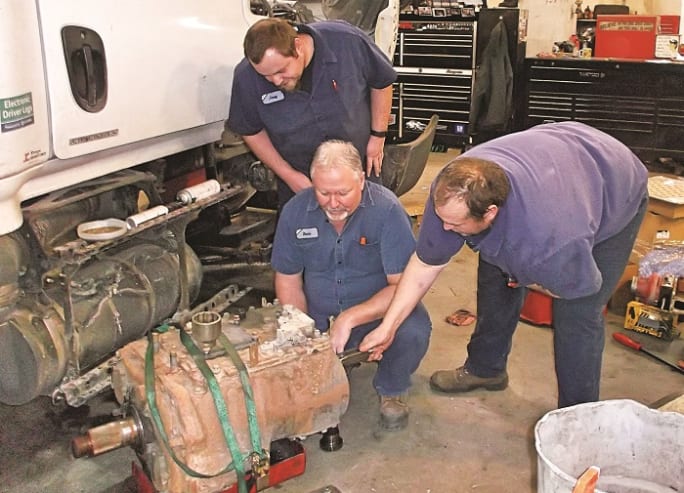
From left, Jerry Brown, a Tier 4 trailer mechanic with Schilli, observes as shop manager David Northcut and Tier 5 truck technician, and Jeff Rickey, a Tier 5 senior truck technician, review a repair on a transmission from one of the company’s trucks. Photo: Schilli
Ramp up retention
A critical piece for industry leaders is keeping the techs they have. Penske focuses its attention on retention from a new hire’s first day, says Gregg Mangione, senior vice president of maintenance at Penske.
Penske has created an ambassadors program to ensure every new hire has a positive first day, first week, first month, and first year. This program pairs seasoned employees or ambassadors with new hires to take them through their first day and check in at regular intervals throughout the first year.
The first day experience is critical to retention, Mangione says, so Penske ensures new employees have a uniform and a locker ready upon arrival, brings them in mid-week when things are slower, and makes sure to introduce them to the staff. “All this sounds simple, but people want to know they have a place,” he says.
Penske also has developed a certified technician program where technicians can continue training to move up from a Technician 3 to a Technician 1 level. This program serves two purposes: One, to get new techs up to speed more quickly, and two, to provide ample opportunities for professional growth and increase job satisfaction. “We started this program a decade ago to build upon a new tech’s knowledge, because they came to us with pretty basic skills,” says Mangione. “But about five years ago, we began looking at this program as a means of driving retention. We were finding that when folks left, they were saying they were looking for a career path and skills development.”
The program is self-driven, meaning techs can move up through the ranks as quickly as they can demonstrate they have mastered new skills. The company worked with Penn Foster Career School to develop internal standards for each technician level and internal materials to pair with OEM-led training. Penske trains students with these internal products, which include books, videos and instructor-led programs, then puts students on the shop floor where they can apply their new skills.
“You can provide people with all the training in the world, but they are not going to retain it unless they have that hands-on component; techs are usually tactile learners,” Mangione explains.
The training is supplemented with regular development discussions (every six months) between the employee and their manager. Here, they can discuss the employee’s skills and goals for the future. Penske compiles specific data about the service work the tech has done, including quality come-back information and preventive maintenance inspections. “Did they have any repeat repairs?” Mangione asks. “The goal behind this meeting is for the technician to gain an understanding of the training the employee can take to fill skills gaps and to fulfill long-term career aspirations.”
Finally, Penske supplies techs with tablet computers to use during servicing. From these they can not only perform system diagnostics, but also can pull up how-to videos, available on demand for complex repairs. The videos are three to five minutes long and are housed in a searchable database for techs to use.
“When we found techs walking back and forth to PCs and using their smartphones to Google things, we set out to build a knowledge base to help with vehicle repairs,” Mangione says. “We had professional writers on staff who could write the best repair instructions in the world, yet we still found variations, so we built our own Penske Education Center (P-Tech), a physical site where we do training, testing and film some of the videos, and it holds approximately 300 videos today.”
All these measures combined are driving up Penske’s retention numbers, giving the company a leg up on the technician shortage. “These efforts have improved our first-year retention rates in some areas of the company by 50%,” Mangione says. “As we sit here looking at the shrinking technician pipeline, we are focusing on retaining the techs we have. Making an investment in people and increasing compensation levels, it helps keep technicians here.”
Ronnie Garrett is a freelance writer based in Fort Atkinson, Wisconsin. She has written about the skilled labor and technician shortage for a variety of industries, including manufacturing and supply chain, trucking and logistics, and aviation.
Related: Augmented Reality Tool Helps Train Diesel Techs [Video]
More Maintenance
Mack Expands Extended Coverage With Four Chassis System Plans
Mack Trucks' new system-specific coverage options allow heavy-duty fleets to select protection for driveline, cab, HVAC, electronics, and advanced safety components.
Read More →
What an Out-of-Service Order Really Costs, and How to Plan for One
The repair invoice is the first number you see — and often one of the smallest. Here’s what else an out-of-service order can cost a fleet, and how planning can reduce the damage.
Read More →
International Launches Online Truck Parts Store
Fleetrite.com lets fleets and repair shops find OEM and all-makes parts, check prices and availability, and order without calling a parts counter.
Read More →

Continental Introduces New Regional Truck Tires
Continental says its new Generation 5 steer and drive tires for regional operations offer longer tread life, with estimated mileage gains of 22% and 19%, respectively.
Read More →
How AI Can Help Your Techs’ Efficiency
The technician shortage isn't going away, and no single fix can close the gap on its own. Trent Broberg makes the case that AI's real job in the shop is protecting the billable hours and job satisfaction of the techs you already have, not asking them to work faster.
Read More →
Color Match Smarter: Tools That Restore & Perform
For fleet managers and collision repair professionals keeping heavy-duty trucks on the road, getting the color right the first time isn't just about appearance — it's about efficiency, turnaround time, and bottom-line results. Discover how today's digital color tools are transforming the repair process from guesswork to precision.
Read More →
Wrong Repair Prompts Recall of Freightliner, Western Star 4x2 Trucks
DTNA is recalling more than 2,400 trucks that received an incompatible software fix instead of the hardware repair required to address brake valve corrosion.
Read More →
Truck Drivers Need More Than Another Alert
Fleets have more visibility into truck health, safety events, and driver activity than ever. The next challenge is turning all that information into useful guidance for the person who has to decide what to do next.
Read More →
The Maintenance Checks Trucking Fleets Should Prioritize Before Fall Freight Picks Up
Making it through August isn’t the same as being ready for the next several months of operation. Find out what systems may have suffered from summer heat and need to be checked out before fall.
Read More →
What Three Fleets Are Doing Differently When Buying Truck Parts in 2026
With freight improving but costs still climbing, fleet maintenance executives explain how they're balancing price, quality, and supplier relationships.
Read More →