Electric and natural gas vehicles are the most well-known alternatives to diesel, but here’s a look at other alternative fuels that may be in the running for certain truck applications.
David Cullen・[Former] Business/Washington Contributing Editor
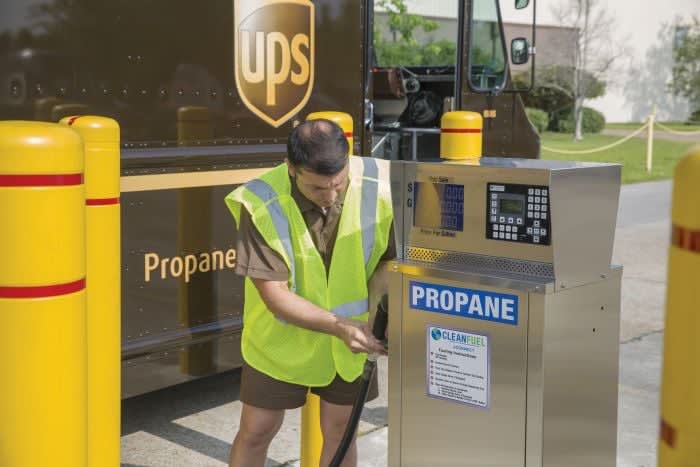
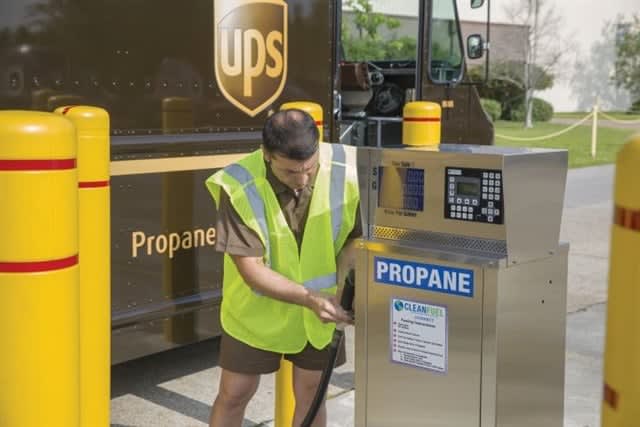
Director of Fleet Procurement Mike Casteel says UPS has “a lot of experience with propane autogas,” including running over 2,000 propane-powered package cars in the U.S. and Canada. iStockPhoto
6 min to read
Director of Fleet Procurement Mike Casteel says UPS has “a lot of experience with propane autogas,” including running over 2,000 propane-powered package cars in the U.S. and Canada. iStockPhoto
Even as natural gas yet reigns as king of alternative fuels for trucks, and electric drive and fuel cells are gaining interest as up-and-coming technologies, there are still other fuels that fleets may consider as worthy alternatives to straight-up petroleum diesel.
Ad Loading...
For commercial vehicles, these other choices chiefly include propane (aka autogas), biodiesel, renewable diesel, and dimethyl ether (DME). Each has its advocates. Propane autogas has been in use for years, and the two diesel alternatives can be adopted simply by fueling with them. DME is more of an outlier in that it caught a lot of attention a few years ago but is not engendering much high-level interest of late.
“All alternative fuels are viable, but not in all applications,” says analyst Kenny Vieth, president of ACT Research. “Because each company’s goal for its fleet is different, even two similar fleets may make different fuel choices. Each fleet will assess its own corporate goals, the local/regional availability and price of the respective alternative fuels, and any regulations and incentives for the areas in which the fleet operates before making the fuel decision. Cost, range, weight, performance, and time will all factor into each fleet’s decision.”
Ad Loading...
Bob Carrick, Freightliner’s vocational sales manager - natural gas, who is a former fleet manager, handicaps the other alternatives succinctly: “Propane autogas makes sense and is gaining traction in the lower GVW classes, up through Class 7. Renewable diesel is a very clean alternative to diesel, and so far has demonstrated fine performance with no significant downsides. Biodiesel works in low concentrations [blends]. DME, however, is still a long way from any adoption. There is no fuel supply, and very little engine durability testing [using the fuel] has been performed to date.”
Volvo has been the main company delving into DME, and John Moore, Volvo Trucks product marketing manager - powertrain, leaves the door open to future fuels and technologies. “Sustainable sources of energy are the future,” he says, “and Volvo will continue to research and invest in the sources of energy that provide the best value for our customers.”
Following is key information on various elements of each of the four “other” alternative fuels discussed above.
Autogas
Propane, or liquefied petroleum gas, is called autogas when used as a motor fuel. It’s widely regarded as a competitive fuel for light-, medium- and even heavy-duty fleet operations. “As a vehicle fuel, it substantially reduces harmful emissions, costs less than gasoline, and is almost entirely domestically produced,” says Alliance AutoGas, a major supplier to truck fleets. “With more than 18 million vehicles worldwide running on autogas, it is the most widely used alternative fuel in the world, just behind gasoline and diesel.”
Autogas is ideally suited for centrally fueled fleets or those that share refueling stations with other fleets, according to the Propane Education & Resource Center. PERC contends that “autogas infrastructure beats conventional fuels and many alternative
Ad Loading...
fuels. Autogas is a non-contaminant of air, land, and water resources, reducing or even eliminating many EPA requirements for installing and maintaining diesel and gasoline infrastructure. For those who need to travel long distances, bi-fuel vehicles offer a gasoline backup to propane autogas.”
Biodiesel
Biodiesel is a domestically produced renewable fuel created from vegetable oils, animal fats, and recycled restaurant grease. Physically, biodiesel is similar to petroleum diesel, but it burns cleaner. Biodiesel meets both the biomass-based diesel and overall advanced biofuel requirement of the Renewable Fuel Standard, a federal program that requires transportation fuel sold in the United States to contain a minimum volume of renewable fuels.
One complaint about biodiesel is cold-weather performance. How well it performs in low temperatures depends on the blend of biodiesel, the feedstock, and the characteristics of the petroleum diesel used, according to the U.S. Department of Energy. In general, the smaller the percentage of biodiesel in the blend, the better it performs in cold temperatures. “Typically, regular No. 2 diesel and B5 [a blend of 5% biodiesel] perform about the same in cold weather. Both biodiesel and No. 2 diesel have some compounds that crystallize in very cold temperatures. In winter weather, fuel blenders and suppliers combat crystallization by adding a cold flow improver. For the best cold weather performance, users should work with their fuel provider to ensure the blend is appropriate.”
Renewable diesel
There is confusion about terminology when it comes to biodiesel and renewable diesel. They are not interchangeable terms. Renewable diesel is fuel derived from biomass that meets registration requirements established by the Environmental Protection Agency under Section 211 of the Clean Air Act as well as those laid out in the American Society of Testing and Materials’ D6751D975 spec.
Hydrogenation-derived renewable diesel, aka “green diesel,” is the product of fats or vegetable oils — alone or blended with petroleum — refined by a hydrotreating process, according to the DOE. As opposed to biodiesel, green diesel meets the petroleum diesel ASTM specification. “This allows it to be legally used in existing diesel infrastructure and vehicles,” notes DOE. “Fuel producers are designing HDRD to substitute for or blend in any proportion with petroleum-based diesel without modifying vehicle engines or fueling infrastructure.”
Ad Loading...
Along with its green credentials, renewable diesel may be a draw for fleets largely because it meets quality standards for fueling new diesel engines and it’s compatible with the existing diesel distribution infrastructure. What’s more, DOE points out, “HDRD’s high combustion quality results in similar or better vehicle performance compared to conventional diesel.”
DME
Dimethyl ether (DME) was something of a hot topic back during the George W. Bush administration. At the time, with development going on primarily in Europe, it was seen as a “near future” alternative fuel for trucks. Then it largely faded from view, no doubt because such great strides have been made in the past decade to clean up diesel exhausts, and because diesel prices have dropped to a point where there is less of a push for alternatives. In addition, natural gas — and propane autogas, too, for that matter – in the U.S. proved a highly successful alternative, and efforts to advance electric-drive and fuel-cell technologies have begun to bear fruit.
A synthetic product, DME would be produced in the U.S. on a large scale by using natural gas as its feedstock (although it also can be made from biomass and many other materials). It would work as an alternative to diesel in specially designed compression-ignition diesel engines, according to DOE. As it needs to be pressurized to be liquefied, DME’s handling requirements are similar to those of propane; both must be kept in pressurized storage tanks at ambient temperature.
DME enjoys some advantages. It has a very high cetane number, which is a measure of the fuel’s ignitibility in compression-ignition engines. The energy efficiency and power ratings of DME and diesel engines are virtually the same. And because of its lack of carbon-to-carbon bonds, using DME can virtually eliminate particulate emissions and potentially negate the need for costly diesel particulate filters, says DOE. However, DME has half the energy density of diesel fuel — which means it needs a fuel tank twice as large.
DME vehicle demonstrations have been undertaken in Europe and North America, including one in which a customer operated 10 vehicles for 750,000 miles.
Ad Loading...
However, DME is not commercially available in the U.S. at this time. But one company here, Oberon Fuels, is producing DME via waste streams, such as biogas made from organic wastes and landfill gas. According to the company, this production method “not only creates a new, cleaner burning fuel, it also leads to dramatic reductions in greenhouse gases that will be very attractive for fleets and governments alike.”
UPS’ Experience
Arguably the most diverse fleet of alternative-fueled trucks, running everything from natural gas to electrics and hybrids, UPS has a lot of experience with propane autogas, with some 2,000 propane-powered delivery trucks currently in the fleet, primarily in the U.S. and Canada.
UPS Director of Fleet Procurement Mike Casteel says propane autogas is easy to transition to. “The vehicles operate much the same as gasoline, and the fueling infrastructure is low cost and easy to install. Propane works best in our fleet in rural areas where the vehicles run fairly high miles and fleet concentration is fairly small. Our average propane deployment is about 20 to 30 trucks in any specific location.
“Propane is a very low-cost fuel,” he continues. “However, with today’s low cost of gasoline, the business case to convert to propane and overcome the incremental cost of the propane truck can be difficult. Most of our most recent propane deployment was done in areas with some type of incentive to use non-traditional fuel, such as in California, Oklahoma, Louisiana, and Colorado.”
UPS also has experience with advanced renewable diesel, consuming more than 13 million gallons of it last year. “This advanced renewable fuel is chemically identical to diesel and can be used in high concentrations, mixed with traditional diesel, or used as a stand-alone fuel without any modifications to the truck,” Casteel says. “But the fuel supply is limited; we use it primarily in our fleet in California.”
He notes that UPS also leverages renewable natural gas, accessing it from the interstate natural gas pipeline system. “We used about 5 million gallon equivalents of RNG last year and we’re on track to use more this year.”
Why do battery-electric Class 8 trucks remain so expensive? A California bill signed by Gov. Gavin Newsom would give fleets and state agencies more visibility into what manufacturers charge.
Volvo’s updated D13 promises lower emissions without sacrificing performance or fuel economy. Take a closer look at what changed inside the engine in this HDT Spotlight video.
Energy Vision estimates fleets could recover the higher purchase price of an RNG-fueled Class 8 tractor in 1.3 to 2.8 years under current fuel-price scenarios.
Calstart is now Catalyst Mobility, reflecting the nonprofit’s growing national role in clean transportation, including zero-emission trucks, infrastructure and incentive programs.
Average U.S. diesel prices have climbed to nearly $6 a gallon, surpassing the 2022 record as tight refinery capacity and Middle East disruptions keep fuel costs elevated.
Fuel delivery depends on more than what happens at the injector. For fleet, maintenance and technical professionals, looking at the full path from pump to injector can provide useful context for understanding engine performance.
The Port Authority of New York and New Jersey announced millions in incentives for zero-emission drayage trucks, yard tractors, and new charging hubs near the port.
Detroit isn’t starting from scratch to meet EPA 2027 diesel emissions standards. Its Gen 6 DD13 and DD15 engines keep much of today’s platform while updating the fuel and aftertreatment systems.
California, Oregon, Washington, British Columbia and Baja California are coordinating plans for truck charging and hydrogen fueling from Canada to Mexico.