





Related: Trucking in the 21st Century
How E-Commerce is Changing Trucking
In the second part of our Trucking in the 21st Century series, we examine the rise of e-commerce and how it is changing the trucking industry.
February 13, 2017
13 min to read
In 1995, Jeff Bezos launched a website to sell books. He billed it as “Earth’s biggest bookstore,” and went through ideas for names including “Cadabra” and “Relentless.” Eventually, he named it after the largest river in the world.
It turned out to be an apt name. Amazon unleashed an ever-growing, inexorable river of e-commerce. The impact of that flow on transportation and logistics goes far beyond Amazon, and far beyond the delivery drivers who were pounding up your home’s front stairs at 11 p.m. the week before Christmas.
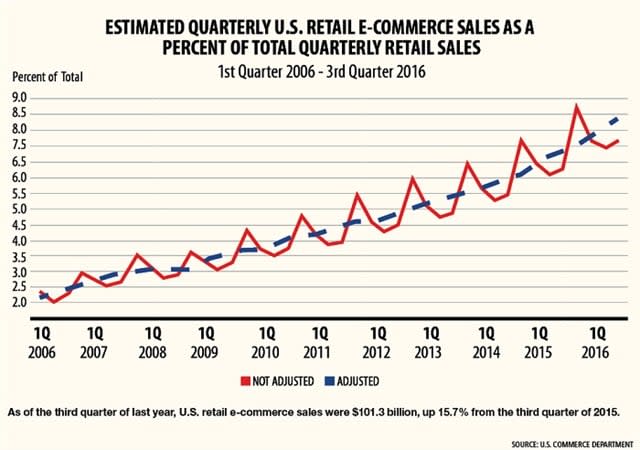
The U.S. Commerce Department didn’t have holiday sales figures at press time, but it reports that for the third quarter of last year, U.S. retail e-commerce sales were $101.3 billion, up 15.7% from the third quarter of 2015. (That’s adjusted for seasonal variation, but not for price changes.)
In contrast, total retail sales for the third quarter were up only 2.2% year over year.
And it’s not just consumer goods like clothing and electronics. For instance, Darryl Barber, automotive segment marketing manager for UPS, says e-commerce is changing the way auto parts distributors do business.
“Consumers who are buying a part are as likely to go online and order it as drive to a local store,” he says. “The aftermarket manufacturers we deal with [report] aftermarket business is up 3.5 to 4% year over year, but it’s up 16 to 20% for the e-commerce channel.”
For UPS, that means parts previously moving in palletized shipments to a warehouse or distribution center are now going out in more frequent, smaller shipments, Barber says. “A lot of times they end up in the package cars on the street — the same guys that deliver your Christmas presents.”
Much of the most direct impact of e-commerce is on package carriers such as UPS and FedEx. UPS, for instance, projects that business-to-consumer parcels (as opposed to the business-to-business parcels that previously made up the bulk of its business) will make up more than half of its U.S. domestic shipments by 2019.
This brings both opportunities and challenges.
Amazon is busy developing its own logistics network, buying airplanes and trailers and reportedly setting up its own brokerage operations.
“Jeff Bezos isn’t going to use that Boeing 767 just in November and December,” says John Larkin, managing director, research, with the Transportation & Logistics Group of investment banking firm Stifel. He’s going to use it 365 days a year, “and let the flex capacity be provided by someone else.” That’s not good for parcel carriers like UPS and FedEx, he says, because they aren’t set up to handle just the peaks. “It’s like trying to accommodate everyone who wants to come to church on Easter Sunday. You have a couple hundred people waiting outside who can’t get in.”
Even if e-commerce doesn’t affect you directly, “it sucks up a lot of capacity, especially in high port-reach areas, like Houston or Long Beach, and also high-density areas where there’s a lot of consumers, like big cities,” says Robert Nathan, CEO of Load Delivered, a third-party logistics company that specializes in food and beverage freight.
But nearly everyone HDT talked to says that whether e-commerce affects you directly or not, the most profound change for logistics — and for nearly all types of trucking — is that e-commerce in general, and Amazon in particular, have put customers in control more than ever before. They want what they want, when and where they want it.
Increasingly we’re a society that values instant gratification, or as close to it as we can get. In 2005, Amazon launched Amazon Prime, giving subscribers free two-day shipping along with other benefits. At a time when customers expected to pay for 4-6 business days, the program was met with skepticism. Although the number of members in Prime is a well-guarded secret, Consumer Intelligence Research Partners reported that as of the third quarter of 2016, its analysis indicates that Amazon Prime had 65 million U.S. members — 38% more than a year earlier.
Amazon raised the bar, and now consumers expect fast shipping and transparency about when they will get their purchases from other e-commerce providers as well. In a 2016 UPS survey, 46% of those surveyed reported they had abandoned an online shopping cart due to a delivery date or time that was too long or not provided.
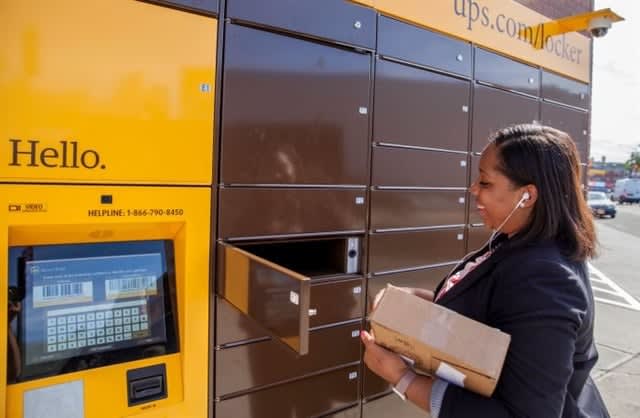
As e-commerce has spelled growing consumer deliveries, new options are arising for delivery points. UPS Access Point Lockers, for instance, offer customers to pick packages up at their convenience — and cut down on the number of separate residential deliveries for UPS. Photo:©istockphoto.com/jahcottontail143
Last-mile delivery
The most obvious impact of e-commerce is on parcel carriers, but e-commerce is changing last-mile delivery in ways that might not be obvious. And it’s changing rapidly, with companies experimenting with different distribution models and technologies.
Take Amazon. It uses FedEx and UPS and a network of courier companies, many of which use independent contractor drivers. It also has its own version of Uber, called Flex, which advertises that people can be their own boss, set their own schedules, and make $18-$25 an hour. And Amazon’s looking to the future with research into drone delivery, and filing patents for technologies such as self-driving delivery trucks, an underground tunnel network, and airborne fulfillment centers.
Smaller companies may use Amazon for fulfillment, or ship via UPS, FedEx, the U.S. Postal Service, or a combination. Both UPS and FedEx offer services for which the post office handles the actual last-mile delivery.
Then there’s the question of where the package is actually being delivered. Customers not only want to get their order fast and to know exactly when it’s going to be delivered, but they also want control over where and how it’s delivered.
No longer do consumers have to choose home or office. Do you want to pick it up at the store on your way home? Have it delivered to your home in the evening? The trunk of your car in the parking deck at your office? Pick it up in a locker at a UPS store, or at the photo counter at your local Walgreens? Change it all on the fly? For instance, UPS My Choice members can sign up for delivery alerts and the ability to reschedule, redirect, or have packages delivered to a UPS Store or to a UPS Access Point location.
Meanwhile, products too large to easily fit through a conveyor-based sorting and handling system, like a lawnmower or treadmill, have to go through a different channel of distribution. Less-than-truckload carriers are taking advantage of this opportunity.
For instance, A. Duie Pyle’s new Express Solutions is using medium-duty trucks designed for last-mile delivery instead of having to take its larger Class 8 trucks and pups into residential areas and other delivery locations without docks.
“We [realized customers] with e-commerce had a greater propensity [to be] smaller customers that had limited [or no] dock areas,” explains Randy Swart, COO of the Pennsylvania-based regional LTL. “So going out and investing in trucks designed to be more nimble with liftgates and decking and all the modern safety conveniences to address that seemed like a really good idea.”
Beyond the delivery
Last-mile delivery carriers, however, are far from the only companies being affected. E-commerce and omni-channel marketing requires a different distribution model than classic big-box store logistics, and that’s affecting truckload and less-than-truckload, long-haul and regional operations.
In the (recent) past, stores like Walmart or Home Depot would have a regional distribution center out in the hinterlands, feeding a state or a region. Product would come in one side and be sorted according to which store it was going to (does that Walmart in Meridian, Mississippi, need two or three garden hoses tomorrow?). Then it would get loaded onto trailers on the other side, and a truckload carrier would then typically deliver that freight to that store. For smaller merchants, such as dollar stores, seven or eight locations might have a single truck delivering to them, so the trailer had to be loaded so the first store you delivered to was the last one you loaded.
But today, as retailers work to not only keep their stores stocked but also deliver directly through their e-commerce platforms, inventory must be forward-positioned within the urban core in order to meet expectations of two-day, one-day, and even same-day delivery. Since that urban real estate is more expensive, that fulfillment center has room for less of each product. So you may see more less-than-truckload shipments going into those urban centers.
“So e-commerce ends up being good for LTL and maybe not quite as good for truckload,” Larkin says, “because some of those dedicated fleet movements between distribution centers and stores may be supplanted by more frequent, smaller vehicles into these smaller fulfillment centers.”
Chattanooga, Tennessee-based truckload carrier U.S. Xpress, however, says it’s found new business transporting loads from DCs to smaller fulfillment centers near urban areas. And Larkin notes that truckload companies may end up repositioning inventory from one regional distribution center to another.
“There are a couple of truckload carriers that seem to be kind of go-to carriers for Amazon,” Larkin says, citing Covenant and Knight. “Then there are those that say, ‘I don’t want to deal with Amazon because they deal kind of the way shippers used to operate, where price is the only thing that matters.’ You don’t want to be a generic player for someone that big. There’s nobody that’s really thrown their lot totally in with Amazon. You’ve got people out there doing 5%, 10% of their business with Amazon, but they want to maintain a diversified freight base so they don’t get too chummy with one person who can start deciding their margins.”
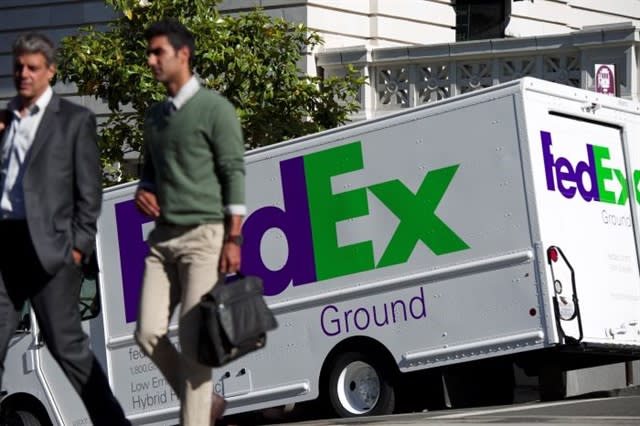
FedEx touts its Ground delivery to small e-commerce businesses, noting that it has improved delivery times, with delivery to many locations in one to two days, at a more economical price.
Behind the scenes
This all means incredibly complex logistics and information technology challenges for shippers, carriers, and third-party logistics providers. And it gets even more complex when you add in the growing emphasis on omni-channel marketing, which aims for a retail experience that integrates the different methods of shopping available to consumers, whether that’s in a physical store, online, by phone, or some combination.
“You’ve got a bunch of PhD rocket scientists sitting around trying to do models to predict where you’re going to need to have what, but consumers are fickle beings,” Larkin says. “On a cloudy day, they may buy one thing, and on a sunny day it might be something else… it’s hard to use predictive analytics to predict consumer behavior exactly. So do you have to have more buffer inventory to position yourself to be able to withstand all that variability? Or do you run the risk of stock-outs, which can be very expensive? If you go the route of building inventories, and interest rates continue to rise, at what point does the cost of carrying that inventory begin to crunch your margins?”
Walmart last year announced it was buying Jet.com Inc., a fast-growing e-commerce company, which uses technology that rewards customers in real time with savings on items that are bought and shipped together. “The Jet people are going to be the people that really end up designing and implementing the broader Walmart e-commerce/omni-channel strategy,” Larkin predicts.
The technology Jet is using, to essentially start making logistics decisions at the online point of sale, is part of a trend that Brian Larwig, vice president and general manager of optimization at transportation software provider TMW Systems, describes as moving “upstream.”
“With our optimization and final-mile tools, the focus goes more and more up the supply chain,” he says. “When a consumer makes a purchase at that point of sale, you can make impactful transportation decisions at that point and can pass savings or additional expense on to the consumer. You’re able to start putting next week or tomorrow’s logistics model together, your supply chain model together, as they are being ordered by the consumer.
“That’s the biggest change with e-commerce,” he says. In the past, “transportation was the end of the line … now someone’s looking out for transportation from the very beginning, all the way through, minimizing transportation costs.”
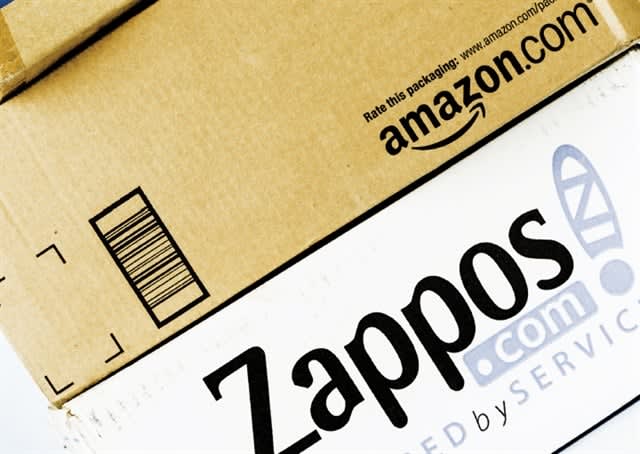
Amazon and Zappos — two e-commerce success stories that have contributed to customer expectations of fast and free shipping.Photo: ©istockphoto.com/CatLane
3PL opportunities
All the complexity of e-commerce and omni-channel marketing is spelling opportunity for savvy companies that can help shippers manage their logistics.
One of them is UPS. Harvey Rickles is marketing director of its Global Logistics & Distribution business unit, which handles outsourced warehousing, distribution and transportation for shippers — aka fulfillment.
“If you think about five years ago, it was fairly standard for people to get an e-commerce order delivered in five days for free,” Rickles says. If you wanted it faster, you paid a premium. “Now they’re looking at two-day, three-day, even next day or same day. And some of that they’re expecting for free and some of that they’re willing to pay for. It’s forcing our customers to look at solutions requiring more locations. ‘Instead of one warehouse, if I want to reach 80, 90% of customers in two days, what kind of solution do I need?’ They don’t want to pay expedited transportation charges, so that causes them to think about putting inventory in three, four, or five locations so they can hit those targets within a normal ground shipment. But that has impacted their inventory; they have to carry more inventory to hit the same service levels in terms of not being out of stock.”
And, he says, they’re looking for later cutoffs from the warehouse, so the order can come in later in the day and still make the evening cutoff for shipping.
“It used to be when you just had fulfillment in stores, there was sort of a weekly cycle and maybe an end-of-month peak,” Rickles explains. “Then when people started ordering on computers, most people got on computers in the evening, so the next morning you would start shipping. Now 50% of orders are coming in through mobile devices, which means orders are coming in all the time, around the clock and throughout the day.
“The demand part of it is becoming really unpredictable. You can have people be in a retail store and placing an order online. On a day-to-day basis the orders are unpredictable, which creates challenges in terms of staffing and getting orders out. You add that to faster cycle times and late cutoffs, it creates quite a challenge for the fulfillment operations.”
Obviously, this has spelled opportunities for Rickles’ side of UPS’s business. “You’re seeing a variety of people who have realized it’s not easy to do this type of fulfillment. As they understand these challenges, they’re thinking maybe this is something we should leave to the guys who do this every day.”
Indirect effects
Although Old Dominion Freight Line doesn’t do a lot of business with Amazon, “it does affect us, because it pushes product to deliver just in time,” explains Steve Hartsell, director of OD Expedited services at the North Carolina-based less-than-truckload carrier. “Shippers don’t carry a lot of inventory anymore. People have learned they can get something as fast as they can. If [companies] don’t carry a lot of inventory, they can use OD as their warehouse — they never have to inventory it, they can use our product to move it though the system and deliver it.”
ODFL offers a growing number of expedited services to meet this trend, including guaranteed Friday-to-Monday delivery with the OD Weekend Promise, OD Expedited On Demand, and Must Arrive By Date (MABD).
Many customers have shipments that need to be delivered in a specific window outside of normal transit times. “We’ll pick it up and manage it with our group and make sure it runs through different freight flows than standard LTL” to get it there at the appointed time, Hartsell explains. In many cases, he says, delivering early is just as bad as delivering late. “It messes up [the receiver’s] inventory. A big box retailer orders so it doesn’t have to stay on their warehouse floor very long.”
Old Dominion started the MABD service about 18 months ago in response. “Our shippers were getting hit by big fines and chargebacks,” he says. “One shipper was getting hit with about $100 grand a month, and we were able to reduce that to less than $10 grand a month.”
So even though ODFL doesn’t see a lot of e-commerce going through its network, the change in expectations “has changed the way we have to do business.” Hartsell notes that a lot of the younger generation moving into management grew up with the Internet and are pushing their companies to be innovative and meet new expectations for speed.
“I’ve been in expedited since 2008, and in the last eight or nine years we’ve changed an awful lot of our service product, especially as it regards IT.” He envisions a time when much of this will be handled through a smartphone app. “If we sit back and do it the old way, people won’t use it. And one of the things we pride ourselves on is changing with the times.”
Subscribe to Our Newsletter
More Fleet Management

Nominations Open for HDT Emerging Leaders
Heavy Duty Trucking is looking for accomplished trucking fleet professionals under 40 who are making an impact and helping lead the industry forward.
Read More →
Why Private Fleets Are Taking More Freight
Private fleets are putting their own trucks on demanding customers and high-cost lanes as companies seek greater control over service, costs, and capacity.
Read More →
Sponsored•September 16, 2026
Color Match Smarter: Tools That Restore & Perform
For fleet managers and collision repair professionals keeping heavy-duty trucks on the road, getting the color right the first time isn't just about appearance — it's about efficiency, turnaround time, and bottom-line results. Discover how today's digital color tools are transforming the repair process from guesswork to precision.
Read More →


FMCSA Pauses Biennial-Update Enforcement Amid Motus Transition
Carriers whose updates were due on or after June 1 have more time, while FMCSA works to stabilize its new registration system and warns of phishing sites impersonating its new carrier registration system, Motus.
Read More →
Sponsored•September 14, 2026
2026 Blueprint for Countering Smarter Supply Chain Theft
Cargo theft is no longer just the cost of doing business. It's a multi-billion-dollar criminal enterprise exploiting vulnerabilities across your fleet, drivers, and supply chain.
Read More →
Sponsored•September 1, 2026
How Telematics Improves Visibility, Control, and Performance in Refrigerated Fleets
Explore how telematics help refrigerated fleets improve visibility, uptime, efficiency, compliance, and cargo protection across connected cold chain operations.
Read More →
What the U.S.-Canada Trade War Means for Trucking
Escalating U.S.-Canada tariffs could disrupt cross-border freight, reduce truck volumes, raise costs, and create new uncertainty for carriers on both sides of the border.
Read More →
What Are Trucking’s Top Concerns for 2026?
The American Transportation Research Institute wants to know what's worrying trucking fleet managers, drivers, and other stakeholders in its annual Industry Issues survey.
Read More →
American Trucking Associations Looks for a New Leader
ATA President and CEO Chris Spear abruptly left his job at the association on August 21, at a pivotal time for the trucking industry.
Read More →
Public Wi-Fi Cybersecurity Risks: How Truck Drivers and Fleets Can Protect Their Data
Public Wi-Fi can expose truck drivers and fleets to credential theft, malware, and other cyber threats. Here’s how to reduce the risk on the road.
Read More →