




10 Things to Consider When Spec'ing an Inverter
Inverters, which convert DC power into AC power to power creature comforts in the truck cab, have always been a magnet for controversy. An expert at one inverter company offers his tips for what to think about when spec'ing an inverter.
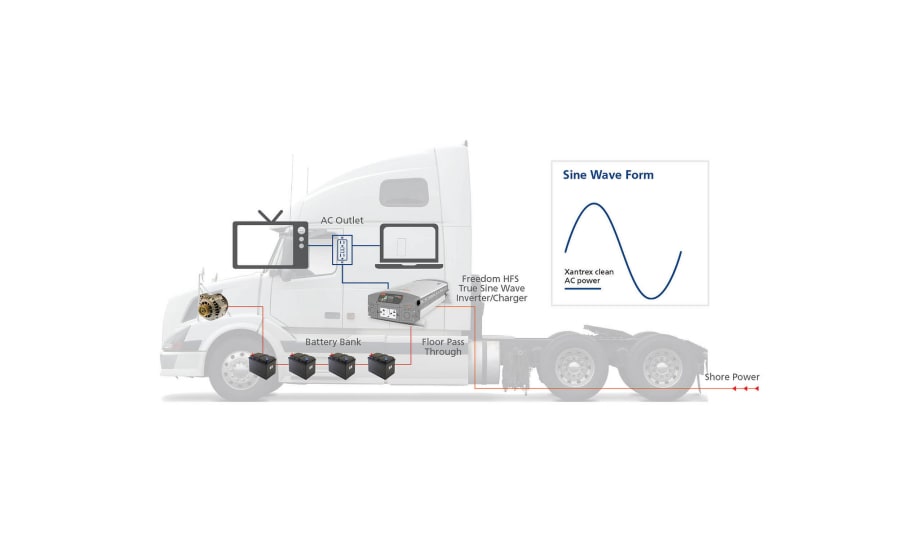
Sine wave is the same power as what you get at home – meaning the voltage is consistent without spikes or drops. Photo courtesy Xantrex
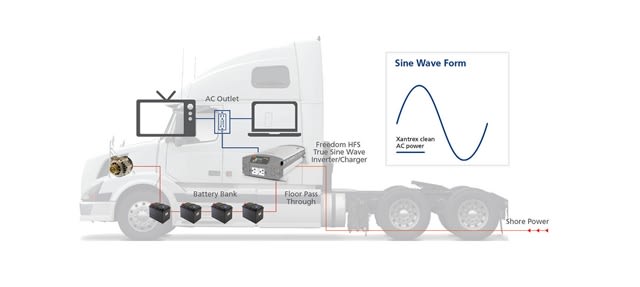
Sine wave is the same power as what you get at home – meaning the voltage is consistent without spikes or drops.Photo courtesy Xantrex
Inverters, which convert DC power into AC power to power creature comforts in the truck cab, have always been a magnet for controversy. Fleets know drivers love them, as they provide an extra measure of creature comfort – who wouldn’t want to plug in their devices like they do at home? But fleet managers can be nervous about inverters and their potential to damage the truck’s electrical system.
However, the distrust of inverters in many cases is becoming a thing of the past – if the right inverter and installation practices are followed, says Don Wilson, technical applications engineer for inverter maker Xantrex. Inverters can be a great asset to drivers and fleets, he says. The key is for fleets to do their homework and know what’s best for their operation prior to making a purchase. One size does not fit all, and inverter quality varies greatly. Here are his top things you need to know when considering investing in inverters for your drivers.
1. Bigger isn’t always better
It’s easy to say get the biggest inverter on the market and you’ll be covered for all your needs. But that’s not the best advice. Inverter sizes range from 300-watt cigarette lighter plug-in inverters to 5,000-watt units. Fleets should do surveys on truck size and power usage and understand how they will use an inverter – what items they want powered and what items will be used at the same time. That will help “right size” the inverter for their operations.
As an example, a driver will often run a microwave, TV and laptop all at the same time. On each device, you’ll see a wattage number. A microwave might be rated at 1,000 watts, a TV at 250 watts, and a laptop at 95. Add them up to see how much continuous power you’ll need and then add 20%.
So, in this case you’ll need just over 1,600 watts. Next, round up to find an inverter that meets your power needs. Xantrex, for example, would recommend an 1,800-watt unit.
2. Plan for surges
While determining continuous power is an important consideration, don’t forget the power you’ll need for surge.
Whenever you power up any device, the initial load is more – and sometimes double – what the continuous power requirement is. The surge rating on quality inverters should be about double. So, a 1,800-watt inverter should be able to handle a short 3,600-watt power surge requirement.
You also need to see how long the inverter can handle the surge – the longer the better. Some inverters on the market can handle only a few milliseconds of surge before the power draw shuts down the inverter. Others can last five seconds or more, and that’s what buyers should look for.
3. Know your sine
Both modified and pure sine wave inverters work well in a truck environment, but for those running sensitive electronics (like CPAP machines) or products that are plugged into their own chargers – a drill or a toothbrush – a sine wave inverter should be the preferred choice. Sine wave is the same power as what you get at home – meaning the voltage is consistent without spikes or drops. So, the device you’re powering reacts just as it would if you were plugged in at home.
You have to pay a little more for that premium power monitoring, and it’s worth it to protect your sensitive equipment. However, if you’re powering run of the mill electronics and appliances, modified sine wave power is just fine.
4. You get what you pay for
The price gap has narrowed and today most higher wattage sine wave inverters cost about 15% to 20% more than a modified inverter.
With a sine wave unit, you’ll notice a slight decrease in the efficiency rating, since electronics within the inverter use power to keep electrical levels consistent. It’s not much – we have an 87% efficiency rating on a Xantrex sine wave unit compared to 92% on a modified inverter. Here’s a good analogy: It’s like the difference between running a 6-cylinder car versus a 4-cylinder car. That 4-cylinder car may get a bit better fuel economy, but the 6-cylinder is better in overall performance.
5. Be careful with do-it-yourself
Generally speaking, it’s fine for a fleet to do an install, but the answer is typically no for an owner-operator. Most fleet technicians will have no problem handling installation.
But remember, you’re working with electricity, and electricity can bite if you’re not careful. It’s our recommendation that inverters over 300 watts feature hard-wiring and fusing.
There is also a bevy of things to consider when installing an inverter, starting with “Where should it go” and “Is there adequate ventilation to allow heat to dissipate?” You also have to be cognizant of wire sizing and the distance between the inverter and plug-ins, which can be put in the sleeper; plus the distance between the battery and inverter. There’s a lot to consider.
Most fleets and owner-operators want the convenience of a factory-installed and warranted inverter. Xantrex recommends either an OEM install when you purchase a new truck, or have the installation done by an authorized dealer. The OEMs have installation down to a science and it’s done on the line to rigid specs. Truck and aftermarket dealers also have the experience, so it’s worth spending a few extra bucks to have the installation done right, the first time, should a fleet’s own staff not have the time or expertise.
6. Look for UL approval
When it comes to reliability, the old adage, “You get what you pay for” comes into play.
Look for an inverter that has a ‘Regulatory Listed’ approval – such as UL or ETL with UL458 rating. This means the inverter was inspected and approved by an independent agency, which safeguards against issues with electricity. UL458 is the listing for inverters and chargers in mobile applications. They must meet strict vibration, environmental, and thermal requirements that non-UL458 units do not.
The Technology & Maintenance Council’s Recommended Practice 163 calls out this UL listing for all inverters and chargers installed in a truck. And TMC’s RP160, which discusses DC and AC wiring in a truck, has requirements that are automatically met by UL458 listed inverters. The main point is that the neutral and ground are bonded together within the inverter.
Inverters that are not UL458 listed do not do this; it allows the inverter to be made at a much lower cost. While they will be cheaper, Wilson says Xantrex has seen these types of products actually shock users. Inverters installed by truck manufacturers all are UL approved, but many inverters sold at truck stops are not. Internally, these non-UL-listed devices often can’t protect themselves against power surges.
7. Inverters can protect themselves
Inverters will occasionally shut down, but quality inverters do so without damaging themselves. If dust or cat hair, for instance, gets inside the inverter, it can cause it to overheat. Some inverters, however, have an error code that lets you know what the problem is – in this case it will tell you that you are overheating and to check the fan. A simple cleaning or “blowing out” will correct the problem and you’ll be back up and running
If you overload the inverter, placing more wattage demands on the inverter than it can handle, the inverter will shut down. The difference between a quality inverter and low-end inverter is how they deal with a shutdown. A quality inverter is designed to shut down with no ill effects. A low-end inverter can “wear out” after multiple overloads.
8. Protect those batteries
Should you consider battery charging? The simple answer is yes if you can use shore power (electrical outlets at home or on the road at terminals, loading docks, or truckstops). When plugged in, you can run everything you’re running with your inverter for as long as you want, plus you can recharge and top off your batteries. The more you can use shore power, the better, as it prolongs the life of your batteries.
In fact, having the shore power option and a charger in the system will add 20% to 30% to the life of the batteries if plugged into grid power whenever possible. It also has the potential to eliminate one battery swap out over the five to six years use of the truck. This happens by keeping batteries fully charged, offsetting parasitic loads, and reducing the number of cycles.
Most installations use the inverter off the truck’s starting batteries, and quality inverters will have a low voltage disconnect (LVD) to shut down when voltage drops to 11.7 volts, Wilson says. This ensures the truck will have enough juice to start.
Check on the LVD feature before you buy an inverter. If you don’t have one in the inverter, or on the truck, an inverter can run the batteries down to 10.5 volts, or below. That’s not good. Sure, it lets you run electrical devices longer in the cab and sleeper. But you may not be able to start the truck.
9. Extra batteries mean extra run time
It can make sense to run two dedicated deep-cycle batteries and connect them to the inverter. They do add weight to the vehicle and cost, so may not be suitable for all applications. But deep-cycle batteries were designed to be drawn down to a 50% state of charge, or 10.5 volts. This gives double to triple the amount of continuous power to run hotel loads – something drivers will appreciate.
10. An inverter and APU are more than compatible
Adding an inverter to a truck’s electrical system will reduce hours of use on a diesel-fired APU (assuming that the APU does not already have shore power compatibility.) And it will reduce maintenance costs and increase APU life. An inverter can be used for hotel loads in the cab as long as environmental conditions do not require air conditioning. When those conditions happen, the operator can just power up the APU for air conditioning.
With this set-up, the only time the APU would need to come on is if the batteries drop to a low level. Once the batteries are charged, the APU can shut off again. This significant reduction in APU run time means a quick payback on the cost of the inverter.
This article was authored under the guidance and editorial standards of HDT's editors to provide useful information to our readers.
More Fuel Smarts

Trucking’s Diesel Squeeze Isn’t Letting Up
With diesel topping $6 a gallon nationally, ATA's Bob Costello explains why fleets should prepare for continued pressure at the pump.
Read More →
FlowBelow Redesigns Trailer AeroSlider to Cut Fuel Use
The lighter trailer aerodynamic system installs in less than 45 minutes, according to the company, with potential payback in under a year depending on fuel prices and trailer mileage.
Read More →
Why Diesel Price Relief Efforts May Fall Short
Diesel prices have eased from September’s record high, but doubts about additional Russian supply and limits on dyed-diesel tax relief mean trucking fleets still face expensive fuel. And prices could go higher.
Read More →
Why Small Fuel Savings Matter in Trucking
Can better fuel economy help pay for driver raises? In this podcast, GP Transco explains how small efficiency gains create room to reinvest in its people.
Read More →
How GP Transco Cuts Trucking Fuel Costs, a Tenth of a Gallon at a Time
What’s another tenth of a mile per gallon worth? GP Transco shares how equipment upgrades and driver coaching turn small gains into meaningful fuel savings.
Read More →
Electric Yard Tractors Move Beyond Pilots
Operating-cost savings have overtaken sustainability goals as the leading reason surveyed fleets are adopting battery-electric terminal tractors, according to new NACFE research.
Read More →
Geotab Links Fleet Card to Vehicle Data
The new card combines fuel discounts with telematics-based purchase controls. Geotab’s analysis also points to potential savings from choosing lower-priced fuel stops.
Read More →
Fleet Economics Shape Electric Truck Outlook
ACT Research expects costs, charging infrastructure, and technology improvements to drive zero-emission commercial vehicle adoption as federal regulations and incentives retreat.
Read More →
Wex Adds Cardless Fuel Payments for Over-the-Road Customers
A new fuel card feature for Wex customers offers convenience and security.
Read More →
New California Law Could Shed Light on Electric Truck Prices
Why do battery-electric Class 8 trucks remain so expensive? A California bill signed by Gov. Gavin Newsom would give fleets and state agencies more visibility into what manufacturers charge.
Read More →