




Powertrain, Aero Enhancements Push Cascadia Fuel Economy
DTNA boss Martin Daum calls the fuel-efficiency gains with the new Cascadia mind-boggling. He said the design target was 5% over the current Cascadia Evolution model, but the design team's efforts produced a truck that bests the Evolution by a full 8%. Daum said new Cascadia in full AeroX trim is 19% more fuel efficient than the current base-model Cascadia.

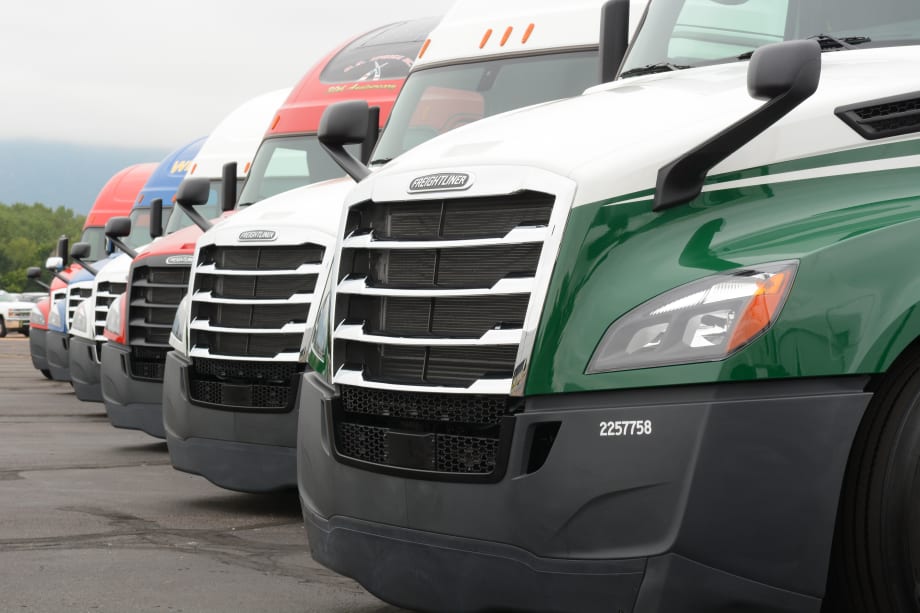
Freightliner's new Cascadia model represents fours years of work. It has tested to be 8% more efficient than the current Cascadia Evolution model. Photo by Jim Park
Freightliner's new Cascadia model represents fours years of work. It has tested to be 8% more efficient than the current Cascadia Evolution model. Photo by Jim Park
COLORADO SPRINGS -- The name is the same, but that's where the similarities end. Freightliner's newest on-highway Class 8 tractor is a brand new truck, from the frame to the rooftop, and practically everything in between. The company says it takes fuel efficiency, safety, driver comfort, connectivity and serviceability to a whole new level.
The truck was shown publicly for the first time on Wednesday, Aug. 31, in a reveal ceremony at the Broadmoor World Arena in Colorado Springs. On view were 12 trucks in fleet colors representing a dozen of Freightliner's biggest customers, each of whom had already purchased a truck sight unseen. They include, alphabetically, Bison Transport, C.R. England, Crete Carriers, Hartland Express, J.B. Hunt, Knight Transportation, Old Dominion, Prime, Schneider, Swift Transportation, U.S. Express and Werner Enterprises.
"The 12 customers in this room represent one out of every four Cascadia trucks sold in North America over the past six years when you exclude leasing companies and trucks sold to dealer stock," said Martin Daum, president and CEO Daimler Trucks North America. "Between them they have invested $9 billion into new Freightliner trucks since 2011."
That dozen fleets and hundreds more with similar business goals will soon be lining up to spend billions more on this new Cascadia. It goes into limited production as a 2018 model-year truck in January 2017. It's expected to be in full production by March. The current version of the Cascadia will remain in production for another two years.
Mind-Bogglingly Fuel Efficient
In his opening remarks, Daum called the fuel-efficiency gains "mind-boggling." He said the design target was 5% over the current Cascadia Evolution model, but the design team's efforts produced a truck that bests the Evolution by a full 8%. Daum said the new Cascadia in full AeroX trim is 19% more fuel efficient than the current base-model Cascadia.
The results were monitored and verified by a third party during a fuel efficiency comparison between a 2016 Cascadia Evolution and the 2018 Cascadia on a 2,400-mile route from Detroit to Portland, Ore., with a 78,000-lb gross combination weight.
The trucks were configured as follows:
2016 Cascadia Evolution: DD15 (GHG14), direct-drive DT12 transmission with IPM 3, Detroit drive axles with 2.41:1 ratio, full Evolution aero package.
2018 Cascadia: DD15 (GHG17), new direct-drive DT12 with IPM 4, Detroit drive with Axle Lubrication Management and 2.16:1 ratio, AeroX aero package.
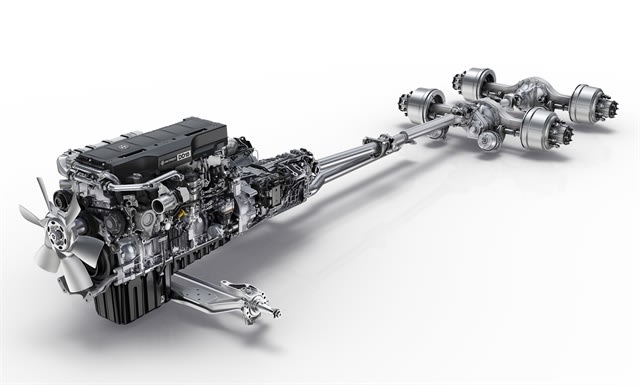
Detroit's Integrated Powertrain is in version 4 and includes predictive cruise control and several mechanical upgrades to the transmission and drive axles. Photo courtesy of Freightliner
"The 8% gain in efficiency is real and repeatable," said Kary Schaefer, general manager, product marketing & strategy, Daimler Trucks North America. "The results were verified by third-party analysts throughout the course of the six-day test. The test showed the new 2018 Cascadia consumed 8% less fuel than our best-spec 2016 Cascadia Evolution."
The premium spec includes the integrated Detroit Powertrain, which combines a 400 hp/1,750 lb.-ft. Detroit DD15 or DD13 engine with the new DT12 direct-drive automated manual transmission, Intelligent Powertrain Management V.4 and Detroit tandem drive axles (a 6X2 will be available later next year).
A new manufacturing process provides super-fine polishing of the gear faces in the DT12. That helps reduce friction between the gear teeth and allows for the use of low-viscosity lube oil. The new Detroit drive axles were redesigned to reduce weight and vibration. They also feature a lower sump volume and friction-reducing gear cutting. An optional Axle Lubrication Management system can further reduce parasitic losses by managing oil levels in the sump to reduce churning losses. The latest generation of IPM, version 4, uses GPS-based predictive cruise control to anticipate upcoming terrain.
AeroX Advances Efficiency
The entire front profile of the truck has changed, with major modifications to the grille and bumper as well as the shape of the hood. The frame rails are splayed outward several inches so the engine can sit lower in the frame, allowing the hood and grille to wrap a little tighter around the engine for lower wind resistance and better visibility, Schaefer says.
The new Cascadia offers two aero packages, a baseline setup and the premium AeroX package. The baseline is essentially the same as the Evolution model, but with further refinements. The aero-styled mirror shells now have an elliptical shape and the mirror arms have been redesigned. There's a new door seal to close the gap around the door. The bumper has been updated and a new air dam has been added. The side-fairing skirts have lower ground clearance and cab-side extenders reach back 20 inches.
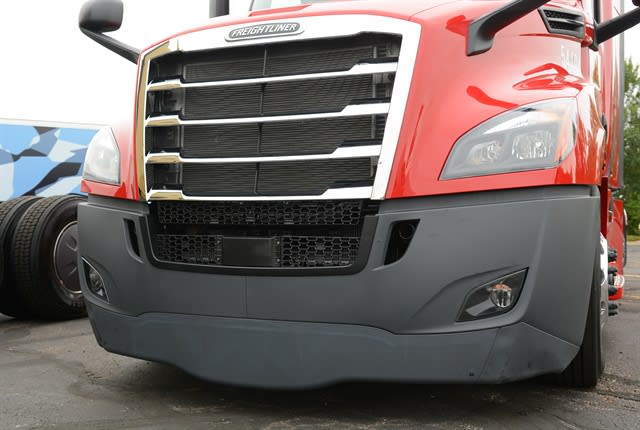
The air dam included with the full AeroX package has just 4 inches of ground clearance, but promises significant fuel efficiency gains. Photo by Jim Park
In AeroX trim, the truck comes with aero door seals, 24-inch flexible cab extender fairings, a lower-ground-clearance front air dam, and advanced FlowBelow drive wheel fairings.
With a mere 4 inches of clearance under the front air dam and the side skirts, these aero features have the potential to become a maintenance headache. On the other hand, the additional fuel savings may be appealing enough to many customers to risk those headaches.
"When you take a look at the new Cascadia, you’ll first note its modern lines and refined styling," said Richard Howard, senior vice president, sales and marketing, Daimler Trucks North America. "But take a closer look, and you’ll see the attention that was given to every detail of the truck to create an aerodynamic vehicle that will reap bottom line benefits for our customers."
Daum says customers who want the full efficiency powertrain and AeroX package can expect to pay about $15,000 over the current base model. Trucks equipped with the premium spec will see a blue-colored letter "I" in the Cascadia name plate.
Corrected 9/7/2016 to clarify price premium.
More Drivers

Nussbaum, Roehl Announce Second Driver Pay Increase This Year
This year has seen a swath of major truck driver pay increases as freight capacity has tightened.
Read More →
From One Generation to the Next: How Mentorship Builds Safer Truck Drivers
After three decades in trucking, Harold Perry shares what he's learned about driver safety, mentorship, and helping the next generation build confidence behind the wheel.
Read More →
Truck Drivers Need More Than Another Alert
Fleets have more visibility into truck health, safety events, and driver activity than ever. The next challenge is turning all that information into useful guidance for the person who has to decide what to do next.
Read More →
FMCSA Removes 110 Truck Driver Training Schools from Certified ELDT List
Federal regulators also are targeting more than 160 additional training providers and launching a nationwide audit of third-party CDL skills testers as part of a broader crackdown on trucking fraud.
Read More →
Hours of Service Pilot Programs: FMCSA Readies for 2027 Rollout
Two pilot programs could eventually reshape hours-of-service rules, giving truck drivers options to pause their 14-hour clock or use longer split sleeper rest periods.
Read More →
Medical Cards, English Proficiency Reshape Roadcheck Violations
Medical-card violations jumped to the top of the driver out-of-service list during CVSA’s 2026 International Roadcheck, while English-language proficiency violations appeared among the leading violations for the first time.
Read More →
Driver Trust Can Make or Break the Success of Fleet Safety Technology
New Teletrac Navman research suggests that onboarding, transparency about driver data, and positive feedback can play a significant role in how commercial drivers respond to safety and coaching technology.
Read More →
EEOC Sues KLLM Over Alleged Sex Discrimination in Driver Training
KLLM is facing a federal sex-discrimination lawsuit over policies the EEOC alleges put female truck driver trainees at a disadvantage.
Read More →
FMCSA Moves to Codify English Language Requirements for Commercial Drivers
By changing regulations on English-language proficiency requirements for commercial drivers, rather than relying on a guidance memo, the FMCSA said future administrations won't be able to walk back the Trump administration's stricter enforcement with just a memo.
Read More →
Drivers Put Western Star Trucks to the Test at Star Nation Experience
Watch to get an inside look at the Western Star trucks, technology, and community behind the Star Nation Experience 2026!
Read More →