




Commentary: Congress Pulls a FAST One on Highway Funding
The simple fact that we finally have a long-term bill is good news yet for a bill that is supposed to be about funding the updating and upkeep of our nation’s highways and bridges, the “funding” portion is disappointing.


Editor in Chief, Deborah Lockridge

Editor in Chief, Deborah Lockridge
We finally have a long-term highway spending bill for the first time since 2005, which calls for spending approximately $305 billion for highway and transit projects over the next five years.
There’s much to like about the FAST Act (which stands for Fixing America’s Surface Transportation). Many provisions that were lobbied for by trucking were included, including one reining in the DOT’s Compliance, Safety, Accountability enforcement program. And there are several programs addressing freight transportation.
The simple fact that we finally have a long-term bill is good news. It gives states some level of stability to help them plan their highway programs going forward.
Yet for a bill that is supposed to be about funding the updating and upkeep of our nation’s highways and bridges, the “funding” portion is disappointing. Despite enjoying the lowest gasoline and diesel prices in years, Congress and the Obama Administration refused to raise fuel taxes, the most logical way to pay for highways.
Instead, in addition to an extension of the current fuel tax, we have a hodge-podge of funding sources and budgetary gimmicks.
If anything, deficit spending will increase under the FAST Act. To make up for the fact that highway revenues likely will not increase much over current levels, the new law transfers money from the General Fund to the Highway Trust Fund, and calls for making up the difference with “offsets” such as:
Changing passport rules for applicants who owe back taxes
Allowing the Internal Revenue Service to hire private tax collectors
Selling crude oil from the Strategic Petroleum Reserve.
A couple of late additions to the bill call for drawing on the Federal Reserve’s capital. Ben Bernanke, former chairman of the Federal Reserve, has sharply criticized this tactic, noting in his blog that “‘paying’ for highway spending with Fed capital is not paying for it at all in any economically meaningful sense. Rather, this maneuver is a form of budgetary sleight-of-hand that would count funds that are already designated for the Treasury as ‘new’ revenue.”
In addition to these accounting games, the money allotted, while an increase, is still simply not enough.
The FAST Act is “cause for optimism,” says Marcia Hale, president of Building America’s Future, but “we are nevertheless concerned that the funding levels … will not sufficiently dig us out of the hole we’ve created by neglecting our infrastructure and transportation.”
Because of this, we can expect more states to take action on their own — raising their own fuel taxes, coming up with creative funding ideas of their own, or turning to public-private partnerships and implementing more tolls.
Perhaps most importantly, the FAST Act does not provide a long-term sustainable solution for fully funding the Highway Trust Fund once this law expires.
We need to raise the federal fuel tax — or better yet, implement a vehicle-miles traveled fee, which would help make it a true user fee. Back in 2009, a bipartisan, Congressionally created commission recommended that the U.S. shift to a mileage-based highway usage fee by 2020. The National Surface Transportation Infrastructure Financing Commission recommended a 10-cent-per-gallon increase in the federal gas tax (15 cents for diesel) and indexing the tax to inflation going forward. The fuel tax, which is not indexed to inflation, in 2009 had already lost a third of its purchasing power since 1993, the last time the tax was increased.
The American Trucking Associations opposed the commission’s recommendations and has pushed for an increase in the traditional fuel tax. Yet Congress couldn’t even manage that sensible solution, giving us fiscal gimmicks instead.
More Fleet Management

How Telematics Improves Visibility, Control, and Performance in Refrigerated Fleets
Explore how telematics help refrigerated fleets improve visibility, uptime, efficiency, compliance, and cargo protection across connected cold chain operations.
Read More →
What the U.S.-Canada Trade War Means for Trucking
Escalating U.S.-Canada tariffs could disrupt cross-border freight, reduce truck volumes, raise costs, and create new uncertainty for carriers on both sides of the border.
Read More →
What Are Trucking’s Top Concerns for 2026?
The American Transportation Research Institute wants to know what's worrying trucking fleet managers, drivers, and other stakeholders in its annual Industry Issues survey.
Read More →

American Trucking Associations Looks for a New Leader
ATA President and CEO Chris Spear abruptly left his job at the association on August 21, at a pivotal time for the trucking industry.
Read More →
Public Wi-Fi Cybersecurity Risks: How Truck Drivers and Fleets Can Protect Their Data
Public Wi-Fi can expose truck drivers and fleets to credential theft, malware, and other cyber threats. Here’s how to reduce the risk on the road.
Read More →
For Nicky Cupp, Fleet Innovation Starts With Frustration
HDT Truck Fleet Innovator Nicky Cupp turns everyday pain points at Fraley & Schilling into opportunities for better technology and smarter processes.
Read More →
Adam Buttgenbach’s Approach to Electric Trucks: Start With Where They Fit
HDT Truck Fleet Innovator Adam Buttgenbach helped PepsiCo build one of North America’s largest EV fleets by focusing on where electric trucks make operational sense.
Read More →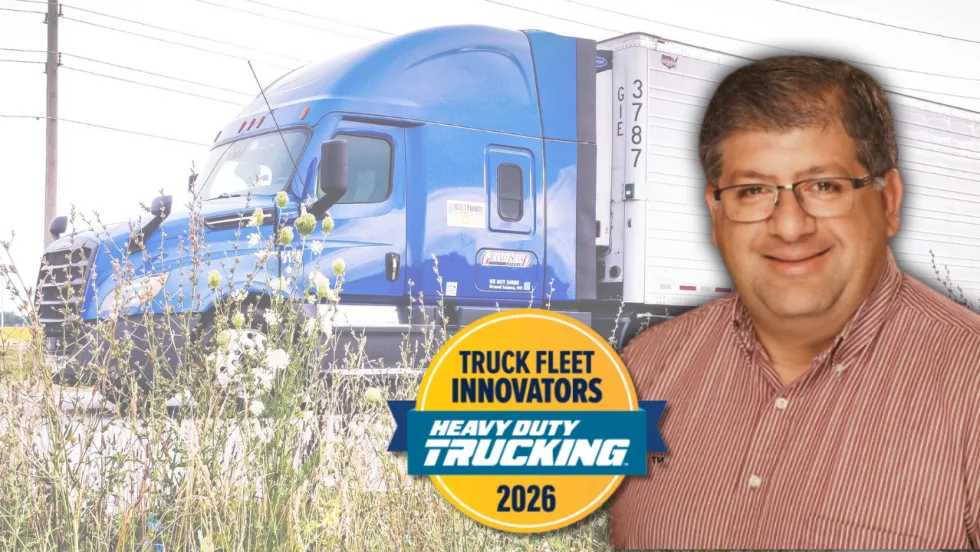
Deen Albert: Let Automation Do the Math, People Make the Decisions
HDT Truck Fleet Innovator Deen Albert makes sure people are still at the heart of operations at Grand Island Express, even while adopting artificial intelligence tools. AI-assisted dispatch helped boost revenue 25% with the same number of trucks.
Read More →
Trimble’s New AI Agent Takes Aim at Fleet Back-Office Busywork
Arc Agent works across Trimble TMS products to automate repetitive tasks such as freight orders, maintenance, invoices, fuel costs and more.
Read More →
How HDT’s 2026 Truck Fleet Innovators Are Rethinking Fleet Operations
Meet five trucking leaders who are challenging assumptions, solving operational problems, and putting innovative ideas to work.
Read More →