





Related: Fuel Savings vs. Shorter Tire Life
Preventing Irregular Wear on Wide-Base Tires
Do wide-base single tires wear differently than standard tires in dual assemblies? We address that question and give tips on how proper care of your wide-base single tires can improve their life and ROI.
July 25, 2015
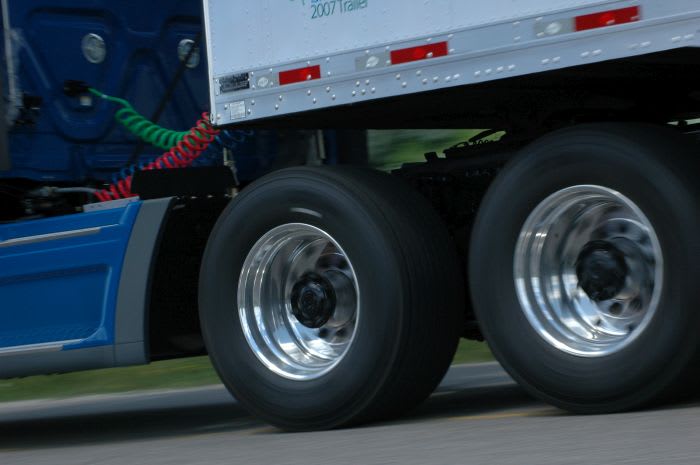
Wide base tires are thought to suffer premature wear. That’s sometimes the case but it’s not universally true.
7 min to read
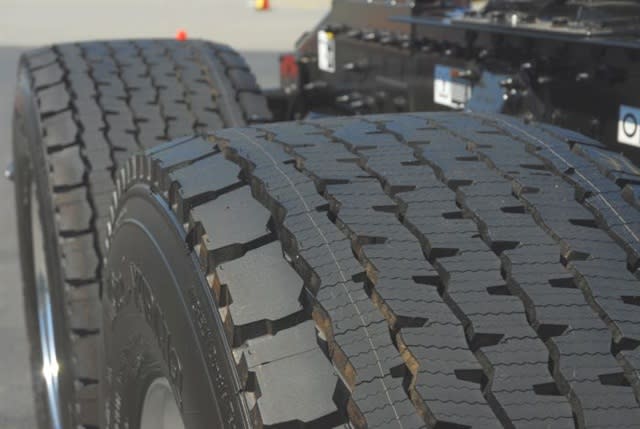
Proper care of your wide-base single tires can improve their life and ROI.
Do wide-base single tires wear differently than standard tires in dual assemblies? There’s a perception among some users and prospective users of wide base tires that they will experience different rates of wear than standard tires. Many also believe that wide base tires are more susceptible to some forms of irregular wear.
The tire makers tell us that some forms of irregular wear were indeed more prevalent in earlier generations of the tires, but that’s supposedly not as much of an issue as it once was.
“Wide base tires may have shown a tendency to develop irregular wear over time, but that was more of a problem with early generations of the tire,” says Matt Loos, director of truck and bus marketing at Bridgestone. “It’s not really the case any longer. The technology and the construction is to the point today where they can be expected to wear at similar rates. That certainly was an issue originally.”
Likewise, Paul Crehan, Michelin’s director of product marketing, says recent offerings address the wear problem.
“This has been a problem for a number of years, but we have spent the last four years trying to figure out a solution,” he says. “Last year we introduced two new wide base tires, one optimized for the highway, the other for regional. Both of these two tire families were designed to fight irregular wear in the shoulder area. By designing the tread pattern and the casing to better manage the load stresses on the tire, we have significantly reduced irregular wear on trailer tires.”
Wide base tires are, by design, subject to different wear conditions than duals, Crehan says, so it shouldn’t come as a surprise that they will wear in different — but predictable — ways.
“With wide base, you have one tire with very big shoulders,” he says. “With duals, the four shoulders can spread the stress out between them.”
Most fleets will experience more irregular wear on trailer tires than drives because of their free-rolling nature.
“It’s an order of magnitude less of a problem because of the torque,” Crehan says, “but wear patterns tend to be seen more frequently on blockier tread patterns.”
The challenge with defining a solution to irregular wear is that you must first identify the factors responsible for the wear. They range from poor maintenance, over- or under-inflation, heavy or light loads and even the type of pavement upon which the tires operate.
The battle against irregular wear, and thus unsatisfactory performance, with wide base tires, like dual tires, has to start with a proper maintenance program. The four same issues arise with wide base tires as well as duals: spec’ing, inflation pressure/tire loading, alignment and mechanical condition.
Inflation and tire loading
These factors are really one and the same thing. It’s the air inside the tire that supports the load, not the tire itself, so the tire must have the minimum inflation pressure for the load on the tire. These figures are available from the manufacturers’ load and inflation tables. It’s thought that wide base tires are more sensitive to deviations in inflation pressure than duals, so operators need to be particularly vigilant, not just to avoid under-inflation-related blowouts, but premature wear as well.
“Wide base tires must be inflated for the heaviest load the tires will carry,” says Crehan. “The problem is, when [the truck is] empty, the tires are wildly over inflated. The same condition exists with duals, but it’s more apparent on wide base.”
Bridgestone, for example, recommends an inflation pressure of 100 psi for 8,820 pounds of tire load on a 445/50R22.5, about 300 pounds heavier than the tire would see in a legal load. The company says 95 psi is fine for 8,460 pounds, which is 40 pounds less than a fully loaded tire would see. If you run lighter loads, say, 70,000 pounds GVW, it might be okay to inflate to 85 or 90 psi.
“People tend to get the pressure right when they are operating closer to max GVW,” says Crehan. “People who operate slightly lighter tend to be over inflated. If you run a lot of variable weight loads, you might not be aware of exactly how much you’re carrying on a daily basis and your weight and inflation pressure might not be an exact match.”
Because of the weight saving properties of wide base singles, the tires are popular with bulk fleets, which often run heavy one way and light or empty back. While it’s impractical to adjust inflation for the lightly loaded condition, Brian Buckham, general manager of product marketing at Goodyear Commercial Tire, suggests lift axles can mitigate tire wear.
“Trucks that operate loaded one way and empty the other way experience varying tire loads at the same pressure levels, and therefore have varying footprints/contact patches,” he notes. “Some fleets use inflation/deflation systems and lift axles to reduce tire wear. Whether a tire is lightly loaded or heavily loaded, and regardless of wheel position, if the correct inflation pressure is used, the desired footprint/contact patch will be achieved and the tire will have an opportunity to wear evenly. As such, both over-inflation and under-inflation should be avoided.”
Wide base tires are thought to suffer premature wear. That’s sometimes the case but it’s not universally true.
Alignment and mechanical condition
Alignment, or rather the lack of it, kills tires — wide base and duals in equal measure.
“Keeping a truck in correct alignment might seem like an expensive proposition, but it’s an investment that can pay big dividends when it comes to extending a tire’s service life,” notes Buckham. “Fleets should keep in mind that traditional front end alignments aren’t always enough. Drive axles need to be brought into alignment, as well. This can have a number of positive effects above and beyond the prevention of irregular wear, including improved truck fuel economy.”
Mechanical problems also extend to worn and loose components, such as kingpins, spring shackles, bushings and shock absorbers. But wheel bearings should be given special attention.
“Loose wheel bearings will cause a negative camber condition, though small, which can impact the inside shoulder of the tire,” notes Mike Beckett, president of MD Alignment in Des Moines, Iowa. “We see the problem with duals as well, but it becomes more obvious more quickly with wide base tires.”
Beckett also says axle flex, particularly on trailer axles, can cause the same negative camber condition. Coupled with loose bearings, the problem is magnified.
“If you look at the mechanics of it, you have two things going on with trailer wheels,” concurs Michelin’s Crehan. “When you load the trailer, the axle flexes. In its normal position the wheel is running perpendicular to the axle. When it flexes you introduce camber to the wheel, which can cause shoulder wear, and it can be the same with improperly adjusted wheel bearings.”
Spec’ing
The final consideration, or perhaps it should be the first, is putting the right tire on the truck for the application. Easier said than done, to be sure, but Bridgestone’s Loos suggests smaller fleets lean heavily on the advice of their tire dealers, or do a little snooping around truckstop parking lots.
“Larger, more sophisticated fleets with maintenance managers and a good relationship with their tire providers are probably doing more things right than wrong,” he notes. “Watching what big fleets in similar lanes and applications are doing is an educational opportunity for the smaller fleets and owner-operators that don’t have the testing and evaluation luxuries big fleets have.”
And a final recommendation, which may seem like closing the gate after the horses have left the barn, is to closely inspect scrap tires to discover why they came off the truck prematurely.
“Tires tell a story,” Crehan says. “A good understanding of your scrap pile will tell you when you’re running over inflated or under inflated, or if there are alignment or mechanical issues. There are different signs for different causes of wear.”
Better still, regular visual examinations of the tries can provide useful information before they have to come off the truck.
“If detected early enough, irregular wear can be countered or corrected in order to help extend tire life.” says Buckham. “Tire rotation can help optimize tire life and mitigate a wear condition if it’s detected early enough.”
If this article seems depressingly similar to ones written about dual tires, it’s because wide base and duals both suffer the same fate if they aren’t looked after. If there’s anything to be said for wide base specifically, it’s probably that those tires are simply more sensitive to certain “improper” conditions, or less forgiving of shoddy maintenance or extreme operating conditions.
The big wide tires can certainly be money savers, but you have to be prepared to make the follow through investment in maintenance if you want to get the true value out of the tire.
Subscribe to Our Newsletter
More Equipment

ZF Expands Commercial Vehicle Push in North America
ZF is expanding its North American commercial-vehicle presence with new transmission applications, electrification, trailer technology and autonomous-driving systems.
Read More →
Tesla Wants a Self-Driving Semi. Are Cameras Enough?
Could Tesla’s camera-only autonomous driving technology work on an 80,000-pound Semi? In this commentary, HDT's Deborah Lockridge takes a look at Tesla, Cybercab, and how autonomous trucks see the road.
Read More →
Kodiak: Driverless Long-Haul Truck Launch on Track for 2026
Kodiak AI says its driverless long-haul safety case is 93% complete and it remains on track to begin commercial operations by year-end 2026.
Read More →
What DOT’s Automated Vehicle Strategy Means for Trucking
The U.S. Department of Transportation issued a new automated-vehicle strategy that outlines plans for driverless-truck regulations, cross-state freight corridors, and federal safety standards.
Read More →
East Coast Port Launches $45M Electric Truck Push
The Port Authority of New York and New Jersey announced millions in incentives for zero-emission drayage trucks, yard tractors, and new charging hubs near the port.
Read More →
PlusAI Going Public to Fund Autonomous Truck Launch
A SPAC deal could provide PlusAI with up to $300 million as it works toward a 2027 commercial launch of factory-built autonomous trucks.
Read More →
NHTSA Moves to Rewrite Truck Fuel-Economy Rules
The National Highway Traffic Safety Administration says it lacks authority to regulate medium- and heavy-duty truck engines separately from complete vehicles, but the existing standards have not yet been eliminated.
Read More →
Detroit Opens Orders for EPA 2027 Engines
Detroit isn’t starting from scratch to meet EPA 2027 diesel emissions standards. Its Gen 6 DD13 and DD15 engines keep much of today’s platform while updating the fuel and aftertreatment systems.
Read More →
Carrier Transicold Adds All-Electric TRU for Stationary Cold Storage
Carrier Transicold’s new Vector 8200 all-electric transport refrigeration unit gives fleets a diesel-free option for temporary refrigerated and frozen trailer storage.
Read More →
A Closer Look at Kenworth’s Electric T880E Vocational Truck [Video]
Learn more about Kenworth's T880E battery-electric vocational truck at the Paccar Technical Center, including its range, applications, upfitting considerations, and PTO options, in this HDT Spotlight video.
Read More →