




4 Ways Hirschbach Saves Fuel
At Hirschbach Motor Lines, an 850-truck-and-growing refrigerated fleet based in East Dubuque, Illinois, the goal is “to become the most fuel-efficient fleet in the trucking business while providing best-in-class service to our customers."

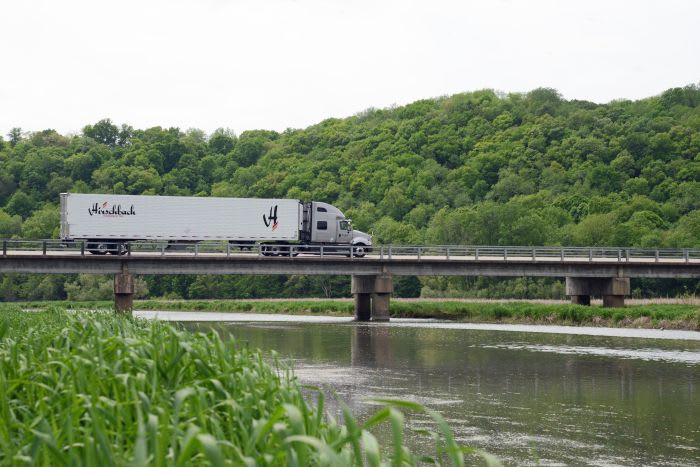
Hirschbach has a maximum four-year trade cycle so it can take advantage of the latest fuel-efficient models, with lightweight, aerodynamic specs and automated transmissions.
Photo courtesy Hirschbach Motor Lines
At Hirschbach Motor Lines, an 850-truck-and-growing refrigerated fleet based in East Dubuque, Illinois, the goal is “to become the most fuel-efficient fleet in the trucking business while providing best-in-class service to our customers,” says President Brad Pinchuk.
While acknowledging that it’s a difficult goal to measure, Pinchuk notes that the fleet’s better drivers regularly average 9.5 to 9.9 mpg, and some of its best drivers can coax more than 10 mpg out of the company’s newest trucks.
While there are “a million and one” ways the company attacks its goal, here are a handful of Hirschbach’s strategies:
1. Spec the most fuel-efficient equipment
Hirschbach’s strong relationships with truck and component OEs help it spec the most fuel-efficient equipment for its operation and give it an advance peek at the latest technology. Those relationships with Navistar and others have led the company to spec a new axle from Dana and get a retrofit calibration for its Cummins ISX engines that allows the trucks to use “coast mode” going downhill.
“You build relationships with all these different people, and you find really smart people who are involved in this,” Pinchuk says.
One of the spec’ing tactics is to take out as much weight as possible, he explains. “Our trucks today are almost 2,000 pounds less than what they used to be not too long ago.”
Although so far testing has not shown 6x2 axles to be a good fit for the company because of traction issues, Pinchuk says, “we’re not going to give up. We’re looking forward to testing Hendrickson’s new 6x2 with power to the rear axle.” (Hendrickson’s OptiMaax features an automated liftable forward tandem axle.)
2. Retrofit aerodynamic add-ons
Hirschbach is not hesitant to do major retrofits. Its latest project is the addition of FlowBelow Tractor Aerokits. These devices use wheel covers and additional fairing pieces that fit between and behind the tractor’s tandems to smooth the flow of air and improve fuel economy. Hirschbach piloted the technology on a small number of trucks to validate its effectiveness and durability before retrofitting the entire fleet. (Third-party supplier Velociti is handling the installation.)
“When we make a decision like this, we like to see the benefit of the decision we’ve made as soon as possible,” Pinchuk says. The company took a similar approach a few years ago in applying SmartTruck UT6 Plus trailer aerodynamic systems.
Generally Hirschbach is looking for a payback on these investments of 18 months or less.
3. Use data to coach drivers
“We’ve got a whole group of people who do nothing but analyze fuel economy,” Pinchuk says. ECM downloads come in every four hours. Those are used to update driver scorecards and more.
“We’ve got ‘coaches’ who are monitoring this information, and we work with our drivers on anything behavior-wise they can do to impact fuel economy,” he says, whether that’s progressive shifting, routing (the most efficient routes are determined with computer software), even how often they stop. “Every time you stop and get back up to highway speeds, you’re consuming a gallon of fuel,” he notes.
Testimonials and interviews with the highest-scoring drivers tease out best practices that are shared with other drivers. Fuel-efficient drivers are eligible for bonuses, and every month each driver’s fuel economy is posted on a board from best to worst.
“No one likes being on the bottom of the list,” Pinchuk says. “People are competitive. They’re trying to move up the list, and asking us what they can do to improve fuel economy.”
4. Fine-tune refrigeration
Hirschbach buys the most fuel-saving refrigeration units available – then uses telematics to make sure they’re operating most efficiently.
StarTrak’s two-way communication reefer management system, ReeferTrak Sentry, allows Hirschbach not only to remotely monitor things such as mode of operation and temperature, but also to change things on the fly without relying on the driver. It has created settings for specific commodities, whether they be bananas, meat or ice cream – and it’s worked with customers to make sure it can keep product in top condition without wasting fuel.
Because continuous mode uses a lot more fuel than start/stop, the computer system helps make sure continuous mode is used only for customers that require it. Some customers want fleets to use reefer settings lower than what is actually needed, but Hirschbach has been able to demonstrate that with its new trailers and reefer technology, that insurance policy isn’t needed.
“Our quest will always be to try to be the best, and we’ll never be satisfied and feel like we’re there,” Pinchuk says. “There’s always room for improvement, and it just becomes part of your culture to continuously improve.”
More Fuel Smarts

New California Law Could Shed Light on Electric Truck Prices
Why do battery-electric Class 8 trucks remain so expensive? A California bill signed by Gov. Gavin Newsom would give fleets and state agencies more visibility into what manufacturers charge.
Read More →
How Volvo Updated Its D13 for EPA 2027 [Watch]
Volvo’s updated D13 promises lower emissions without sacrificing performance or fuel economy. Take a closer look at what changed inside the engine in this HDT Spotlight video.
Read More →
Diesel Price Spike Shortens Payback for Natural Gas Trucks, Report Says
Energy Vision estimates fleets could recover the higher purchase price of an RNG-fueled Class 8 tractor in 1.3 to 2.8 years under current fuel-price scenarios.
Read More →

Calstart Becomes Catalyst Mobility, Reflecting Broader Focus
Calstart is now Catalyst Mobility, reflecting the nonprofit’s growing national role in clean transportation, including zero-emission trucks, infrastructure and incentive programs.
Read More →
Record Diesel Prices Squeeze Trucking Fleets
Average U.S. diesel prices have climbed to nearly $6 a gallon, surpassing the 2022 record as tight refinery capacity and Middle East disruptions keep fuel costs elevated.
Read More →
How Fuel Delivery Shapes Engine Performance
Fuel delivery depends on more than what happens at the injector. For fleet, maintenance and technical professionals, looking at the full path from pump to injector can provide useful context for understanding engine performance.
Read More →
East Coast Port Launches $45M Electric Truck Push
The Port Authority of New York and New Jersey announced millions in incentives for zero-emission drayage trucks, yard tractors, and new charging hubs near the port.
Read More →
Detroit Opens Orders for EPA 2027 Engines
Detroit isn’t starting from scratch to meet EPA 2027 diesel emissions standards. Its Gen 6 DD13 and DD15 engines keep much of today’s platform while updating the fuel and aftertreatment systems.
Read More →
Zero-Emission Truck Corridor Planned for West Coast
California, Oregon, Washington, British Columbia and Baja California are coordinating plans for truck charging and hydrogen fueling from Canada to Mexico.
Read More →
A Closer Look at Kenworth’s Electric T880E Vocational Truck [Video]
Learn more about Kenworth's T880E battery-electric vocational truck at the Paccar Technical Center, including its range, applications, upfitting considerations, and PTO options, in this HDT Spotlight video.
Read More →