




Navistar Outlines SuperTruck Progress
Increasing brake thermal efficiency in the SuperTruck's diesel engines is proving more challenging than expected and the goal of 55% still seems a ways off.

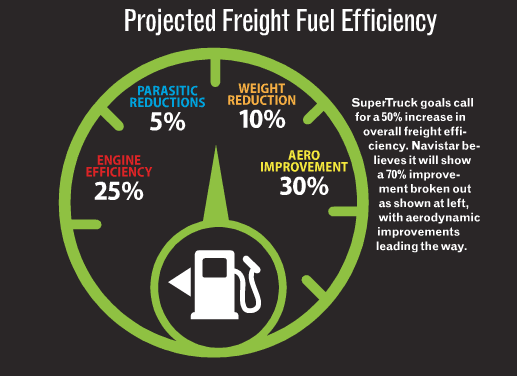
A breakdown of how Navistar's SuperTruck will achieve its efficiency goal.
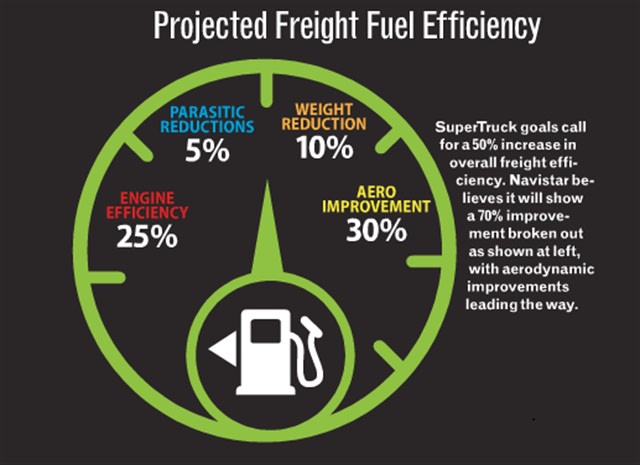
A breakdown of how Navistar's SuperTruck will achieve its efficiency goal.
Earlier this year, Peterbilt and Cummins made headlines when they announced they had achieved 10.7 mpg with their SuperTruck tractor-trailer under real-world driving conditions.
But there are still several other teams working on SuperTruck projects. The Department of Energy’s SuperTruck program provided $284 million in matching funds to four manufacturer teams to develop a research project improving the freight-hauling efficiency of heavy-duty, long-haul tractor-trailers.
The goal is to provide a 50% increase in overall tractor-trailer freight efficiency compared to a 2010 baseline.
A harder task is the goal to increase engine efficiency by 20%, achieving 50% brake thermal efficiency, or BTE, compared to a 42% baseline. In baseline EPA-2010 models, about 42% of the energy in a gallon of diesel actually goes to powering the truck. Most of it is lost to heat, internal friction, parasitic loss and other things.
Navistar’s take
At the recent Green Fleet Conference in Schaumburg, Ill., Navistar’s Darren Gosbee, engineering director, advanced technology and powertrain calibration, shared some insights from what Navistar has learned on its project.
Each truck maker is going about meeting the SuperTruck goals in slightly different ways. Gosbee said Navistar believes it will achieve a 70% improvement, made up of about 30% aerodynamic improvements, 25% engine efficiency improvements, 10% weight reduction and 5% reduction in parasitic loads.
For instance, Gosbee said, aero improvements for the project are largely about matching the tractor and trailer together. “It’s really about the trailing body aerodynamics, the leading body aerodynamics, and how you manage the gap.”
You have to get the trailing body dynamics right before you turn your attention to the leading body, he said, and maximize how the airflow passes down the trailer. With the help of trailer partner Wabash, the Navistar SuperTruck project has been looking at rear, nose, underbody and side skirt options.
“We’ve been doing aerodynamic work in wind tunnels for the last nine months, intently focusing on the tractor-trailer combination and what we can actually do. It’s one-eighth scale work, but final validation will be in a full-scale wind tunnel.”
When it comes to weight reduction, he said, “take a look at the extra weight we carry in suspensions, steering and brake systems. Frame rails are themselves extremely heavy. Battery boxes are still quite heavy. The essence here is to look at what we can do with composites to reduce weight and maintain integrity.”
Information technology plays a role, as well. More than one of the SuperTruck projects are using predictive cruise control, which use data to tell the truck what kind of terrain is ahead and adjust speed and throttle accordingly.
“Once you have predictive cruise, you have terrain knowledge and you can start to apply that intelligently. That really become the key factor on how smart technologies interact with the rest of the vehicle,” Gosbee said.
In addition, he said, engineers can use that knowledge of the terrain to empower the onboard computers to decide when to run the compressor, when to run the HVAC, how to optimize electrical systems and more.
The engine challenge
But it turns out that getting to that 50% number on engines is harder than everyone originally expected, he said.
“By far the hardest challenge is the engine.”
Right now, he said, the project is at 47.5% BTE – a big improvement from that 42% baseline, but still short of the 50% project goal, and much less the 55% that’s supposed to be “modeled” as a path forward.
Gosbee outlined some of the things you can do to improve the BTE of the engine:
Make sure your combustion is as efficient as possible.
Get the gases in and out more efficiently
Reduce the friction in the rotating components
Increase cylinder pressure
Redesign injectors and pistons
Refine the injection rate
Design a less complex, low-restriction exhaust gas recirculation system
Use high-temperature cooling, which means keeping the heat in the combustion chamber. Pushing it out through the cooling system is a waste.
Lower restriction in the turbocharging, aftertreatment and exhaust systems
Reduce friction between pistons, piston rings, liners and bearings. “There’s been very little advancement in bearings, and there are now new bearings out there that are much lower friction,” he said.
Reduce parasitic losses from the oil, water and fuel pumps. These “don’t need to run at the rate the engine does, so we’re taking them away from direct engine speed.”
Look at how the fan operates – “32-blade fans running at 70 horsepower do take a lot of energy.”
One strategy being used by SuperTruck teams is using a smaller engine.
“When you talk about 150 to 175 hp to move 65,000 pounds through the air on flat land, you don’t need high-horsepower engines, high torque curves and torque reserve,” Gosbee explained.
And of course, he said, manufacturers already are improving efficiency in the way the engine is mated with a transmission and driveline.
“We can no longer consider the engine and transmission as two separate components. The engine, transmission and driveline must be treated as a fully integrated system.”
We’re talking about downspeeding here, with direct-drive automated transmissions and very numerically low rear axle ratios (as low as 1.94) to keep the engine operating at lower rpms in the fuel-saving “sweet spot” as much as possible.
“There’s more technology coming on transmissions that we’ll see in the next couple of years.”
All of this, however, is in some ways low-hanging fruit, Gosbee said.
All the SuperTruck projects, he said, “stumbled at about the 48% level, and that’s where waste heat recovery comes in. All four of the SuperTrucks will end up with some form of waste heat recovery and some sort of turbocompounding, because that 55% is a real stretch,” he predicted.
Cummins exceeded its engine efficiency target at 51.1% BTE. But one of the ways it got there was with a heavy and complex waste heat recovery system.
In addition to complexity and weight, another challenge with waste heat recovery, Gosbee said, is the aftertreatment system.
“Part of the heat system that we rely on as vehicle manufacturers has to be used to keep the aftertreatment chemical plant running at its optimal temperature. So we’re in this challenge of keeping the aftertreatment systems clean and operational and trying to maximize heat recovery.”
Nevertheless, he said, “This will happen. Whether it happens for 2020 or 2025 is just a matter of time. To get to the next hurdle you have to start recovering that heat energy.”
More Fuel Smarts
Electric Yard Tractors Move Beyond Pilots
Operating-cost savings have overtaken sustainability goals as the leading reason surveyed fleets are adopting battery-electric terminal tractors, according to new NACFE research.
Read More →
Geotab Links Fleet Card to Vehicle Data
The new card combines fuel discounts with telematics-based purchase controls. Geotab’s analysis also points to potential savings from choosing lower-priced fuel stops.
Read More →
Fleet Economics Shape Electric Truck Outlook
ACT Research expects costs, charging infrastructure, and technology improvements to drive zero-emission commercial vehicle adoption as federal regulations and incentives retreat.
Read More →
Wex Adds Cardless Fuel Payments for Over-the-Road Customers
A new fuel card feature for Wex customers offers convenience and security.
Read More →
New California Law Could Shed Light on Electric Truck Prices
Why do battery-electric Class 8 trucks remain so expensive? A California bill signed by Gov. Gavin Newsom would give fleets and state agencies more visibility into what manufacturers charge.
Read More →
How Volvo Updated Its D13 for EPA 2027 [Watch]
Volvo’s updated D13 promises lower emissions without sacrificing performance or fuel economy. Take a closer look at what changed inside the engine in this HDT Spotlight video.
Read More →
Diesel Price Spike Shortens Payback for Natural Gas Trucks, Report Says
Energy Vision estimates fleets could recover the higher purchase price of an RNG-fueled Class 8 tractor in 1.3 to 2.8 years under current fuel-price scenarios.
Read More →
Calstart Becomes Catalyst Mobility, Reflecting Broader Focus
Calstart is now Catalyst Mobility, reflecting the nonprofit’s growing national role in clean transportation, including zero-emission trucks, infrastructure and incentive programs.
Read More →
Record Diesel Prices Squeeze Trucking Fleets
Average U.S. diesel prices have climbed to nearly $6 a gallon, surpassing the 2022 record as tight refinery capacity and Middle East disruptions keep fuel costs elevated.
Read More →
East Coast Port Launches $45M Electric Truck Push
The Port Authority of New York and New Jersey announced millions in incentives for zero-emission drayage trucks, yard tractors, and new charging hubs near the port.
Read More →