




Hours of Service Hot Button Questions, Part 1
Every year, hours-of-service questions from drivers and carriers make up the vast majority of inquiries concerning the Federal Motor Carrier Safety Regulations. In this first installment in a three-part series, we look at electronic logging devices.
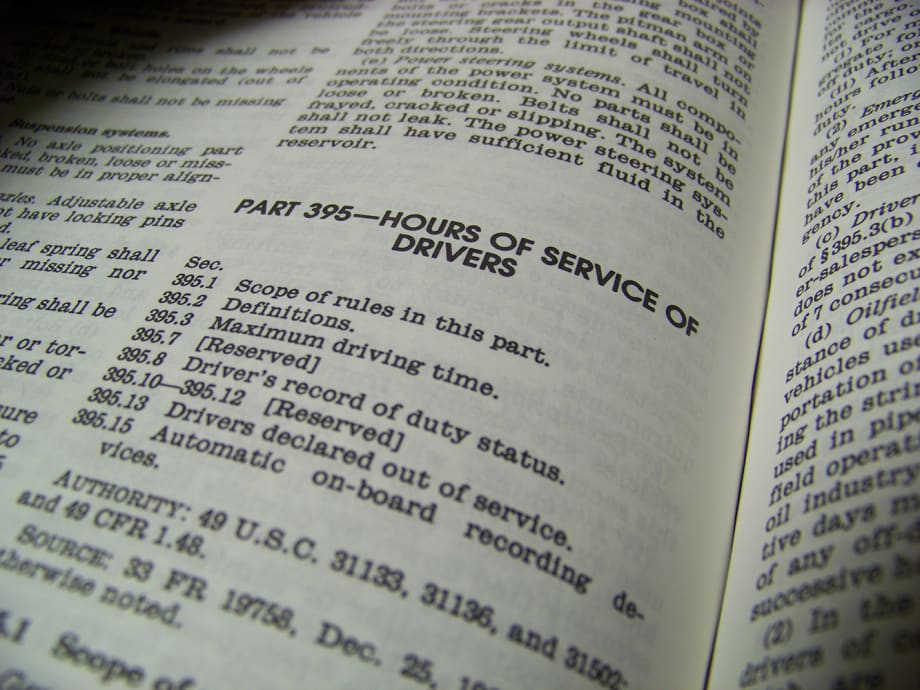
Every year, hours-of-service questions from drivers and carriers make up the vast majority of inquiries concerning the Federal Motor Carrier Safety Regulations. This year, concerns dealt with three main topic areas: electronic logging devices, 30-minute rest breaks, and restarts.
In this article, the first of a three-part series, we'll look at electronic logging devices.
Volumes have been written regarding the pros and cons of electronic logging devices, what is required, and when will they be mandatory. Many of the questions stemmed from the ELD mandate proposal published on March 28. The comment period ended in late June, and as of this writing, there is not much to report. The Federal Motor Carrier Safety Administration is in the process of reviewing the comments and presumably writing the final rule.
The Department of Transportation puts out a monthly Report on DOT Significant Rulemakings, but the most current report still does not reflect any estimate for the final rule; it only shows that the proposal process is complete.
The ELD proposal and recent guidance have prompted many to ask the question, “To print, or not to print?”
A typical question: “We’ve been using electronic logging for some time. Recently, my driver had a roadside inspection and was asked to print her logs. Can they ask that and does she have to be able to print?”
The answer is, “It depends.” There are currently three types of electronic logs:
Computer programs that assist drivers in the completion of manual logs
Computer programs that assist drivers in the completion of manual logs with electronic signature capabilities
Automatic On-board Recording Devices (AOBRDs) as defined in Section 395.2 and regulated in Section 395.15. In recent years, these have also become known as Electronic On-board Recorders (EOBRs) and Electronic Logging Devices (ELDs).
AOBRDs require no printing capability. This has always been the case, but some enforcement officers held an opinion that the devices did need to print. To set the record straight, the FMCSA published guidance in May. The publication included an additional official interpretation for Section 395.15:
"The FMCSRs do not require AOBRDs to provide a hardcopy printout for an enforcement official. As long as the information made available for display on the AOBRD meets the requirements of §395.15(i)(5), the driver and motor carrier are not required to provide additional RODS documentation to an enforcement official at the roadside. However, an enforcement official may request that additional information be provided by email, fax, or similar means within 48 hours for follow-up after the conclusion of the roadside inspection."
In regard to computer programs that assist drivers in the completion of manual logs, in July, the FMCSA published new guidance that made a differentiation between programs that have electronic signature capabilities and those that do not.
The previous guidance remains the same if electronic signatures are not used:
The driver must print and manually sign the RODS daily.
The driver must have in his or her possession the printed and signed RODS for the prior seven consecutive days (if required on those days).
The driver should be given an opportunity to print and manually sign the current day’s RODS at the time of the inspection.
New guidance is provided for logs that are electronically signed:
At the time of an inspection of records by an enforcement official, the driver may display the current and prior seven days RODS to the official on the device’s screen.
If the enforcement official requests printed copies of the RODS, the driver must be given an opportunity to print the current and prior seven days’ RODS (if required on those days) at the time of inspection.
So, in the case of logs that are electronically signed, enforcement has the option of either using the device or asking for the logs to be printed.
This article was authored under the guidance and editorial standards of HDT's editors to provide useful information to our readers.
More Drivers

Nussbaum, Roehl Announce Second Driver Pay Increase This Year
This year has seen a swath of major truck driver pay increases as freight capacity has tightened.
Read More →
From One Generation to the Next: How Mentorship Builds Safer Truck Drivers
After three decades in trucking, Harold Perry shares what he's learned about driver safety, mentorship, and helping the next generation build confidence behind the wheel.
Read More →
Truck Drivers Need More Than Another Alert
Fleets have more visibility into truck health, safety events, and driver activity than ever. The next challenge is turning all that information into useful guidance for the person who has to decide what to do next.
Read More →
FMCSA Removes 110 Truck Driver Training Schools from Certified ELDT List
Federal regulators also are targeting more than 160 additional training providers and launching a nationwide audit of third-party CDL skills testers as part of a broader crackdown on trucking fraud.
Read More →
Hours of Service Pilot Programs: FMCSA Readies for 2027 Rollout
Two pilot programs could eventually reshape hours-of-service rules, giving truck drivers options to pause their 14-hour clock or use longer split sleeper rest periods.
Read More →
Medical Cards, English Proficiency Reshape Roadcheck Violations
Medical-card violations jumped to the top of the driver out-of-service list during CVSA’s 2026 International Roadcheck, while English-language proficiency violations appeared among the leading violations for the first time.
Read More →
Driver Trust Can Make or Break the Success of Fleet Safety Technology
New Teletrac Navman research suggests that onboarding, transparency about driver data, and positive feedback can play a significant role in how commercial drivers respond to safety and coaching technology.
Read More →
EEOC Sues KLLM Over Alleged Sex Discrimination in Driver Training
KLLM is facing a federal sex-discrimination lawsuit over policies the EEOC alleges put female truck driver trainees at a disadvantage.
Read More →
FMCSA Moves to Codify English Language Requirements for Commercial Drivers
By changing regulations on English-language proficiency requirements for commercial drivers, rather than relying on a guidance memo, the FMCSA said future administrations won't be able to walk back the Trump administration's stricter enforcement with just a memo.
Read More →
Drivers Put Western Star Trucks to the Test at Star Nation Experience
Watch to get an inside look at the Western Star trucks, technology, and community behind the Star Nation Experience 2026!
Read More →