




Gas-to-Liquids Technology Makes Fuel, Oil From Natural Gas
A a giant facility in Qatar, Shell is turning natural gas into products normally produced from crude oil — fuel, base oils, paraffin, kerosene, etc.

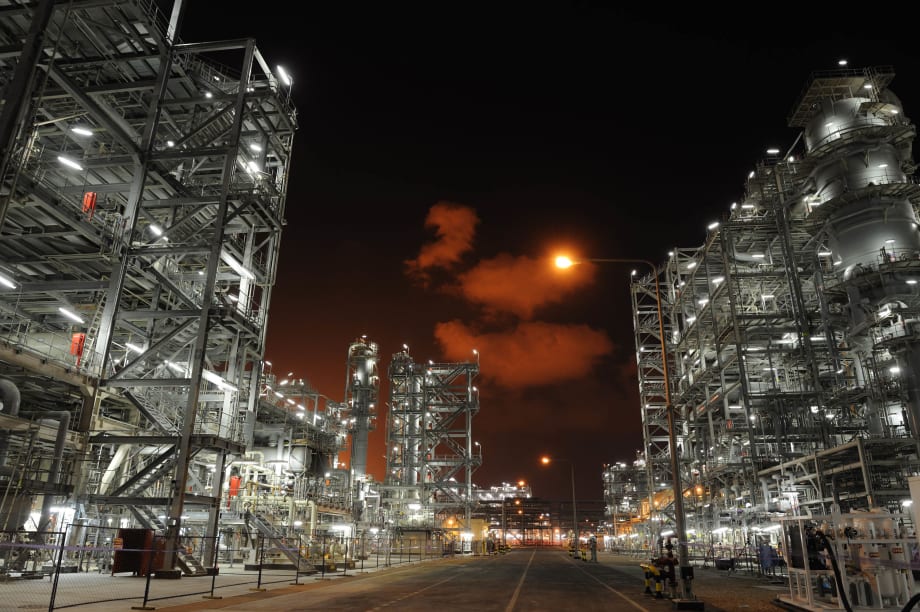
Shell’s gas-to-liquids plant in Qatar is the largest in the world. Photo: Shell
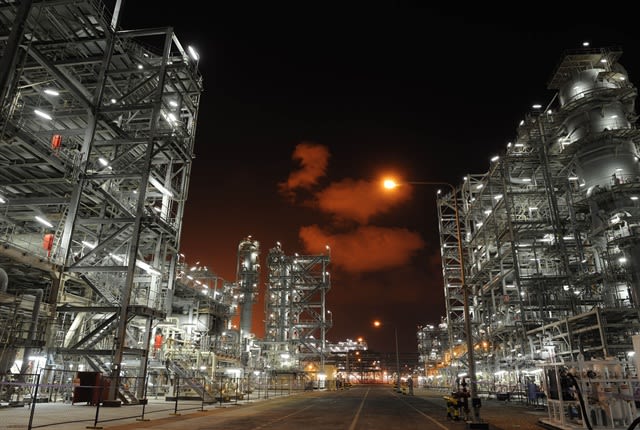
Shell’s gas-to-liquids plant in Qatar is the largest in the world.Photo: Shell
At a giant facility in Qatar, Shell is turning natural gas into products normally produced from crude oil — fuel, base oils, paraffin, kerosene, etc.
Shell started looking for a way to convert natural gas into liquid hydrocarbons back during the Middle East oil crisis of the 1970s. While it found a way to do it in the lab, the researchers could only make a few drops a day. It took 10 years to get to where they could produce a larger sample — a whopping three barrels per day.
It took another 10 years to start producing commercially at a plant in Malaysia in 1993, which today can produce 14,700 barrels a day.
In 2012, Shell’s Pearl GTL plant started production in Qatar. The size of 453 soccer fields and made with enough steel to build 10 Eiffel towers, the Qatar plant can produce 140,000 barrels a day. The complex process is covered by 3,500 patents.
“Shell produces a lot more natural gas than oil these days, and we need to find ways of making that useful for transportation industries,” explains Richard Tucker, general manager of commercial and industry fuels and lubricants technology for Shell.
In a couple of global markets, where fuel quality is a problem, Shell is putting the GTL “gasoil” fuel into the market as a pure diesel fuel. “It’s cleaner burning and helps to reduce emissions, and has a very high cetane number, around 80.
“It also can help reduce engine noise,” Tucker notes.
GTL diesel fuel also can be used to blend with petroleum-based diesel to improve it.
Probably the first place GTL will get widespread use in the U.S. won’t actually be in fuels, but in engine oils, as Shell likely will use the purer base stock to help it create lower-viscosity engine oils to improve fuel economy and meet the upcoming new engine oil classification standards. GTL-based lubricants already are being used in light vehicles.
In fact, Shell just launched Pennzoil products containing GTL in the U.S., a top-tier product called Pennzoil Ultra, for autos, according to Selda Gunsel, Shell vice president of technology.
“We have current research and development projects we are focusing on for heavy-duty using GTL,” she says. “We’ve developed prototypes and are doing field trials. It will be applied to heavy-duty engine oil, transmission fluids, grease, because the base oils make them suitable for formulating high-performance lubricants for virtually any application.”
The U.S. Energy Department says there are currently five GTL plants operating globally, with capacities ranging from 2,700 barrels per day to Shell’s 140,000. None are currently in the U.S. Several have been proposed, but late last year, according to DOE, Shell cancelled plans to build a large-scale GTL facility in Louisiana because of high estimated capital costs and market uncertainty regarding natural gas and petroleum product prices. n
More Fuel Smarts

How Volvo Updated Its D13 for EPA 2027 [Watch]
Volvo’s updated D13 promises lower emissions without sacrificing performance or fuel economy. Take a closer look at what changed inside the engine in this HDT Spotlight video.
Read More →
Diesel Price Spike Shortens Payback for Natural Gas Trucks, Report Says
Energy Vision estimates fleets could recover the higher purchase price of an RNG-fueled Class 8 tractor in 1.3 to 2.8 years under current fuel-price scenarios.
Read More →
Calstart Becomes Catalyst Mobility, Reflecting Broader Focus
Calstart is now Catalyst Mobility, reflecting the nonprofit’s growing national role in clean transportation, including zero-emission trucks, infrastructure and incentive programs.
Read More →

Record Diesel Prices Squeeze Trucking Fleets
Average U.S. diesel prices have climbed to nearly $6 a gallon, surpassing the 2022 record as tight refinery capacity and Middle East disruptions keep fuel costs elevated.
Read More →
How Fuel Delivery Shapes Engine Performance
Fuel delivery depends on more than what happens at the injector. For fleet, maintenance and technical professionals, looking at the full path from pump to injector can provide useful context for understanding engine performance.
Read More →
East Coast Port Launches $45M Electric Truck Push
The Port Authority of New York and New Jersey announced millions in incentives for zero-emission drayage trucks, yard tractors, and new charging hubs near the port.
Read More →
California Bill Could Shed Light on Electric Truck Prices
Why do battery-electric Class 8 trucks remain so expensive? A California bill headed to Gov. Gavin Newsom would give fleets and state agencies more visibility into what manufacturers charge.
Read More →
Detroit Opens Orders for EPA 2027 Engines
Detroit isn’t starting from scratch to meet EPA 2027 diesel emissions standards. Its Gen 6 DD13 and DD15 engines keep much of today’s platform while updating the fuel and aftertreatment systems.
Read More →
Zero-Emission Truck Corridor Planned for West Coast
California, Oregon, Washington, British Columbia and Baja California are coordinating plans for truck charging and hydrogen fueling from Canada to Mexico.
Read More →
A Closer Look at Kenworth’s Electric T880E Vocational Truck [Video]
Learn more about Kenworth's T880E battery-electric vocational truck at the Paccar Technical Center, including its range, applications, upfitting considerations, and PTO options, in this HDT Spotlight video.
Read More →