




DME: Companies Testing 'Alternate’ Alternative Fuel
Volvo Trucks is testing dimethyl ether in a pair of Volvo VNL 300 trucks with D13 DME engines with partners Oberon Fuels and Martin Energy Services.


Photo: Volvo Trucks
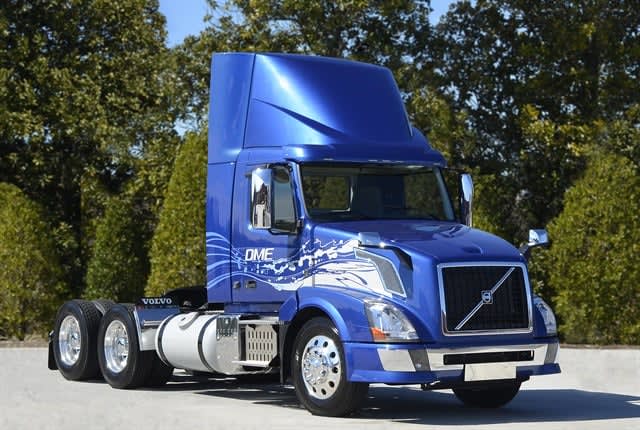
Photo: Volvo Trucks
With the number of alternative fuel options available to fleets now and in the future, there are many different avenues that need to be researched before a decision can be made. For engineers at Volvo Trucks, the road chosen was one less traveled — dimethyl ether, or DME.
For more than a year, Volvo has piloting a pair of Volvo VNL 300 trucks with D13 DME engines with a pair of partners, Oberon Fuels and Martin Energy Services. Each stakeholder brings a unique piece of the DME puzzle to the table. While Volvo has developed an engine and fuel delivery system that maximizes the benefits of DME so that it runs like diesel, Oberon has produced and provided the fuel that runs the heavy-duty vehicles for Martin Energy Services, a provider of fuels, lubricants and fueling logistical support along the Gulf of Mexico.
“The main benefit of DME is that it is a true diesel replacement in the sense that it is a high-quality compression ignition fuel,” says Elliot Hicks, Oberon’s chief operating officer. “You get the efficiency and torque that you get with diesel from DME, with a simple engine setup.”
The DME-powered duo currently hauls fuel for Martin Energy Services throughout Texas, giving Volvo Trucks a real-world proving ground for the fairly new alternative fuel.
“We’re continuing to work toward commercialization and anticipate low-volume production in 2017,” says Frank Bio, Volvo Trucks director of sales development, specialty vehicles and alternative fuels. “We continue to develop the DME engine, fuel system and work with our suppliers to commercialize all the needed components for a successful launch.”
Currently, according to Bio, North American field testing of DME-powered Volvo VNL daycabs continues to validate Volvo Trucks’ optimism about the long-term promise of DME as a transportation fuel.
“Drivers have been overwhelmingly positive about operating the DME-powered trucks, noting that they perform like the diesel-powered vehicles,” Bio says. “Like propane, DME does not require high-pressure pumps or cryogenic storage. Drivers quickly grow accustomed to the fueling process.”
Horsepower, torque and engine brake response are the same as diesel, Bio says. Fuel efficiency is on par with diesel and 9 to 15% better than a spark-ignited engine.
The D13-DME engines were based on the Volvo D13 engine with adjustments made to the fuel system — including injectors, pumps, seals, and fuel tanks — and the electronic engine management system.
A little backstory
Oberon Fuels was founded in late 2010 in San Diego after developing a process to convert biogas and natural gas into DME, first focusing on monetizing waste gas streams such as biogas from digesters and landfills.
“DME came across our radar early on as a good potential fuel and something that was well suited to the production size that we were looking at,” Hicks explains. “Volvo came out as one of the leaders in DME development in the world.”
Volvo Trucks began developing a DME-powered heavy-duty vehicle in 2007, which it showcased along with a number of other alt-fuel vehicles in Brussels. After a quick introduction of the vehicle at the Washington International Renewable Energy Conference in 2008, Volvo Trucks decided to move forward to bring a DME vehicle to the North American market.
Fast-forward to the opening of an Oberon Fuels DME-processing facility in the Imperial Valley region of Southern California in June 2013. Volvo now had a steady supply of the fuel to power its pilot program.
“Oberon has demonstrated an economical model for producing smaller batches of DME,” Bio says. “They have also assisted in the process for establishing ASTM standards for fuel-grade DME.”
Easy decision
The decision to pursue DME as an alternative fuel can be summed up in one short phrase, according to Bio: It’s clean, simple and safe.
Clean: DME can easily be produced from North America’s abundant supply of natural gas or a variety of sustainable domestic sources, giving it the potential to reduce energy dependency. Combustion of DME produces ultra-low emissions and no soot, removing the need for a diesel particulate filter. Also, DME doesn’t contain sulfur and poses no harm to the environment. It’s non-toxic and biodegradable, and it will not contaminate soil or water.
Simple: Only minor engine modifications are necessary for a Volvo D13 diesel engine to run on DME. DME is similar to propane, making it easier and cheaper to handle, store, and dispense. There’s no need for cryogenic or high-pressure storage, and DME tanks are considerably lighter and less complex than CNG or LNG tanks.
Safe: Along with being non-toxic, DME is non-carcinogenic and already used as an aerosol propellant in cosmetics and other household products.
Putting it to the test
The test vehicles have been hauling fuel for Martin Energy Services since June 2013, but they aren’t the only testing Volvo has been doing.
“We’re nearing a million miles of testing globally across a number of customer vehicles and test vehicles in various development stages,” Bio says. U.S. test locations include North Carolina, where Volvo Trucks’ North American headquarters is located, and customer operations in California and Texas.
A second pilot test, which is being developed in conjunction with Safeway and the San Joaquin Valley Air Pollution Control District, will test the DME-propelled haulers on California highways. The project proposal was submitted to the pollution-control agency solicitation through its technology advancement program.
“Our air quality situation in 2008, when we developed our ozone plan to attain the 1996 standard, showed that we could not meet that standard by 2023,” says Kevin Wing, senior air quality specialist, San Joaquin Valley Air Pollution Control District.
Wing and his team are excited by this DME project for multiple reasons: DME burns like diesel, it has an emissions profile that is much more like natural gas, and it does not require as high a pressure to stay liquefied.
“Another big advantage is that it can be produced from biogas, which gives us no net increase in our NOx emissions,” Wing says.
Volvo and Oberon Fuels continue to research how DME will perform on the national, and global, alt-fuel stage.
“We’re working hard to get DME included in the alternative fuels conversation. The biggest issue is that most policy makers are not aware of DME,” concluded Hicks.
More Fuel Smarts

How Volvo Updated Its D13 for EPA 2027 [Watch]
Volvo’s updated D13 promises lower emissions without sacrificing performance or fuel economy. Take a closer look at what changed inside the engine in this HDT Spotlight video.
Read More →
Diesel Price Spike Shortens Payback for Natural Gas Trucks, Report Says
Energy Vision estimates fleets could recover the higher purchase price of an RNG-fueled Class 8 tractor in 1.3 to 2.8 years under current fuel-price scenarios.
Read More →
Calstart Becomes Catalyst Mobility, Reflecting Broader Focus
Calstart is now Catalyst Mobility, reflecting the nonprofit’s growing national role in clean transportation, including zero-emission trucks, infrastructure and incentive programs.
Read More →

Record Diesel Prices Squeeze Trucking Fleets
Average U.S. diesel prices have climbed to nearly $6 a gallon, surpassing the 2022 record as tight refinery capacity and Middle East disruptions keep fuel costs elevated.
Read More →
How Fuel Delivery Shapes Engine Performance
Fuel delivery depends on more than what happens at the injector. For fleet, maintenance and technical professionals, looking at the full path from pump to injector can provide useful context for understanding engine performance.
Read More →
East Coast Port Launches $45M Electric Truck Push
The Port Authority of New York and New Jersey announced millions in incentives for zero-emission drayage trucks, yard tractors, and new charging hubs near the port.
Read More →
California Bill Could Shed Light on Electric Truck Prices
Why do battery-electric Class 8 trucks remain so expensive? A California bill headed to Gov. Gavin Newsom would give fleets and state agencies more visibility into what manufacturers charge.
Read More →
Detroit Opens Orders for EPA 2027 Engines
Detroit isn’t starting from scratch to meet EPA 2027 diesel emissions standards. Its Gen 6 DD13 and DD15 engines keep much of today’s platform while updating the fuel and aftertreatment systems.
Read More →
Zero-Emission Truck Corridor Planned for West Coast
California, Oregon, Washington, British Columbia and Baja California are coordinating plans for truck charging and hydrogen fueling from Canada to Mexico.
Read More →
A Closer Look at Kenworth’s Electric T880E Vocational Truck [Video]
Learn more about Kenworth's T880E battery-electric vocational truck at the Paccar Technical Center, including its range, applications, upfitting considerations, and PTO options, in this HDT Spotlight video.
Read More →