The Benefits of Low-Rolling-Resistance Tires Explained
There's little doubt left that tires formulated for lower rolling resistance work as advertised, but it's still tough to give up at few thousandths of an inch of tread. After all, tire miles are important, too. How much of a difference does the reduction in rolling resistance make?
Most of us now acknowledge there's some benefit to running low-rolling-resistance tires. They are supposed to improve fuel economy, right? That's the idea, and for the most part that's exactly what they do. But are they all they are cracked up to be? Well, that depends on the specific tire and to a large degree how well it's maintained.
Ad Loading...
A so-called low-rolling-resistance tire inflated to its optimum pressure for the load and wheel position will deliver better fuel economy that a standard or non-LRR tire because the standard tire absorbs more of the energy used to roll the tire. Energy is consumed by internal friction in the tread and casing, traction and even squirming and wiggling of the tread or lugs while the tire is in motion.
Ad Loading...
How well a tire resists internal friction and energy loss is very much a matter of the rubber compounds used in the tread and casing construction, the tread pattern itself and the depth of the tread. Tire manufacturers offer a variety of designs, each boasting certain attributes, some of which are tied to rolling resistance.
Not all low-rolling-resistance tires are created equal, so some tires will perform better than others. Some start life with a thinner tread (which gives rise to the sense that you're giving up tread life for fuel economy), some use firmer compounds with less internal friction, and still others claim to be low-rolling-resistance tires but their pedigree is sometimes questionable.
Bridgestone tells us that tire casings (including belts) contribute about 50-65% of tire rolling resistance. The advent of the low-profile sidewall back in the 1980s produced significant reductions in sidewall flex, and hence, fuel efficiency. They weren't called low-rolling-resistance tires at the time, but they were the precursors to today's more fuel-efficient designs.
Today's casings are further optimized to lower rolling resistance by refining stress distribution and minimizing internal friction caused when the sidewall flexes under load. And in the case of wide-base single tires, two sidewalls per wheel position are eliminated, further reducing the tire's overall rolling resistance.
The remaining percentage of a tire's rolling resistance comes from the tire tread, so much of the focus in developing fuel efficient tires has been on tread design.
Ad Loading...
"Some compounds, especially those incorporating silica, or using formulas that combine natural and engineered synthetic rubber, can reduce tire rolling resistance significantly," says Guy Walenga, director of engineering for commercial products and technologies at Bridgestone.
Despite the fuel savings benefits of these tires, there's still some reluctance to embrace the product. Fleets can expect modest reductions in miles-to-take-off in many cases, and fleets that operate in northern parts of the country have expressed concern about traction on snowy or icy roads -- and even in rainy weather.
According to Larry Tucker, marketing manager for commercial tires at Goodyear, the economic argument against shallower tread is moot today. He says the fuel savings over the life of the tire more than offsets its shorter life.
"With rising fuel costs all fleets are looking at ways to improve fuel economy, even fleets that were once concerned only with tread life," he says. "With the proper tools we can calculate exactly the cost per mile and operating cost of each tire and determine the tire that is the most economical to use in their application. We can show fleets that even though they may sacrifice some tread depth, they are offsetting that with improved fuel economy. In a majority of the cases the fuel-efficient tires are always more economical to run than deeper tread tires."
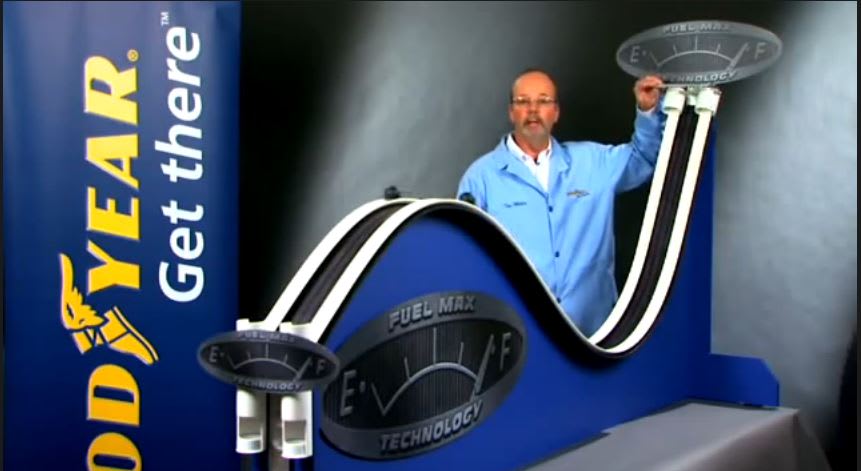
Having said all that, does low rolling resistance really make a difference? To demonstrate how much of a difference, we have a video produced by Goodyear, starring Tim Miller, Goodyear's national fleet manager. It's a short and simple explanation of how low-rolling-resistance compounding can affect the amount of energy -- diesel fuel -- needed to keep those tires rolling. In the video, Miller compares the company's Fuel Max tires to standard tires. The results are graphically hard to argue with. I suspect if any of the other top-tier tire manufacturers had done a video like this, the results would be similar.
Listen as Mike Roeth of the North American Council for Freight Efficiency shares insights into battery-electric trucks, natural gas, biofuels, and clean diesel on this episode of HDT Talks Trucking.
NACFE's Run on Less - Messy Middle project demonstrates the power of data in helping to guide the future of alternative fuels and powertrains for heavy-duty trucks.
Mike Kucharski, vice president of refrigerated carrier JKC Trucking, says diesel price jumps tied to global instability are squeezing carriers already struggling with weak freight rates.
In today’s cost-conscious market, fleets are finding new ways to get more value from every truck on the road. See how smarter maintenance strategies can boost uptime, control costs and drive stronger long-term returns.
Purdue researchers demonstrated a high-power wireless charging system capable of delivering energy to electric heavy-duty trucks at highway speeds, advancing the concept of electrified roadways for freight transportation.
The Environmental Protection Agency is asking diesel engine makers to provide information about diesel exhaust fluid system failures as it considers changes to emissions regulations.
The Environmental Protection Agency said California can’t enforce its Heavy-Duty Inspection and Maintenance Regulation, known as Clean Truck Check, on vehicles registered outside the state. But California said it will keep enforcing the rule.
The Trump administration has announced it will no longer criminally prosecute “diesel delete” cases of truck owners altering emissions systems in violation of EPA regulations. What does that mean for heavy-duty fleets?
Natural gas is quietly building a reputation as a clean, affordable, and reliable alternative fuel for long-haul trucks. And Ian MacDonald with Hexagon Agility says the Cummins X15N is a big reason why.