




DME: An Alternative Fuel that is Coming Soon
Volvo Trucks North America believes dimethyl ether, or DME, is the real fuel of the future, and the company intends to get it to market as a motor fuel by 2015 in Volvo VN models as well as Mack Pinnacle trucks from its sister company.

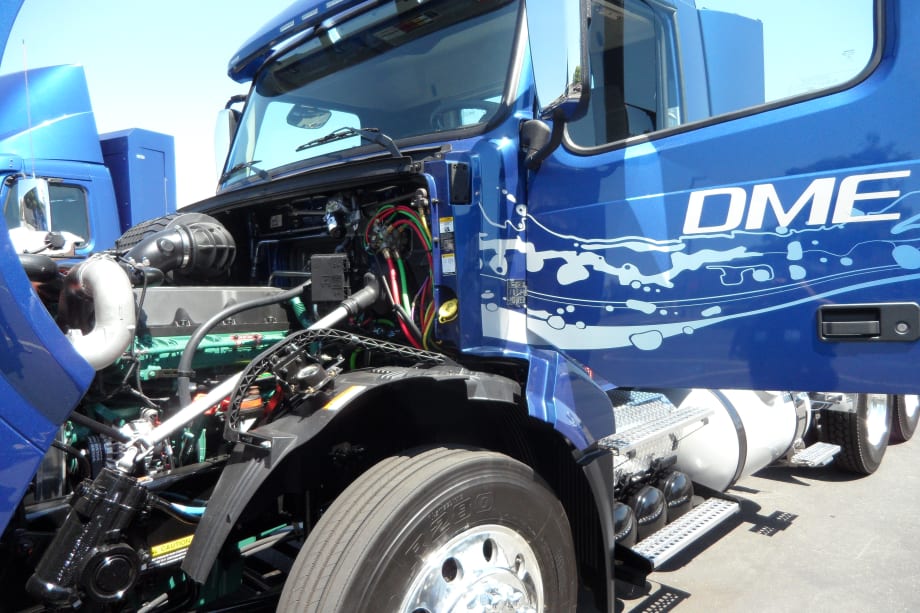
This DME engine is based on a Volvo D13 diesel. This prototype has common-rail fuel injection, which the production engine might or might not use.
Volvo Trucks North America believes dimethyl ether, or DME, is the real fuel of the future, and the company intends to get it to market as a motor fuel by 2015 in Volvo VN models as well as Mack Pinnacle trucks from its sister company.
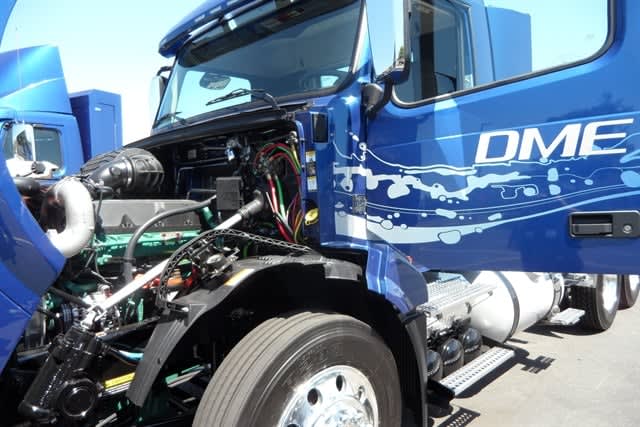
This DME engine is based on a Volvo D13 diesel. This prototype has common-rail fuel injection, which the production engine might or might not use.
DME can be made from methane that occurs in many forms, from decomposing cow and chicken manure to rotting grass clippings and landfill gas, as well as natural gas. It burns extremely cleanly and should not have the kind of up-front cost penalty as some other “green” alternatives.
Although there are some incentives involved from the state of California to get the project rolling, Rebecca Boudreaux, president of Oberon Fuels, says she and her colleagues have established a good business case for DME without government money. Oberon began producing DME this summer at a new plant at Brawley, Calif.
The companies have found a way to produce DME in small quantities. That way markets can be developed locally and regionally, sidestepping the infrastructure challenge faced by natural gas.
DME is a nontoxic substance used overseas as a cooking fuel and other things, but not as motor fuel, Boudreaux said. One exception is 10 Volvo trucks in Sweden that have been in extensive field-testing with fleets.
Most Americans have never heard of DME, but it’s a common, non-toxic propellant used in products such as hair spray, deodorant and lube oil.
DME burns so cleanly that it leaves no soot and emits just a fraction of other pollutants, Boudreaux says. For example, carbon dioxide emissions are 95% less than diesel.
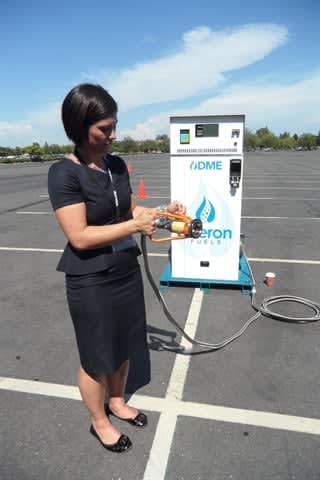
Rebecca Boudreaux, president of Oberon Fuels, shows a 21-gallon-per-minute dispenser. The nozzle twists onto a
vehicle’s filler neck.
Starting next year, Safeway, the grocery giant based in northern California, will start running test tractors. Meanwhile, Volvo test units are already being run in Texas by Martin Transportation, a hauler of bulk commodities and construction materials. Some also will be bought by California agencies that are backing the project. By 2015, they are scheduled to be available to the industry at large.
DME under the hood
Diesel engines take well to DME, and need only a special injection system and different cylinder heads to handle high fuel flow, and simple steel fuel tanks to store it aboard a truck, explains Ed Saxman, Volvo’s marketing product manager for alternative fuels.
Those tanks are the same as those used for propane, so they are far cheaper than the vessels required for compressed and liquefied natural gas. Like propane, DME stores at about 75 pounds per square inch and at ambient temperature, versus 3,600 psi for CNG and minus 260 degrees for LNG.
DME storage is simple and relatively inexpensive, with a fueling station costing in “the tens of thousands of dollars instead of in the hundreds of thousands, as with natural gas,” Boudreaux says. Fueling will be consistent, with no short fills caused by low pressure in a storage tank, as sometimes happens with CNG, Saxman said. And DME can be stored in the hot sun, like propane, with no boiling off and venting as can occur with LNG.
DME burns so cleanly that the engine needs no exhaust-gas recirculation, a diesel particulate filter or variable geometry turbocharger – all sources of reliability problems and maintenance expense, Saxman says. The fuel is injected at relatively low pressures, so the fuel system needn’t be so stout.
With no DPF, there are no regenerations to burn out ash, and with compression ignition the operating temperatures are lower than with spark ignition required for CNG and propane. The engine control software is the same as for a diesel.
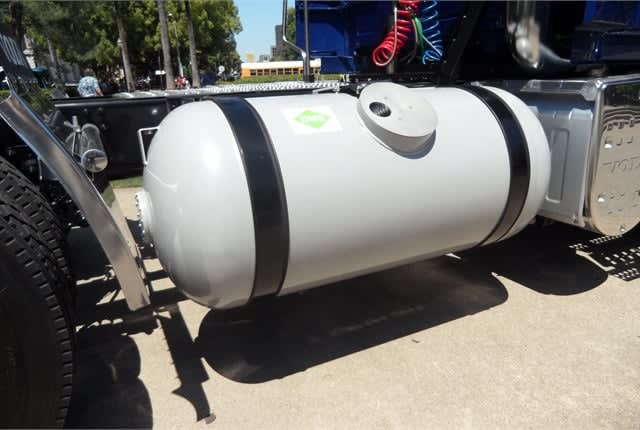
A steel DME fuel tank is the same kind used for propane. The modest storage pressure of 75 psi makes the tank, built for propane’s 125 psi, overbuilt.
DME still requires a catalytic converter and might need selective catalytic reduction. One thing already known is that DME lacks lubricity. Either the fuel has to be treated with an additive to protect exhaust valves, or those valves could be hardened as they are in gasoline engines destined to burn propane or natural gas.
More importantly, DME has about half the energy content of diesel fuel, so a truck will have to carry about twice the amount of DME for a given range. Two gallons of DME weigh 11 pounds compared to diesel’s 7.5 pounds, so a DME-fueled truck or tractor might be heavier than one with a straight diesel.
That’s unless the truck’s owner can reduce that range (most vehicles today carry too much fuel anyway, Saxman believes). The typical DME-powered truck will be a daycab with a 600-mile range.
Like any alternative fuel, DME will initially be better suited to local and regional trucking than long-haul, Boudreaux says. With an output of 4,500 gallons per day, Oberon’s small-scale production plant in Brawley is meant to support hub-and-spoke operations where trucks return often to refuel.
DME’s cost per diesel-equivalent gallon will be about the same as diesel’s, according to Oberon. Its advantage is its cleanliness for low emissions; safety, so a leak will be a non-event, unlike the mess and official concern for a diesel spill; and the use of plentiful domestic natural gas or renewable biomass feedstocks.
What will a truck or tractor with a DME engine cost? It will be “competitive with diesel,” is all Saxman or Volvo’s sales and marketing president, Goran Nyberg, would say.
More Fuel Smarts
Why Diesel Price Relief Efforts May Fall Short
Diesel prices have eased from September’s record high, but doubts about additional Russian supply and limits on dyed-diesel tax relief mean trucking fleets still face expensive fuel. And prices could go higher.
Read More →
Why Small Fuel Savings Matter in Trucking
Can better fuel economy help pay for driver raises? In this podcast, GP Transco explains how small efficiency gains create room to reinvest in its people.
Read More →
How GP Transco Cuts Trucking Fuel Costs, a Tenth of a Gallon at a Time
What’s another tenth of a mile per gallon worth? GP Transco shares how equipment upgrades and driver coaching turn small gains into meaningful fuel savings.
Read More →
Electric Yard Tractors Move Beyond Pilots
Operating-cost savings have overtaken sustainability goals as the leading reason surveyed fleets are adopting battery-electric terminal tractors, according to new NACFE research.
Read More →
Geotab Links Fleet Card to Vehicle Data
The new card combines fuel discounts with telematics-based purchase controls. Geotab’s analysis also points to potential savings from choosing lower-priced fuel stops.
Read More →
Fleet Economics Shape Electric Truck Outlook
ACT Research expects costs, charging infrastructure, and technology improvements to drive zero-emission commercial vehicle adoption as federal regulations and incentives retreat.
Read More →
Wex Adds Cardless Fuel Payments for Over-the-Road Customers
A new fuel card feature for Wex customers offers convenience and security.
Read More →
New California Law Could Shed Light on Electric Truck Prices
Why do battery-electric Class 8 trucks remain so expensive? A California bill signed by Gov. Gavin Newsom would give fleets and state agencies more visibility into what manufacturers charge.
Read More →
How Volvo Updated Its D13 for EPA 2027 [Watch]
Volvo’s updated D13 promises lower emissions without sacrificing performance or fuel economy. Take a closer look at what changed inside the engine in this HDT Spotlight video.
Read More →
Diesel Price Spike Shortens Payback for Natural Gas Trucks, Report Says
Energy Vision estimates fleets could recover the higher purchase price of an RNG-fueled Class 8 tractor in 1.3 to 2.8 years under current fuel-price scenarios.
Read More →