




Are You On Top of Your Fuel-Buying Program?
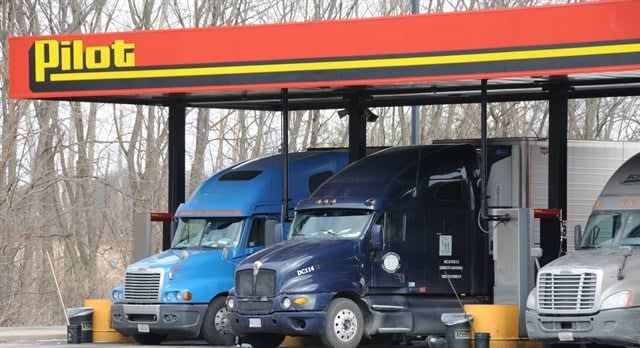
Pilot, the largest truckstop chain in the country with more than 650 outlets and $29 billion in annual revenues, is being investigated for allegedly defrauding customers by withholding fuel rebates and discounts.

“Trust but verify,” President Ronald Reagan is famous for having said. He was talking about dealing with the Soviet Union during the Cold War, and it’s an irony of history that he was borrowing a Russian proverb used by Vladimir Lenin. But wherever it came from, it now is the watchword for doing business with Pilot Flying J.
Pilot, the largest truckstop chain in the country with more than 650 outlets and $29 billion in annual revenues, is being investigated for allegedly defrauding customers by withholding fuel rebates and discounts.
The investigation is far from complete, but an affidavit prepared by the Federal Bureau of Investigation to obtain a search warrant alleges that for years a group of Pilot Flying J employees deliberately and callously ripped off carriers who were not keeping close track of their fuel data.
“If the customers aren’t smart enough to know what they’re getting, then they don’t deserve the rebate,” sa Pilot Flying J salesman Chris Andrews in a recorded conversation published in the affidavit.
Similar sentiments, many of them expressed in profane terms, are recorded throughout the 120-page affidavit. They illustrate an alleged pattern of deception summarized in this way by FBI Special Agent Robert Root:
“A conspiracy and scheme executed by Pilot employees to defraud certain Pilot customers by deceptively reducing discounts and rebates due to Pilot customers, without the customers’ knowledge or approval, for the dual purposes of increasing Pilot’s profitability and the sales commissions of the Pilot employees.”
The public responds
The legal system has only begun to unravel this event, so conclusions about what Pilot Flying J did are premature. As one customer who was targeted by the Pilot Flying J employees says, he’s not even sure a crime was committed.
But about this there is no question: It’s a scandal that has rocked the industry.
“This has been a huge shock,” says Marcello Paolacci, senior advertising and sales specialist with the Oil Price Information Service.
He says OPIS, a provider of fuel price data, is getting calls from carriers wanting to get audits of their entire history with Pilot Flying J.
The events at Pilot Flying J are a wakeup call to the industry, says David McKinney, vice president and general manager of IDSC Software Group at TMW Systems, which sells the ExpertFuel optimization system.
“It’s amazing to me how much money changes hands in this space without people knowing exactly where it’s going and why,” he says.
One Fleet's Fuel-Purchasing Lesson
“Fuel purchasing has been kind of a handshake business. It should be trust but verify.”
That’s the lesson learned by Curt Morehouse, office manager for Pilot Flying J customer W.N. Morehouse Truck Line, a 100-truck refrigerated fleet based in Omaha, Neb.
Morehouse says he found out something was wrong when Pilot Flying J offered him a revised rebate deal. His assistant looked into it and came back saying the new deal was worse than the old one.
His fuel management system, IDSC’s ExpertFuel, showed that Pilot Flying J had been billing incorrectly, to the tune of $146,000. When he complained, Pilot Flying J acknowledged a mistake but said the damage was only $88,000. Morehouse took the money because he had not had ExpertFuel installed long enough to prove the higher number.
Then the FBI raided Pilot Flying J and released the affidavit.
Morehouse says the affidavit shows that the Pilot Flying J salesmen made a mistake when they offered the new deal: They didn’t think that he was checking up on them.
“They messed up when they ripped me off,” Morehouse says.
He referred to a recorded conversation in the affidavit in which Pilot Flying J regional sales manager Kevin Clark, speaking about Morehouse, says, “… the dumb s*** never checked (the optimizer)….”
But of course, Morehouse was checking. After the affidavit was released, Pilot Flying J CEO Jimmy Haslam called Morehouse to apologize, and he got the money he was owed.
The affidavit is “pretty damning,” Morehouse says, but he still hopes Pilot Flying J will work through the problem.
“I’d hate to see the hardworking ladies at the fuel desk lose their jobs because of something that a greedy guy did. I don’t even know if a law was broken.”
He still uses Pilot Flying J, among other fuel suppliers, because the price is good. “I have to pay my drivers the best wages and can’t do that unless I’m getting the best deal on fuel,” he says.
Pilot’s response
In the wake of the revelations, Pilot Flying J is making some changes. Haslam launched an audit of Pilot Flying J’s 3,300 trucking company contracts and says the company will make customers whole if discrepancies are found. He has placed several members of the diesel sales team on administrative leave pending the outcome of the investigation.
He also says that by the end of June, Pilot Flying J will eliminate manual processing of rebates. All transactions will be processed electronically. The FBI affidavit indicated that manual processing was an apparent weak point in the company’s control system.
“Manual rebates” was a term used at Pilot Flying J to refer to “the intentional and deceptive reduction of a rebate amount due to a customer, without the customer’s knowledge or approval,” the affidavit states.
Pilot Flying J also will take on a chief compliance officer, and has retained prominent Washington, D.C., attorney Reid Weingarten as a special investigator.
A matter of focus
Pilot Flying J’s moves may start to restore trust with its customers, but it’s up to each carrier to make sure he’s getting a fair deal on his fuel – not just with Pilot Flying J but with any fuel supplier.
After labor, fuel typically is a fleet’s biggest cost item, yet one expert says few fleets do a thorough job of auditing their transactions.
“Auditing is cumbersome,” says Glen Sokolis, president of the Sokolis Group fuel management company. “Many companies feel it is a waste of time. Their [fuel] supplier tells them they’re getting this or that, and they settle for it without checking.”
Fraud certainly is a risk, but the bigger risk is simple error. The fuel business is complex and billing is prone to mistakes, says Ryan Mossman, vice president and general manager at FuelQuest. Day to day, he sees a 10% error rate in fuel invoices. These are inadvertent mistakes, about half in the buyer’s favor and half in the seller’s.
He attributes it to the large number of moving parts in fuel pricing. Taxes alone can be bewildering. In Alabama, for example, purchasers pay federal, state, county, municipal and police jurisdiction taxes, plus environmental fees.
“And that’s even before you get to the fuel price,” he says. “There are some people who don’t even know what police jurisdiction they are in. And those tax rates change all the time.” He says that last year FuelQuest recorded 431 changes in motor fuel taxes in the U.S.
Other variables include environmental regulations that change the price of fuel from place to place, as well as different fuel blendings depending on the local climate.
“Mistakes can creep in and sit there unnoticed for years,” he says. An error of even a fraction of cent can add up to real money over time. Other elements of the cost need to be transparent, as well.
Sokolis says a carrier should double-check the basic fuel price it gets from the truckstop against a third-party source, such as OPIS.
Fuel prices: A moving target
Adding to the complexity, the rate of change in fuel prices is accelerating.
Mossman says that before 2004, carriers didn’t have to worry much about day-to-day price changes. Fluctuations of more than 5 cents occurred only 1.5% of the time. Now moves of 5 cents or more happen 25% of the time, he says. Similarly, day-to-day 3-cent moves happen almost 50% of the time now, compared to just 6% before 2004.
Carriers also should compare one truckstop’s freight charges – the rate for hauling the diesel from the rack to the pump – against those of a nearby truckstop. And of course keep track of volumes and rebates.
Carriers may believe that they can manage the risk by doing spot checks. They look at the numbers once a month and if they balance, they assume that all is well.
But it doesn’t work that way, says Paolacci of OPIS. “Fuel has to monitored on a day-to-day or a weekly basis.”
Large carriers may have experts on staff to manage fuel. They will negotiate deals with the truckstop chains, optimize their routing for best pricing, perhaps hedge their company’s purchases, keep up with fuel news around the world – and make sure the transactions are audited and balanced to the penny.
That’s a daunting job description for a smaller carrier.
“Smaller carriers think they can’t afford it because their margins are already thin,” Paolacci says.
But there are many computerized tools available that make fuel management accessible to smaller carriers. These systems typically access objective fuel pricing data and can automatically track purchasing and rebate numbers, as well as help with route optimization. In addition to IDSC’s ExpertFuel, other examples include ALK’s PC Miler Fuel Optimization, ProMiles, and Prophesy FuelLogic.
“It always has been surprising to me that this type of technology isn’t adopted by every fleet, because it’s really the fleet’s friend,” says McKinney of IDSC. “It really does have strong returns, and once it’s set you can forget it.”
Visibility of the data is key in correcting balances with fuel suppliers, he says. “You can’t prove what you can’t measure.”
For Curt Morehouse, the Pilot Flying J episode comes down to two lessons.
One: Understand that pennies add up. “Even when you’re only getting gypped out of 3.5 cents, when that happens for a long time it adds up to quite a bit of money.”
Two: Be like Reagan. “There’s still good people in this industry, more good than bad, but we still make mistakes, and some people might blame their purposeful wrongdoings on mistakes. So, trust but verify.”
More Fuel Smarts

How GP Transco Builds Fuel Savings a Fraction at a Time
Aerodynamic specs, solar panels, and driver incentives help GP Transco turn small efficiency gains into savings it can reinvest in its people.
Read More →
Trucking’s Diesel Squeeze Isn’t Letting Up
With diesel topping $6 a gallon nationally, ATA's Bob Costello explains why fleets should prepare for continued pressure at the pump.
Read More →
FlowBelow Redesigns Trailer AeroSlider to Cut Fuel Use
The lighter trailer aerodynamic system installs in less than 45 minutes, according to the company, with potential payback in under a year depending on fuel prices and trailer mileage.
Read More →
Why Diesel Price Relief Efforts May Fall Short
Diesel prices have eased from September’s record high, but doubts about additional Russian supply and limits on dyed-diesel tax relief mean trucking fleets still face expensive fuel. And prices could go higher.
Read More →
Why Small Fuel Savings Matter in Trucking
Can better fuel economy help pay for driver raises? In this podcast, GP Transco explains how small efficiency gains create room to reinvest in its people.
Read More →
How GP Transco Cuts Trucking Fuel Costs, a Tenth of a Gallon at a Time
What’s another tenth of a mile per gallon worth? GP Transco shares how equipment upgrades and driver coaching turn small gains into meaningful fuel savings.
Read More →
Electric Yard Tractors Move Beyond Pilots
Operating-cost savings have overtaken sustainability goals as the leading reason surveyed fleets are adopting battery-electric terminal tractors, according to new NACFE research.
Read More →
Geotab Links Fleet Card to Vehicle Data
The new card combines fuel discounts with telematics-based purchase controls. Geotab’s analysis also points to potential savings from choosing lower-priced fuel stops.
Read More →
Fleet Economics Shape Electric Truck Outlook
ACT Research expects costs, charging infrastructure, and technology improvements to drive zero-emission commercial vehicle adoption as federal regulations and incentives retreat.
Read More →
Wex Adds Cardless Fuel Payments for Over-the-Road Customers
A new fuel card feature for Wex customers offers convenience and security.
Read More →