




Are Your Batteries up to the Challenge?
If there's a problem with your truck's electrical system, simply replacing the bad batteries with fresh ones may consign those to the scrap bin, too


If there's a problem with your truck's electrical system, simply replacing the bad batteries with fresh ones may consign those to the scrap bin, too.
Most batteries don't require much in the way of maintenance anymore. Inspect the case for damage, clean the terminals and you're good to go.
But batteries do fail, and a single weak or damaged cell can take down a group of batteries. Electrical current, like water, flows to the lowest point - in this case, the cell with the lowest charge. So even with all systems shut off, current will still flow from good batteries to the bad one because the cells are connected. The first step is to identify the problem battery cell.
"You have to disconnect all the batteries in the group and test them individually," says Gale Kimbrough, engineering and technical services manager at Interstate Battery. "Today's conductivity testers can test a pack of four batteries in a group, but they may not isolate the bad one. The testers can also be influenced by corrosion on the terminal connectors causing small voltage drops."
If you can determine which battery is faulty, remove it and find out why it failed.
"Generally only one of the batteries in the pack is bad; the rest are likely discharged due to the bad battery," says Bruce Purkey of Pur key's Fleet Electric.
If no battery stands out from the rest, perhaps the problem lies elsewhere, such as in the charging system, or a short or current draw somewhere there shouldn't be. That pushes the problem somewhere upstream of the batteries, out of the sphere of battery maintenance, yet the problems are intimately related.
Parasitic loads are created by onboard electronics, such as communications and instrumentation systems.
"If the engine is inactive for a long enough time, parasitic loads will drain the battery to discharge, at which point they are unable to maintain a voltage that is high enough for proper operation of electronic equipment," says Kalyan Jana, development support manager for specialty markets at EnerSys, makers of Odyssey batteries. "The battery probably will not be able to turn the engine if it is discharged to less than 70% of the battery's capacity."
In order to prevent excessive discharge of the battery when the vehicle is inactive for an extended time, Jana recommends connecting the batteries to an appropriately rated trickle charger, or disconnecting the negative battery cable to prevent excessive discharge.
Proper charging is key to performance and longevity, especially with absorbed glass mat batteries, says Brad Bisaillon, strategic accounts and transportation sales manager for Trojan Battery.
"Batteries discharge during use as well as self-discharge when idle," he says. "While in storage, batteries should be charged periodically to ensure they do not remain at a low state of charge."
Bisaillon says charge time will depend on how deeply the batteries have been discharged.
"Deeply discharged batteries will take longer to charge, while those with shallower discharges will take less time," he says. Battery charging should be limited to 16 hours, and most chargers are programmed for this as a safety feature. Be sure to set the battery charger for the appropriate program for AGM batteries.
You can see that while most of today's batteries can be considered "maintenance free," that is not totally true. Maintenance and service issues may have just been shifted away from the batteries themselves, but the problems certainly haven't gone away. If you're waiting for problem-free batteries, you could be waiting a while.
More Fleet Management

AUCTION OF EQUITY INTEREST IN HEAVY HAUL TRUCKING COMPANY!!
Mark your calendar: June 30, 2026 (10:00 a.m. PDT). MagnaTrans, LLC, a California limited liability company doing business as Magna Transportation Group is going to auction! Bid on a 37.5% ownership interest in this Rancho Cucamonga-based heavy haul and over-dimensional trucking company operating across California, Oregon, and Arizona. The equity interest will be sold to the highest bidder or bidders under Article 9 of the Uniform Commercial Code at 10:00 a.m. PDT.
Read More →
Volvo Trucks Adds Unattended Over-the-Air Software Update Capabilities
The latest evolution of Volvo’s over-the-air update technology allows software updates to run while trucks are parked, helping fleets keep vehicles current without disrupting operations.
Read More →
How Waste Connections is Using Data, Telematics, and AI
How do you manage and maintain more than 18,000 connected trucks? Data. Lots of it.
Read More →

Why Fleet Data Matters More Than Ever at Waste Connections [Watch]
Waste Connections' Chuck Palmer explains how telematics, predictive maintenance, safety analytics, and AI help keep vehicles on the road and drivers safe in this episode of HDT Talks Trucking.
Read More →
NMFTA Launches Free, Anonymous Cybersecurity Threat Report Portal
Organizations are encouraged to anonymously report freight fraud, cargo crime, and cyber threats while gaining visibility into incidents reported across the transportation sector.
Read More →
AI Can Optimize a Fleet. Can It Replace Human Judgment?
Fleets fear falling behind if they don’t adopt AI quickly enough. They also fear what happens if the technology makes the wrong decision.
Read More →
Jamie Hagen Gets Real About Running a Small Fleet in an Uncertain Economy
Small fleet owner Jamie Hagen says new legal risks, volatile fuel prices, and a changing freight market are forcing small carriers to rethink how they operate — and what they can afford.
Read More →
Jamie Hagen Gets Real About Freight, Fuel Prices, Safety, and Small-Fleet Survival
Running a small trucking fleet right now isn’t easy, especially right now. And Jamie Hagen doesn’t sugarcoat it.
Read More →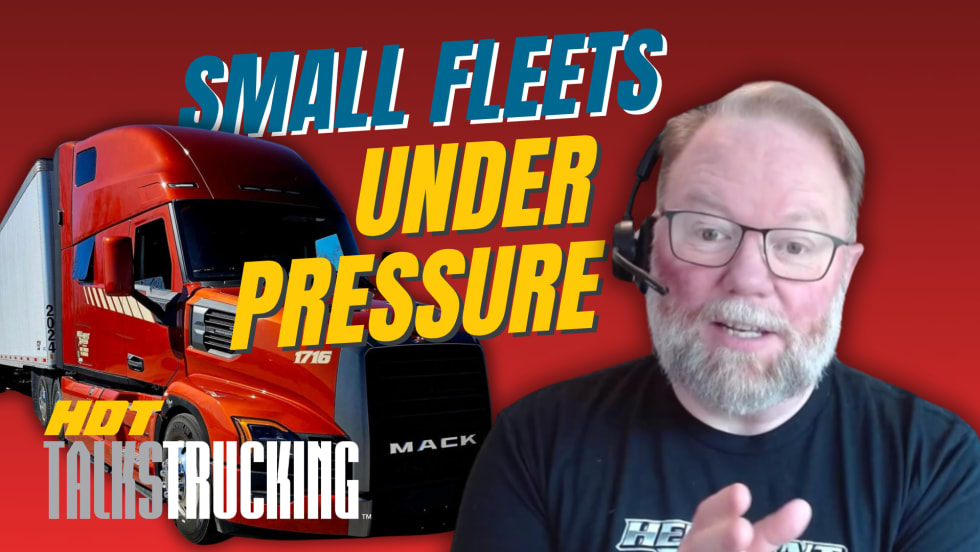
Jamie Hagen Gets Real About Freight, Fuel Prices, Safety, and Small-Fleet Survival
Running a small trucking fleet right now isn’t easy, especially right now. And Jamie Hagen doesn’t sugarcoat it.
Read More →
Data Lock‑In or Integration Lock‑Out?
Data fragmentation is costing dealerships, OEMs, fleets, and upfitters millions. Here’s why interoperability may be the fix the trucking industry needs.
Read More →