Starting this summer, the nearly 200 technicians who work for Inland Truck Parts at its locations in 10 states across the central U.S. will be heading to the Kansas City area to train in a new, dedicated training facility, complete with classroom space for nearly 100 students,
Everyone has time and budget constraints these days, so your plan to create a useful training program have to be realistic. Hands-on training is best, but you might need to look at other alternatives.  |
three service bays and nine rebuilding benches.
The company currently brings techs from various locations to its Kansas City-area headquarters for training classes that may last two or four days, but President and CEO Dave Scheer believes the investment will mean higher-quality training for his drive-in service and component rebuilding techs.
The building itself is a million-dollar investment, not counting the equipment, and the real cost is the trainers, the technician travel and the lost productivity.
"The cost is greater, in my opinion, to not do it," Scheer says.
The training challengeScheer knows that technician training has never been more important than it is today. Independent service providers face more competition from dealer shops than ever. Customers face increasing pressures to keep equipment in tip-top shape to avoid poor scores under the DOT's new Compliance, Safety, Accountability enforcement regime.
If you want to keep up with the dealers, you're going to have to invest in training your technicians. For instance, Worldwide Truck and Equipment, the American Truck Dealers/Heavy Duty Trucking Truck Dealer of the Year, budgets two weeks of training every year for every technician on the payroll.
Another nominee for Truck Dealer of the Year, Omaha Truck Center, built a state-of-the-art training center with older and current engines that can be run on a water dyno. Different breakdowns can be simulated, allowing for hands-on training of diagnostics and repairs. Two full-time trainers focus their efforts on keeping the dealership's staff up to date, and they're in the process of hiring a third.
"This is one of the things that helps us keep technicians," says Trey Mytty, president and CEO. "They get continuous training."
Training for technicians also can make a big difference in your shop's efficiency. We're not talking just in terms of clearing jobs quickly but also about ensuring that those jobs don't come back 500 miles later because the thing wasn't fixed right the first time.
"One thing's for sure," says Bendix veteran Ron Gervais, who now runs his own training company, Freinmeister Group, "is that it is less expensive to provide training than it is to allow an untrained employee to perform a task he or she knows little about."
Pre-training prepWhat form will your technician training take? First, the experts will tell you, decide what you need. Take a look from 30,000 feet and assess your team's strengths and weaknesses. Do you need to improve performance? Specific product knowledge? Maybe a return to the fundamentals?
Really, it's a question of looking at who you're going to be training and working backward. Talk to your technicians. Find out where they feel they're falling short. Many managers do the opposite, looking to see what training is available and blindly assuming it will fit. Start with conceiving the result you want, and only then go shopping.
Inland Truck Parts relies on suppliers for only about 20% of its technician training, Scheer says. The rest it handles itself, with two full-time technical trainers.
At Inland Truck Parts, about 40 classes are being offered this year on topics such as electronics, air conditioning and the newest engine technology and diagnostics. Each technician and his or her supervisor determine what classes to take.
"The single most effective way to train technicians is to understand their needs and design training that meets those needs," says Jeff Moss, learning technology manager at Mack North American Institute (the training arm of Mack Trucks).
One distributor we spoke with (who preferred not to be identified) admits that it has allowed its training program to be dominated by what its suppliers offer rather than determined by what its techs really need. This parts and service provider is in the process of revamping its training, especially important now because the company has, in the past couple of years, expanded the number of systems it services.
Everyone has time and budget constraints these days, so your company's capacity to create a useful training program has to be realistic. Can you afford to send people off-site for a day or two at a time? How many people are you going to be training? Are they spread out geographically or all in one place? If you're looking to buy CD/DVD-based programs, do you buy off-the-shelf material or can you afford to have it custom-designed? Are your techs disciplined enough to handle self-managed online training without a live instructor?
You'll likely find that their needs differ quite a lot from one mechanic to the next. As much as needs differ from one person to another, so will their ability to absorb training in the first place. Language competency and basic literacy will come into play here, too.
"Literacy plays a key role in our approach to training," says Moss. "Beyond reading comprehension, we consider computer literacy and technical literacy essential skill sets for today's service technician."
The questions are endless, really, and choosing the means of training delivery will be as important as decisions on content.
Delivery optionsIt's not feasible for many shops to send their people away for a few days to some distant classroom. Even finding time at home base can be tough. Hands-on classes are being supplemented, and in some cases replaced, by Web-based options.
Bendix, for example, still runs its long-established three-day product schools at various fixed locations throughout the U.S. and Canada (there are 24 of them this year). It also recently introduced on-site product schools to provide customer flexibility and reduced expenses. The company also conducts product-specific training at fleets, dealers, distributors and OEMs.
Another approach is coming.
"We will be introducing a new program through our Web Learning Center," explains John Reid, manager of service, warranty and training at Bendix. "This will allow customers to go to the Bendix website and take specific training modules. Students will be tested as they progress through the module. Once completed and they have passed the test, they will be able to print out a certificate of completion."
Hands-on is bestTraditional training, with a teacher at the front of a classroom, a video being played or slides being shown, is essentially a one-way process without much interaction. There's very often no test at the end, no measurement of a trainee's comprehension. According to the only research we could find, the retention rate using this method is just 20 to 25%.
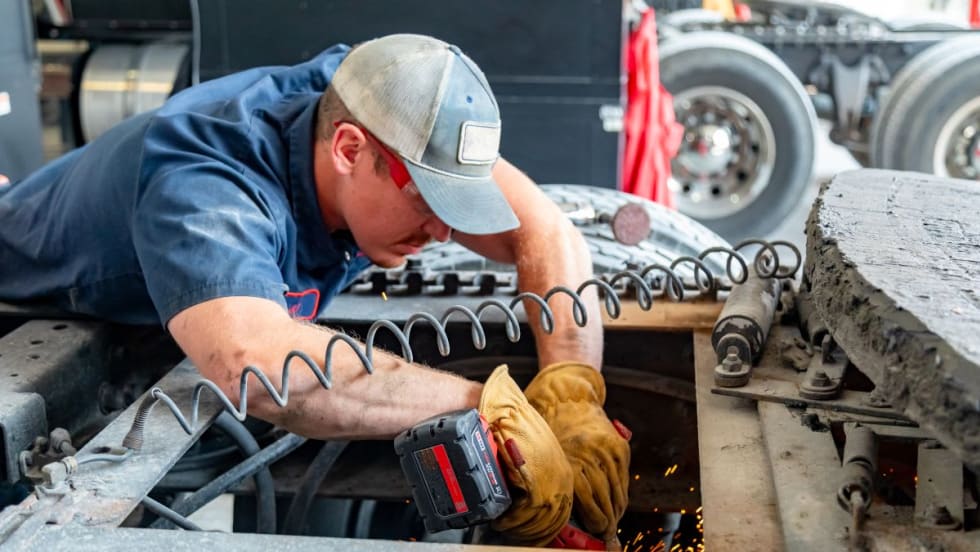
Hands-on interactive workshops are much more effective. Instructor-led, and popular with technicians themselves, they have the advantage of mixing written materials, video demonstration, and participation in tasks such as teardown/rebuild and fault diagnosis, usually with real trucks and components.
Everyone we interviewed for this story agreed that it's the best approach, and retention can be above 80%. That is, if you can gather technicians together in one place, either in your own shop or by sending them to off-site sessions that are often held at local colleges, trade schools and sometimes hotel meeting rooms.
"For our product line, we find classroom training works the best because it gets the technician out of the shop and into a quiet environment that is conducive for learning," says Bendix's Reid.
"Once the classroom training is complete, a trip to the vehicle may help," he adds. However, he notes, "in many cases, we have found that actually conducting training on a vehicle is good fo