




Building Safer Trucks
A driver grabs an exit and heads into the curve of the ramp too fast. He steers hard to try to make the sharpening turn, but his trailer can't follow. Its rear begins flipping and the motion quickly continues forward, pulling over the tractor

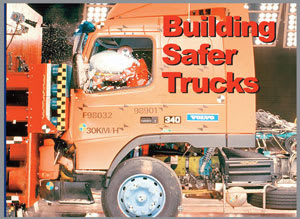
Volvo crash-tests its European and American trucks to meet the Swedish Road Board impact tests, which it says are more stringent than the Euro and SAE tests used by other truck builders. (Photo courtesy of Volvo Trucks)
A driver grabs an exit and heads into the curve of the ramp too fast. He steers hard to try to make the sharpening turn, but his trailer can't follow. Its rear begins flipping and the motion quickly continues forward, pulling over the tractor.
If the driver's buckled in and the cab holds up, he probably survives. Without the belt, though, he's thrown around inside the cab, maybe tossed out a window, and probably badly injured or killed.
Statistics say a rollover is the most deadly type of wreck for truck drivers, and it's very costly, according to a study released by the Federal Motor Vehicle Safety Administration. A property-damage-only rollover crash would cost $196,958, an injury rollover crash would cost $462,470, and a fatal rollover crash would cost $1.14 million. Add traffic delays, damage to the owner's reputation and grief for everyone concerned.
The effects of such an accident, and others, too, can be lessened, or mitigated, through "passive" methods, such as getting drivers to simply wear their seat belts and building strong, crash-resistant cabs. Accidents can be prevented in the first place with "active" means, from constant vigilance by drivers to electronic devices that sense an imminent rollover or collision and apply the brakes to try to stop it. Suppliers say collision-avoidance and anti-rollover products are gaining in popularity.
Crash standards
Cabs of many heavy trucks today are built to comply with one or more standards requiring resistance to crushing. The tests are designed to simulate the forces encountered in actual accidents, especially rollovers, which collapse the upper part of the cab. In the U.S., compliance with such standards is currently voluntary. A buyer could seek a truck that meets a certain standard or stipulate in a request for bids that it does so. However, he cannot spec it as such.
The three standards most followed today are:
- Society of Automotive Engineers J2422, a roof-strength test updated in 2010. It places a 13,000-foot-pound load on the roof of a daycab, which can't collapse more than stipulated amounts. The standard obviously tests the cab's A and B pillars as well as the roof itself. Most domestic truck builders say their latest models comply with SAE J2422, and some exceed it. Volvo, for instance, says it tests to 108,000 foot-pounds.
- European Economic Community R29, a crash standard for commercial trucks and buses. American builders with European ownership, and even those based here, meet this standard with many of their models. For example, Navistar International says it uses high-strength steel in key load-bearing areas such as the A pillars, door hinge pillars, dash panel and rear sill of most cabs. Freightliner, Kenworth, Mack and Volvo take similar steps.
- Swedish Road Board impact test, which bashes upper-front and upper-rear areas with heavy weights to ensure cabs don't cave in. Volvo Trucks must meet the standard with its trucks for Sweden and voluntarily tests American cabs against the standard.
Active avoidance
Surviving crashes is good, but avoiding them is far better. Optional electronic systems actively sense a threat and warn the driver. If he does nothing, they apply brakes to try to prevent a frontal collision or rollover. Bendix and Meritor Wabco sell such systems to builders of trucks, tractors and trailers, and Haldex makes one for semitrailers. Their electronic controls "piggyback" onto a vehicle's existing antilock braking system, which is usually of the same brand. In a combination vehicle, the systems work independently, so no electrical link needs to be established between tractor and trailer(s).
Meritor Wabco's OnGuard and Bendix's Wingman are "collision mitigation" systems. Using radar, they peer ahead through fog, snow, rain, smoke, darkness and just plain clear air to spot obstacles in front of the truck. Eaton's Vorad (for vehicle onboard radar) was the original forward-looking system when it came out in 1994, and it was recently acquired by Bendix. They all give audible and/or visual warnings to the driver, who can then react. If the system has "active braking," it will cut engine power and apply the brakes forcefully enough to stop short of the obstacle, all without the driver touching the pedals.
Devices also can look into a driver's right-side blind spots and warn if something's there, especially if the driver has started changing lanes. Early on, Vorad's sensors saw all kinds of things that registered as threats when they weren't - guardrails along a curving freeway ramp, for example - and beeped, buzzed and flashed lights like Chicken Little. Improved software has reduced this, and drivers and owners have testified to the effectiveness of these devices.
Lane departure warning systems such as AutoVue (previously sold by Iteris, now owned by Bendix) and Takata, now offered by Meritor Wabco, do as their names imply: They warn drivers when they are straying from a travel lane, as determined by the system watching stripes and other cues. The warnings can be lights and buzzers or, more cleverly, the sound of rumble strips broadcast through radio speakers. It is also possible to wire the seat to strip vibrations.
Adaptive cruise control with active braking is a recent innovation. This function is now part of Meritor Wabco's OnGuard and Bendix's Wingman and Wingman Advanced. The devices can cut power and apply brakes when the vehicle is closing in dangerously on another.
Anti-rollover systems are offered by Bendix, Meritor Wabco and Haldex. The systems use accelerometers to sense lateral movement, and some also detect yawing, or the rotation of the vehicle out of a straight path. They tell electronic controls what's happening, and, working with standard ABS electronics, the controls activate the brakes to try to correct the problem.
In the rollover scenario we started with, a system would have intervened when it sensed that lateral forces were building too fast and immediately applied the rig's brakes. It would've done this wheel by wheel to maximize braking power and minimize any tip-over effects, and it would have acted before the driver even realized that he or she was in trouble. (Click here to learn more about rollover stability control and electronic stability control, and the federal government's interest in them.)
Costs worthwhile?
Suppliers and truck builders are reluctant to talk about pricing, but a device might be listed at $2,000 to $4,000. The FMCSA's complex cost-benefit analysis says such spending is more than worthwhile.
"For every dollar spent, carriers get more than a dollar back in benefits that could be quantified for this analysis, ranging from $1.66 to $9.36" based on various factors including operations and purchase prices of safety devices, says a study, "Analysis of Benefits and Costs of Roll Stability Control Systems for the Trucking Industry." The analysis predicts payback times of six to 30 months.
Simple arithmetic shows that avoiding just one expensive rollover could more than pay for the entire cost of equipping a fleet's tractors and trailers. The same is true for frontal collisions.
Such systems are popular with operators of tankers and other vehicles whose wrecks are especially expensive, suppliers say. Regular over-the-road freight carriers are beginning to go for the technology, too, because they see that it's worthwhile, say some truck builders. Buyers of the technology are still a small minority among total vehicle purchases, but the numbers of units are slowly growing. Will you be among them?
From the May 2012 issue of HDT.
More Safety & Compliance
How Waste Connections is Using Data, Telematics, and AI
How do you manage and maintain more than 18,000 connected trucks? Data. Lots of it.
Read More →
Fleet Advantage: Top Logistics Fleets Outperform National Safety Benchmarks
Fleet Advantage's latest TRUST Safety Index found leading logistics fleets maintained significantly lower out-of-service rates and stronger safety scores than national averages, while highlighting persistent challenges related to tires, brakes, and unsafe driving behaviors.
Read More →
Why Fleet Data Matters More Than Ever at Waste Connections [Watch]
Waste Connections' Chuck Palmer explains how telematics, predictive maintenance, safety analytics, and AI help keep vehicles on the road and drivers safe in this episode of HDT Talks Trucking.
Read More →
Short Takes: How K&B is Using AI
Fleets need to "get on board the train" with AI, says Lance Evans of K&B Transportation in this HDT Talks Trucking Short Takes episode.
Read More →
Short Takes: Inside K&B’s Truck Safety Tech
Listen to learn how K&B Transportation uses cellphone-blocking technology, speed management systems, weather geofencing, bridge avoidance tools, and more to improve driver safety.
Read More →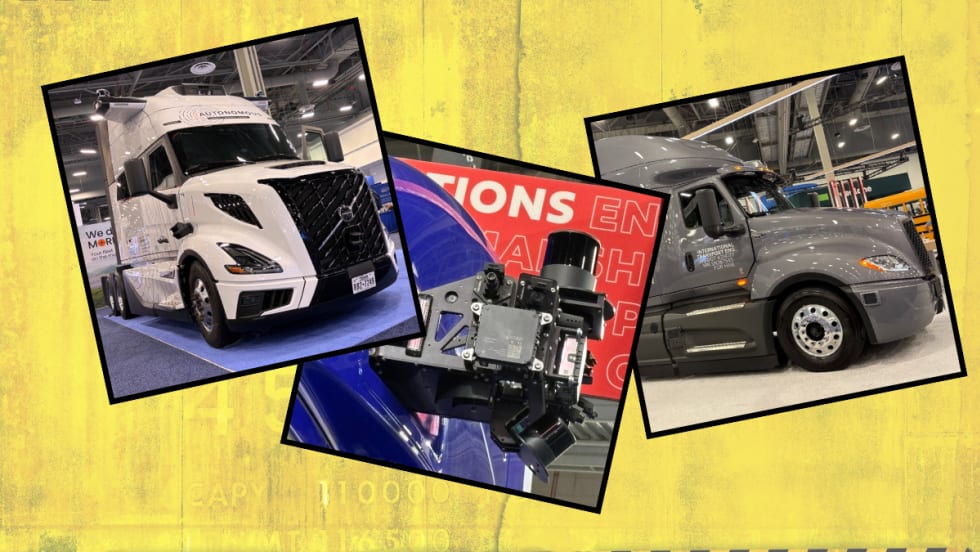
The Biggest Gap in Driverless Trucking Isn’t Tech. It’s Safety Validation
Nauto’s Stefan Heck says autonomous trucks are advancing quickly but proving they’re safe enough for large-scale deployment may be the industry’s hardest challenge.
Read More →
Truck Crash Rates Are Down. So Why Do Insurance Costs Keep Rising?
ATRI’s latest research points to litigation, social inflation, and soaring claims costs as key drivers behind record-high liability premiums for trucking fleets. But there are things motor carriers can do.
Read More →
FMCSA Removes More Than a Dozen ELDs from Registered List
The FMCSA continues its efforts to fight electronic logging devices that don't meet federal requirements, removing more than a dozen from the registered ELD list in May.
Read More →
How the Supreme Court Broker Liability Ruling Could Reshape Trucking’s Safety Landscape
The Supreme Court’s May 11 broker-liability ruling may not radically rewrite transportation law overnight. But industry experts say it will intensify pressure on brokers, carriers, and shippers to prove they are prioritizing safety.
Read More →
Recall of Fontaine Fusion Flatbeds Warns Owners Not to Use the Trailers
Some Fontaine Fusion flatbed trailer manufactured between February 2025, and March 2026 could have mainbeams weakened by hydrogen embrittlement because of a problem in the galvanizing process.
Read More →