




The Purpose of the Emergency Response Guidebook
Many shippers and transporters of hazardous materials are familiar with the small orange Emergency Response Guidebook. Most associate the ERG with compliance with the Hazardous Materials Regulations (49 CFR), using it to provide emergency response information for a hazardous materials shipment. Yet that is not why the ERG was created
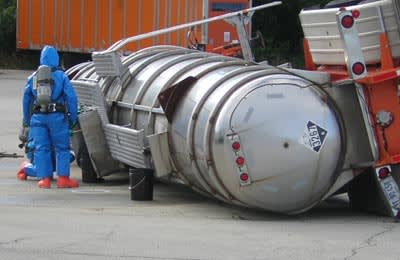
The scenario was part of a Schneider National exercise for hazardous materials responders, but in real life, many carriers keep a current Emergency Guidebook in their trucks to comply with hazmat regulations.
Many shippers and transporters of hazardous materials are familiar with the small orange Emergency Response Guidebook. Most associate the ERG with compliance with the Hazardous Materials Regulations (49 CFR), using it to provide emergency response information for a hazardous materials shipment. Yet that is not why the ERG was created.
The Emergency Response Guidebook originally was developed by the U.S. Department of Transportation, Transport Canada and the Secretariat of Transport and Communications of Mexico for use by police, firefighters and other emergency personnel who are the first to arrive at the scene of a transportation incident involving hazardous materials/dangerous goods. The ERG helps first responders quickly identify the hazard(s) of the materials and protect themselves and the general public during the initial response phase of an incident.
The "initial response phase" is the period following the first responders' arrival at the scene, during which the presence and/or identification of hazardous materials is confirmed, protective actions and area securement are initiated, and assistance of qualified personnel is requested.
The DOT distributes copies of the ERG to emergency responders throughout the U.S. The goal is to have one available to every emergency responder in the country. Occupational Safety and Health Administration and Environmental Protection Agency regulations require that first responders be trained on the use of the ERG.
To increase the likelihood that emergency response information will be available to first responders at the scene of a hazardous materials incident, the Hazardous Materials Regulations require that emergency response information accompany most shipments of hazardous materials. (Emergency response information is not required for hazardous materials that do not require shipping papers or are classified as an ORM-D.)
The emergency response information can be provided in several ways:
- It can be entered on the hazmat shipping papers; or
- It can be provided in another document, other than the shipping paper, that includes the basic description (and technical name if appropriate) of the hazardous material. A Material Safety Data Sheet is an example of this type of document; or
- It can be provided in a separate document, other than the shipping paper, that cross-references the description of the hazardous material on the shipping paper with the emergency response information contained in the document. The ERG is an example of this type of document.
Carriers that transport hazardous materials must maintain the emergency response information the same as they do shipping papers. The emergency response information must be readily available to, and recognizable by, authorities in the event of an incident or inspection.
Although not the original intended use for the ERG, keeping an ERG with the hazmat shipping papers is an easy way to comply with the emergency response information requirements in the Hazardous Materials Regulations. Many carriers play it safe and carry an ERG in their vehicles to cover any hazmat load/situation they may encounter.
The ERG is updated and issued every four years by DOT's Pipeline and Hazardous Materials Safety Administration. The next edition, the 2012 ERG, is anticipated to be released in early 2012. Anyone who works with hazardous materials will want the new 2012 ERG to be sure they have the latest emergency response information.
Thomas Ziebell is a senior editor, Hazardous Materials Transportation for J.J. Keller & Associates.
From the December 2011 issue of HDT.
More Safety & Compliance

How Waste Connections is Using Data, Telematics, and AI
How do you manage and maintain more than 18,000 connected trucks? Data. Lots of it.
Read More →
Fleet Advantage: Top Logistics Fleets Outperform National Safety Benchmarks
Fleet Advantage's latest TRUST Safety Index found leading logistics fleets maintained significantly lower out-of-service rates and stronger safety scores than national averages, while highlighting persistent challenges related to tires, brakes, and unsafe driving behaviors.
Read More →
Why Fleet Data Matters More Than Ever at Waste Connections [Watch]
Waste Connections' Chuck Palmer explains how telematics, predictive maintenance, safety analytics, and AI help keep vehicles on the road and drivers safe in this episode of HDT Talks Trucking.
Read More →
Short Takes: How K&B is Using AI
Fleets need to "get on board the train" with AI, says Lance Evans of K&B Transportation in this HDT Talks Trucking Short Takes episode.
Read More →
Short Takes: Inside K&B’s Truck Safety Tech
Listen to learn how K&B Transportation uses cellphone-blocking technology, speed management systems, weather geofencing, bridge avoidance tools, and more to improve driver safety.
Read More →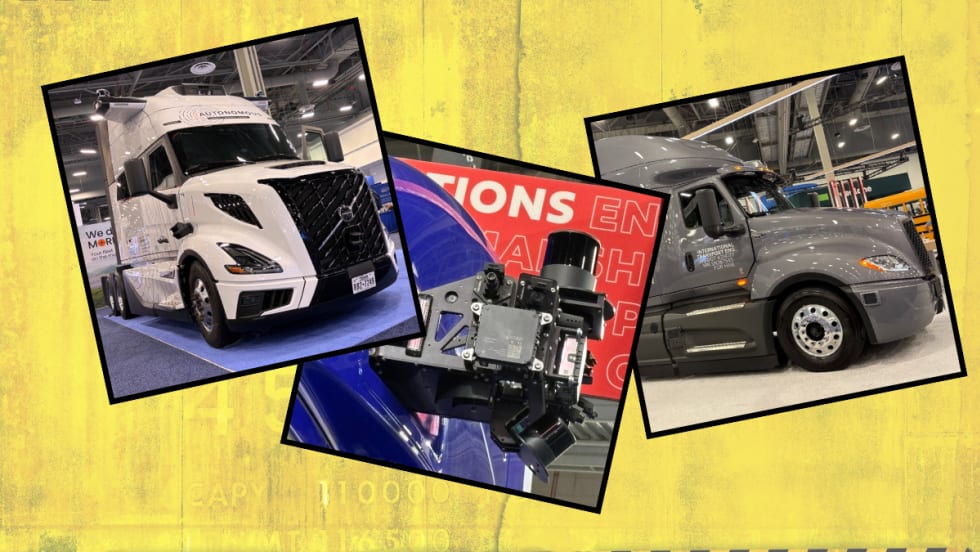
The Biggest Gap in Driverless Trucking Isn’t Tech. It’s Safety Validation
Nauto’s Stefan Heck says autonomous trucks are advancing quickly but proving they’re safe enough for large-scale deployment may be the industry’s hardest challenge.
Read More →
Truck Crash Rates Are Down. So Why Do Insurance Costs Keep Rising?
ATRI’s latest research points to litigation, social inflation, and soaring claims costs as key drivers behind record-high liability premiums for trucking fleets. But there are things motor carriers can do.
Read More →
FMCSA Removes More Than a Dozen ELDs from Registered List
The FMCSA continues its efforts to fight electronic logging devices that don't meet federal requirements, removing more than a dozen from the registered ELD list in May.
Read More →
How the Supreme Court Broker Liability Ruling Could Reshape Trucking’s Safety Landscape
The Supreme Court’s May 11 broker-liability ruling may not radically rewrite transportation law overnight. But industry experts say it will intensify pressure on brokers, carriers, and shippers to prove they are prioritizing safety.
Read More →
Recall of Fontaine Fusion Flatbeds Warns Owners Not to Use the Trailers
Some Fontaine Fusion flatbed trailer manufactured between February 2025, and March 2026 could have mainbeams weakened by hydrogen embrittlement because of a problem in the galvanizing process.
Read More →