




Test Drive: MaxxForce 15 for the Big Hills
When Navistar execs turned the key on one of the first MaxxForce 15 engines at the 2009 Mid-America Trucking Show, there were more than a few doubting Thomases in the audience

The MaxxForce 15's engine brake is based on a retarder used by Cat for off-highway applications, and modified to deliver more on-highway braking power.
Photo: Heavy Duty Trucking
When Navistar execs turned the key on one of the first MaxxForce 15 engines at the 2009 Mid-America Trucking Show, there were more than a few doubting Thomases in the audience.
Today, just 27 months later, the MaxxForce 15 is up and running and on the order books. It's slated for full production by the end of this summer.
Although several engine makers, including Navistar International, have been boosting 13 liters as the desired size for most Class 8 trucks, Navistar's delisting of the Cummins ISX15 in 2010 left it a couple of liters short of some customers' demands. There's obvious need for a 15-liter engine in some heavy-haul and severe-service applications. But there's still demand in the over-the-road segment, too.
"Some customers just sleep better at night having 15-liter power in the fleet," said Tim Shick, Navistar's director of business and product strategy. "There's demand for the larger engines, and we believe the 15-liter market will continue growing even after 2014."
In May, Navistar hosted an event in Tooele, Utah, for its dealer network along with a few choice customers, called Heavy Duty Boot Camp. There, participants got a close look at the new engine, and everyone had a chance to drive one. Most were limited to a few laps around a closed track at the Miller Motorsports Park, but I took a 2011 ProStar+ with a fully loaded trailer out for a spin around Salt Lake City, including a trip through Parley's Canyon - a 9-mile hill on Interstate 80 east of the city.
The MaxxForce 15 uses the same Advanced Exhaust Gas Recirculation emission strategy as the 12.4-liter MaxxForce 13, along with similar air and fuel management. The double turbocharging arrangement with interstage cooling is basically the same, as are the EGR cooler and valve, and certain other parts. The high-pressure fuel pumps are different as they rotate in opposite directions, and the fuel injectors have different spray patterns.
That the bottom end of the MaxxForce 15 is based on Caterpillar's C15 is common knowledge. The MaxxForce 15 uses the C15's block, oil pan, crankshaft, and a few other parts. Pistons are Navistar's, with a different bowl shape tailored to its emissions strategy. The front end of the engine has been redesigned so the high-pressure common-rail pump could be driven off the front gear train (Cat ran its unit injectors off the camshaft). The cam has also been redesigned for improved retarder performance.
The decision to use the Cat bottom end was a matter timing and availability, explained Titus Iwaszkiewicz, Navistar's general manager of powertrain product development.
"That option was the best combination of proven hardware, program timing compatibility, and capability to accept MaxxForce performance and emissions technology," he said. "Navistar has paid Cat a royalty to use their parts, but Navistar has either re-sourced the Cat design or works directly with Cat suppliers."
As Caterpillar acknowledges, the CT15 engine in its new vocational truck is the MaxxForce 15, plus some potential new ratings and yellow paint.
Iwaszkiewicz explains some of the engine's features in this video:
Air management
Navistar says a key part of its emissions-reduction strategy is precise control of intake air pressure, flow rates and temperatures. Its engines use a complex process called "regulated series sequential turbocharging" to manage air flow, while a water-cooled interstage cooler controls air temperatures.
A regulator valve between the two turbos - the first a high-pressure, low-mass-flow design, and the second a low-pressure, high-mass-flow unit - sends air from one turbo or the other, or both simultaneously, into the engine. At high speed, the larger turbo does most of the work. At low engine speed, the smaller one works harder. Both are always engaged so there's no "cliff event" when air flow is switched from one turbo to the other. Both turbos are wastegated for better pressure control and to guard against a blowout.
Electronic controls modulate air flow and manifold pressures based on engine speed and power demand. As a result, the intake manifold pressure, or turbo boost, runs rather flat. Drivers looking to manage fuel economy by limiting boost pressure would find the task difficult with this setup, as the electronic control module does most of that work.
"You move the throttle pedal a certain amount for a certain road speed and you hold it there," Iwaszkiewicz said. "The ECM senses power demand based on pedal position and fuels the engine as efficiently as possible. These engines run best at low rpm - near peak torque - so the driver should keep the truck in as high a gear as possible at the lowest rpm within the torque range for the best power and best fuel efficiency."
The interstage cooler is not just a cooler, but a heater, too, Shick explained. A valve regulates coolant flow through the interstage cooler to optimize intake air temperature and density, and ultimately, combustion temperature and efficiency. That results in fewer regen events.
There are actually two radiators in the Advanced EGR system. The main engine cooling system runs at about 200 degrees, and an intake-air radiator runs at 100 to 110 degrees. The second radiator also rejects heat from the EGR cooler, taking a load off the main cooling loop. There's still an air-to-air (charge-air) cooler for inlet air.
Whoa power
The MaxxForce 15's engine brake is based on a retarder used by Cat for off-highway applications, and modified to deliver more on-highway braking power, Iwaszkiewicz said. The C15's camshaft is robust, so Navistar engineers could put a steep ramp angle on its exhaust lobes. This opens exhaust valves wide, and very quickly, to provide maximum retarding power.
"We use the turbos to build maximum boost pressure in the intake system, and then pop open the exhaust valve at the very top of the compression stroke, building maximum compression in the cylinder, and releasing it very fast so there's very little energy left in the cylinder for the downstroke," Iwaszkiewicz said.
The MaxxForce 15 is rated at 580 retarding horsepower at 2,000 rpm, and still produces 480 horsepower at a much lower 1,400 rpm, which is where an engine operates at highway cruise speed. By comparison, a 15-liter ISX makes 600 retarding horsepower at 2,000 rpm but 380 at 1,500, Shick said.
"People don't run their engines at 2,000 rpm. They run them at 1,400. We concentrated on getting the most out of the engine brake at the speeds people use them at," he explained. But "to get the full benefit of our engine brake, all a driver needs do is drop a gear and run the engine at or close to 2,000 rpm."
Odds and ends
The MaxxForce 15 is quiet, although like the C15, some geartrain noise was evident. It uses multiple injections to smooth the combustion event, which also promotes more complete burning of the fuel and makes less soot. The double blessing here is that less soot winds up in the diesel particulate filter or in the oil pan. The engine has a 40,000-mile oil change interval, and a 400,000-mile DPF cleaning interval.
As for weight, the engine is heavy at 3,209 pounds. But add weight from competitors' selective catalytic reduction components, and Navistar's 15-liter engine is actually lighter, Navistar claims. All the MaxxForce 15's weight sits on the steer axle, while some of an SCR system's weight placement is on the drive axles.
Our test truck scaled 12,240 pounds on the steer and 33,740 on the drives, for a gross weight of 45,980.
More Equipment
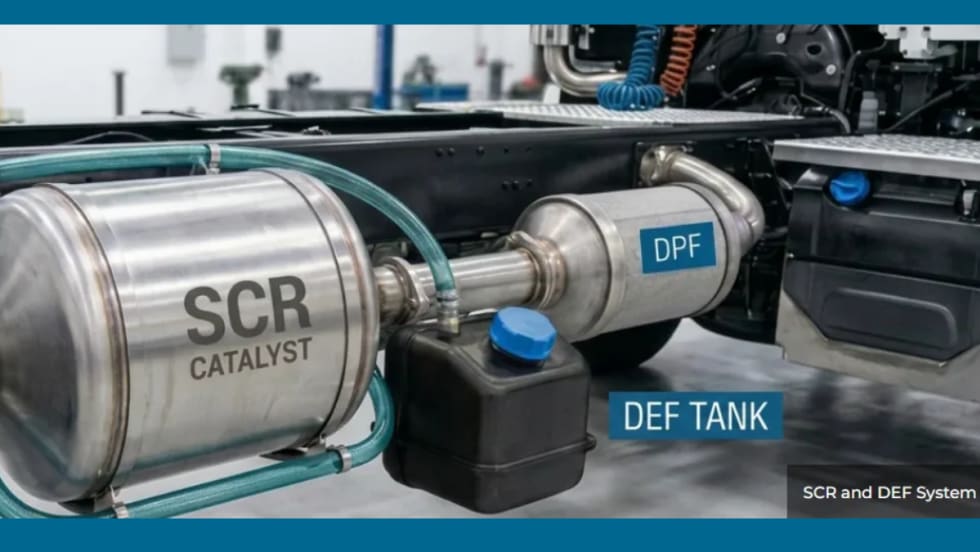
Engine Technology Forum Launches SCR, DEF Resource Center Amid Emissions Debate
The Engine Technology Forum’s new online hub aims to provide fleets, policymakers, and equipment owners with fact-based information about selective catalytic reduction technology, diesel exhaust fluid and emissions compliance.
Read More →
Prime Inc. to Open $7.9M Flagship Used-Truck Dealership
A new driver-focused facility to sell Prime Inc's used trucks and trailers will be the first purpose-built location in the company's history.
Read More →
Lessons Learned About Alternative Fuels: Start Small, Stay Flexible
Practical advice on adopting alternative fuels and ZEVs from HDT's 2026 Top Green Fleets, from renewable diesel and natural gas to electric trucks.
Read More →
Kenworth Names Peter Ahrens General Manager
Leadership changes at Kenworth take effect July 1 as the OEM promotes two longtime Paccar executives to key management roles.
Read More →
Hino Adds Electric Class 6/7 Truck
Hino says the Le Series is an important step in the company's efforts to reduce environmental impact and support its customers’ sustainability goals.
Read More →
ACT Expo 2026: Highlights in Photos
The 2026 Advanced Clean Transportation Expo featured a broad range of commercial vehicle technologies, from EVs to autonomous trucks to the latest diesel and alternative-fuel engines.
Read More →
Hendrickson Debuts Electraax E-Axle for Medium-Duty Trucks
Developed with Driventic, Hendrickson's new integrated e-axle is designed to improve efficiency, reduce weight, and extend range in Class 6-7 EV applications.
Read More →
Peterbilt Unveils Freedom 250 Special Edition Model 589
Peterbilt’s just-announced limited-run patriotic Model 579 tractor celebrates America’s 250th birthday with custom styling and premium features.
Read More →
Mack Unveils EPA 2027-Compliant MP13 Engine With More Power, Better Fuel Economy
Along with unveiling its EPA 2027-compliant MP13 engine, Mack outlined powertrain changes across its Class 6-8 lineup, including new Cummins-based X10 engines.
Read More →
Kodiak and Roehl Transport Launch Autonomous Route Between Dallas and Houston
Kodiak AI and Roehl Transport have begun autonomous freight operations on a regular Dallas-Houston route, marking another step toward Kodiak’s planned driverless launch by the end of 2026.
Read More →