




Research Shows Oil Viscosity Affects Fuel Economy
You could save as much as 1 percent on your fuel economy simply by switching from a 15W-40 engine oil to a 10W-30 engine oil, according to new research from Chevron Oronite

You could save as much as 1 percent on your fuel economy simply by switching from a 15W-40 engine oil to a 10W-30 engine oil, according to new research from Chevron Oronite.
A research paper, titled "The Lubricant Contribution to Improved Fuel Economy in Heavy Duty Diesel Engines," will be presented by Chevron Oronite engineers during the Society of Automotive Engineers' Commercial Vehicle Engineering Congress and Exhibition in Rosemont, Ill., Oct. 6-7.
The testing
Chevron installed equipment to conduct fuel economy testing using the Volvo D12D Fuel Economy Test, a lab-based test used in Europe, in its lab in Rotterdam in The Netherlands. This kind of testing allows researchers to precisely load the engine and run it under prescribed conditions the computer controls.
"Many of the OEMs have internal fuel economy tests, but most are not willing to release theirs because they are viewed as a competitive advantage," explains Gary Parsons, global OEM and industry liaison manager, Chevron Oronite.
The testing used a 15W-30 as a reference oil. The results were "weighted" with factors to represent hilly conditions or flat conditions.
In flat conditions, where obviously you would get the best fuel economy no matter what the oil, a 15W-40 oil performed nearly 0.8 percent worse than the base 15W-30. The 10W-30 performed nearly 0.2 percent better than the 15W-30. That's close to a 1 percent difference between the 15W-40 and the 10W-30.
"Based on our tests, we believe that SAE 10W-30 is a better choice than SAE 5W-40 for cost/performance," Parsons says. "Of course, all of the OEMs are concerned about any potential trade-off between engine durability and fuel economy. In other words, they don't want to recommend engine oil that may provide fuel economy benefits, but result in less durability. Much of our testing is focused on evaluating both aspects."
Why Lower Viscosity Saves Fuel
The oil pump in the engine basically sucks the oil out of the oil pan, and it pumps that oil and circulates it around in your engine to lubricate it - much like your heart pumps to circulate the blood in your body. The thicker that oil is, the more energy it takes to pump that oil, which uses fuel.
Just like people may take blood thinner to make it easier on their heart to pump it, it's the same with engine oil.
So why not go even lower? Why not a 5W-30?
The engine oils still has to be thick enough, to offer enough protection, to keep the parts from coming into contact with each other, to prevent wear. So you can't necessarily just keep going thinner and thinner without formulating the oil and additives to keep the durability up.
In a multigrade engine oil rating, the first number, like the 10W or 15W, is an indication of how thick the engine is under low temperature conditions. The second number, the 30 or 40, is how the engine behaves at about 210 degrees, at full operating temperature.
Most heavy-duty trucks and even midrange trucks operate much of the time at full operating temperature, Parsons explains. "So the difference between an XW-30 and a XW-40, you see a fuel economy different more related to the 30 vs. the 40 rather than the 10W vs. the 15W."
"A lot of people have 5W-40 synthetic heavy-duty motor oils out there, and they are used in low temperature conditions. Some people do see fuel economy benefits, particularly in pickup and delivery applications or other applications where the engine doesn't always reach operating temp, or there are a lot of cold starts."
While the 5W-30 performed even better in Chevron's test, at close to 0.4 percent over the base 15W-30 oil, vehicle operators may be hesitant to make such a dramatic change in viscosity grade from today's SAE 15W-40. In the case of 5W-40 weight oils, they require the use of synthetic base oils, raising the cost. 10W-30s do not, Parsons notes.
Durability
Many truckers in this country are skeptical of lower-viscosity engine oils, believing they won't offer enough protection.
However, lower-viscosity oils for heavy-duty engines are being adopted in other parts of the world. In Europe today the most popular grade for heavy-duty engine oil is 10W-40 and they are moving to 5W-30 in many cases. Parsons says, particularly in winter operations.
Part of the reason you can used lower-viscosity oils today than you could in the past is that the precision and the tolerances in the engine hardware itself is much better today. Parsons points out that today's engines are produced with high-tech machining practices that create surfaces with fewer microscopic peaks and valleys - more mirror-like.
The Future of Fuel Economy
Parsons also points out that there is a very strong likelihood that truck fuel economy standards will be coming in the next four to five years as part of government efforts to reduce greenhouse gas emissions.
"The last 10 or 15 years, the focus has been on reducing NOx and particulate emissions, which we've all done an incredible job on," Parsons says. "For 2010, those emissions are almost taken to zero. Now the focus will shift back to fuel economy."
More Fuel Smarts

Electric Yard Tractors Move Beyond Pilots
Operating-cost savings have overtaken sustainability goals as the leading reason surveyed fleets are adopting battery-electric terminal tractors, according to new NACFE research.
Read More →
Geotab Links Fleet Card to Vehicle Data
The new card combines fuel discounts with telematics-based purchase controls. Geotab’s analysis also points to potential savings from choosing lower-priced fuel stops.
Read More →
Fleet Economics Shape Electric Truck Outlook
ACT Research expects costs, charging infrastructure, and technology improvements to drive zero-emission commercial vehicle adoption as federal regulations and incentives retreat.
Read More →
Wex Adds Cardless Fuel Payments for Over-the-Road Customers
A new fuel card feature for Wex customers offers convenience and security.
Read More →
New California Law Could Shed Light on Electric Truck Prices
Why do battery-electric Class 8 trucks remain so expensive? A California bill signed by Gov. Gavin Newsom would give fleets and state agencies more visibility into what manufacturers charge.
Read More →
How Volvo Updated Its D13 for EPA 2027 [Watch]
Volvo’s updated D13 promises lower emissions without sacrificing performance or fuel economy. Take a closer look at what changed inside the engine in this HDT Spotlight video.
Read More →
Diesel Price Spike Shortens Payback for Natural Gas Trucks, Report Says
Energy Vision estimates fleets could recover the higher purchase price of an RNG-fueled Class 8 tractor in 1.3 to 2.8 years under current fuel-price scenarios.
Read More →
Calstart Becomes Catalyst Mobility, Reflecting Broader Focus
Calstart is now Catalyst Mobility, reflecting the nonprofit’s growing national role in clean transportation, including zero-emission trucks, infrastructure and incentive programs.
Read More →
Record Diesel Prices Squeeze Trucking Fleets
Average U.S. diesel prices have climbed to nearly $6 a gallon, surpassing the 2022 record as tight refinery capacity and Middle East disruptions keep fuel costs elevated.
Read More →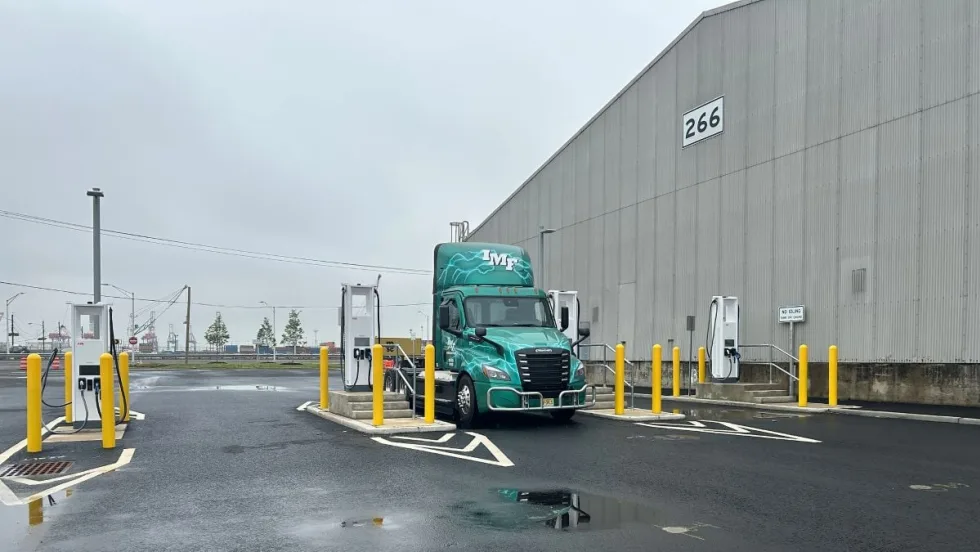
East Coast Port Launches $45M Electric Truck Push
The Port Authority of New York and New Jersey announced millions in incentives for zero-emission drayage trucks, yard tractors, and new charging hubs near the port.
Read More →