




Sterling 360 Scoots Through Circles
There's a funny story about the Sterling 360's name. In a short bull session following a press conference last year, a couple of Sterling executives related that they considered calling the truck "AC 360," as in a circular 360 degrees, because the truck is "better all around," which became its marketing slogan.

There's a funny story about the Sterling 360's name. In a short bull session following a press conference last year, a couple of Sterling executives related that they considered calling the truck "AC 360," as in a circular 360 degrees, because the truck is "better all around," which became its marketing slogan.
I don't recall what AC would've meant, but they decided on just "360" - and soon learned of the then-new CNN program, "Anderson Cooper 360." Whew, that was close. But who knows, maybe this would've become the news commentator's official ride, kind of like Arnold Schwarzenegger's Hummer.
This 360 is Sterling's version of Mitsubishi Fuso's made-in-Japan FE145, a Class 4 low-cab-forward vehicle rated at 14,500 pounds (there are also lighter and heavier models sold under both nameplates). They compete in a crowded segment dominated by domestic conventionals.
The 360 is in the Sterling lineup because execs wanted to provide dealers with something to sell besides its medium- and heavy-duty conventionals. Sterling gets the 360 from Fuso because it's a sister company through their common ownership by Daimler AG of Germany.
The 360 is a slick and nimble truck that deserves more sales than it gets, and that goes for all imported and domestic low-cabovers sold here. Execs at all the importers thought that a recent entry into the market by Ford and International, with their jointly built (in Mexico) LCF and CityStar, would boost interest in LCFs, but it hasn't happened. Most buyers still prefer conventionals.
This particular truck was on the lot at Valley Freightliner-Sterling-Western Star in Cleveland, Ohio. Susan Gallik, an exec at Sterling's PR agency in Cleveland, arranged with salesman Andy O'Donnell to let me drive it. This was on a cloudy, chilly day, and the first thing I can say is that the 360's heater worked fine.
As to work applications, O'Donnell said he had just sold a couple of 360s with dump bodies to a local park district. People there like the trucks because they're compact and easy to run on sidewalks and maneuver around buildings and other obstacles.
That's not to say that these trucks are small. Low cabovers sometimes look little in photos and even in person - until you walk up to one. Then you find that the cabs are wide and their beefy frames easily tote full-size bodies. Compactness comes primarily from the no-nose design; all those BBC inches that would be taken up by a conventional's hood, fenders and everything underneath becomes payload space on an LCF's chassis.
Put another way, a cabover provides several feet more room for a body and load in any given overall length than any comparable conventional. And the LCF's wheelbase will be shorter, aiding maneuverability.
The cab tilts up to reveal the engine, and a mechanic can just step around a front wheel and do his service and repair work while standing there. It sure beats crawling under a truck or leaning under the hood of a typical midrange conventional. The 360's cab tilts easily; just pop the lock behind the cab, grab hold of the body and raise it. It can almost be done with one hand, and the lift mechanism locks in place so wind won't push it back down.
The engine is a Fuso 4M50, a 4.9-liter (299-cubic-inch) four-cylinder turbodiesel running through an Aisin 6-speed automatic transmission. The engine makes up to 175 horsepower (Fuso advertises it as 185) and 391 pounds-feet of torque. It's more than enough for city duties, and should easily keep up with normal stop-and-go traffic. On the freeway it begins running out of steam at about 65 mph; it'll do 70 or more, but has to work harder at it than big-cubic-inch domestic I-6 or V-8 diesels, which is no surprise.
Economy with an I-4 should be better, and Sterling claims that testing against a competitive four-cylinder LCF showed the Sterling is 19 percent more economical. But as they say, "Your results may vary."
After I'd snapped some photos, I observed that "360" implied a compass' full 360 degrees, and I made Gallik and O'Donnell wait outside in the cold while I spun the truck in a circle - two or three of 'em, actually - in a wide driveway. I didn't put a tape on the resulting tire tracks, but the circle's radius was really tight (any dimension will depend on a truck's wheel cut and wheelbase). A low cabover gives you the feeling that you can turn so sharp that you'll T-bone yourself if you're not careful. That might almost be true if we had been pulling a trailer.
As it was, the 14-foot American stakeside body was all that was behind the cab. The body was interesting in itself, constructed partly of composite plastics that should last almost forever. Its floor was smooth-surfaced plastic that hadn't yet been blemished with a load. Because the body was empty, I couldn't make a judgment on the truck's behavior under load.
The roomy cab, though, was full, as the three of us all piled in for a jaunt through the neighborhood, and we each had plenty of sitting and leg space. Gallik, a tall lady, was in the middle seat but had plenty of legroom because the dash-mounted transmission selector leaves the flat floor completely clear. The cab is so wide that there's room for a "stuff" tray just to the driver's right, and the driver's seat has a fold-down arm rest. On each door is a raised horizontal bar that acts as an arm rest, at least when the window's down.
Power windows and door locks are standard, as is a tilt-telescoping steering column. Interiors are attractively trimmed with comfortable two-tone cloth-faced seats and easy-to-use gauges and controls that are pretty much straight from the Fuso FE. Sterling says it has packaged certain features and pre-engineered the chassis for various vocations, so ordering is simple. Most FE and 360 cab exteriors are painted a rather common white, as this one was, but you can also get more daring red, green, blue, silver and black.
Entry into a low-cab-forward truck takes a little practice, but is pretty easy on this one due to its setback steer axle and the wide step ahead of it. That step is less than a foot from the pavement, and doors are claimed to be the widest in the LCF segment, so the first part of the climb isn't bad. Then you just slide sideways onto the seat. In getting out, you can just turn to the left (or right if you're the passenger) and hop down.
I'm describing all this because most Americans have never been in a cabover. Conventionals - many of them based on the domestic Big Three's pickups - still take about 80 percent of the midrange commercial truck market because they are very competent in their own right, they usually cost less than a cabover, and are thought to be safer and better riding.
Cabovers can have a good ride, even with the steer axle right under the driver and passengers, because the springs are long and compliant. So the ride is bus-like, with a lot of vertical motion when going over bumps and through potholes. The streets we traversed on Cleveland's south side had a lot of broken and bowed concrete - typical for an old city in a cold climate - and those springs got a good workout. The ride was sometimes bouncy, but it wouldn't have been much better - only different - in a conventional. On smooth freeway pavement the 360 rode fine.
More Fleet Management

AUCTION OF EQUITY INTEREST IN HEAVY HAUL TRUCKING COMPANY!!
Mark your calendar: June 30, 2026 (10:00 a.m. PDT). MagnaTrans, LLC, a California limited liability company doing business as Magna Transportation Group is going to auction! Bid on a 37.5% ownership interest in this Rancho Cucamonga-based heavy haul and over-dimensional trucking company operating across California, Oregon, and Arizona. The equity interest will be sold to the highest bidder or bidders under Article 9 of the Uniform Commercial Code at 10:00 a.m. PDT.
Read More →
Volvo Trucks Adds Unattended Over-the-Air Software Update Capabilities
The latest evolution of Volvo’s over-the-air update technology allows software updates to run while trucks are parked, helping fleets keep vehicles current without disrupting operations.
Read More →
How Waste Connections is Using Data, Telematics, and AI
How do you manage and maintain more than 18,000 connected trucks? Data. Lots of it.
Read More →
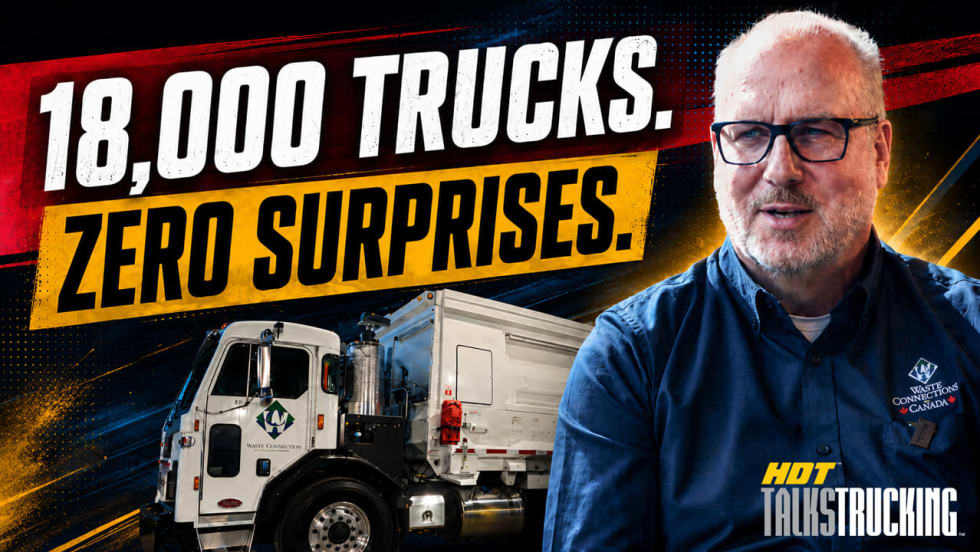
Why Fleet Data Matters More Than Ever at Waste Connections [Watch]
Waste Connections' Chuck Palmer explains how telematics, predictive maintenance, safety analytics, and AI help keep vehicles on the road and drivers safe in this episode of HDT Talks Trucking.
Read More →
NMFTA Launches Free, Anonymous Cybersecurity Threat Report Portal
Organizations are encouraged to anonymously report freight fraud, cargo crime, and cyber threats while gaining visibility into incidents reported across the transportation sector.
Read More →
AI Can Optimize a Fleet. Can It Replace Human Judgment?
Fleets fear falling behind if they don’t adopt AI quickly enough. They also fear what happens if the technology makes the wrong decision.
Read More →
Jamie Hagen Gets Real About Running a Small Fleet in an Uncertain Economy
Small fleet owner Jamie Hagen says new legal risks, volatile fuel prices, and a changing freight market are forcing small carriers to rethink how they operate — and what they can afford.
Read More →
Jamie Hagen Gets Real About Freight, Fuel Prices, Safety, and Small-Fleet Survival
Running a small trucking fleet right now isn’t easy, especially right now. And Jamie Hagen doesn’t sugarcoat it.
Read More →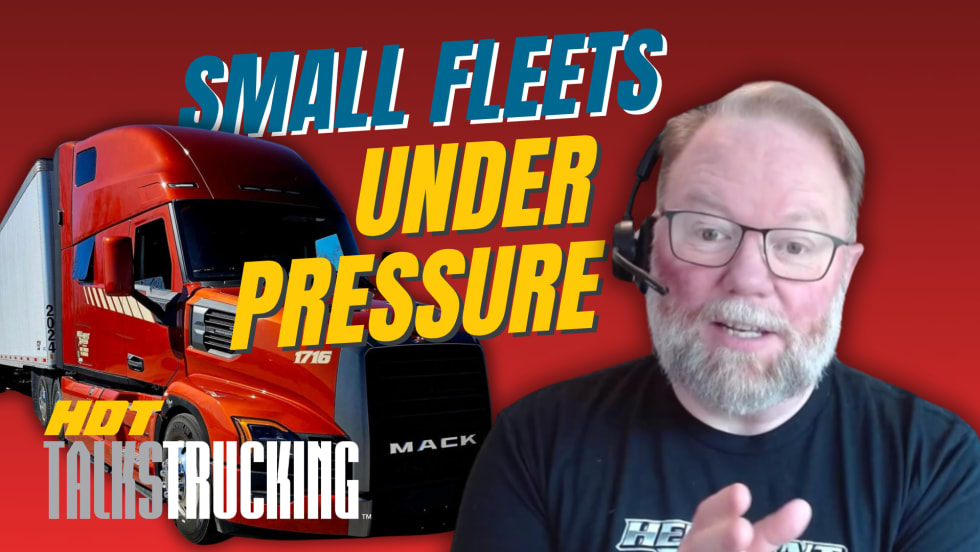
Jamie Hagen Gets Real About Freight, Fuel Prices, Safety, and Small-Fleet Survival
Running a small trucking fleet right now isn’t easy, especially right now. And Jamie Hagen doesn’t sugarcoat it.
Read More →
Data Lock‑In or Integration Lock‑Out?
Data fragmentation is costing dealerships, OEMs, fleets, and upfitters millions. Here’s why interoperability may be the fix the trucking industry needs.
Read More →