





Need another reason to sweat your tire pressure? How about CSA? It would be hell explaining to your grandkids that you used to run a trucking company until the DOT put you out of business because of poor tire maintenance.
Under-inflated Tires Are No Longer Just an Efficiency Issue: They Can Affect Your Safety Profile
Need another reason to sweat your tire pressure? How about CSA? It would be hell explaining to your grandkids that you used to run a trucking company until the DOT put you out of business because of poor tire maintenance
July 6, 2011
5 min to read
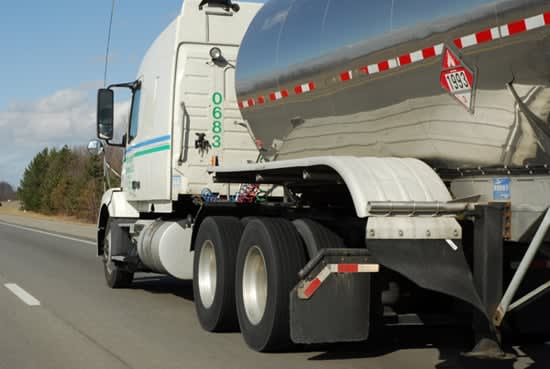
As unlikely as that might be, the Department of Transportation's own numbers suggest under-inflated tires could be a significant enforcement concern for the industry (only 44 percent of all truck tires are within 5 psi of their target inflation, FMCSA has found). And if not inflation, then tire condition in general - cut tires, insufficient tread, leaking tires, etc. - will prove problematic.
Within the context of the Federal Motor Carrier Safety Administration's CSA (Compliance, Safety and Accountability) regime, tire condition falls under the Maintenance BASIC (Behavior Analysis and Safety Improvement Categories). Within the Maintenance BASIC, there are no fewer than 14 ways your tires can get you into trouble.
Violations are weighted on pre-determined relationships to crash risk. Nine of the violations carry eight points out of a possible 10, suggesting that DOT believes tire condition plays a significant role in crash causation. The inflation-related violations are not that severe, but given the number of tires running around out there believed to be under-inflated, tire pressure violations could be easy pickin's for the truck inspectors.
The problem with Section 393.75 of the Federal Motor Carrier Safety Regulations is that it offers no definition of "under-inflated." Nor does 393.75 specify a minimum inflation pressure for tires.
Instead, 393.75 states: "No motor vehicle shall be operated on a tire which has a cold inflation pressure less than that specified for the load being carried. If the inflation pressure has been increased by heat because of recent operation of the vehicle, the cold inflation pressure shall be estimated by subtracting an inflation buildup factor."
Each 11R22.5 tire in a legally loaded dual-wheel assembly will bear as much as 4,250 pounds. The Tire and Rim Association Load and Inflation Tables tell us that tire would be just fine at 70 psi. In fact, the tire would be fine loaded up to 4,380 pounds. That's 30-35 psi lower that most fleets inflate their tires. But is that tire flat by FMCSA/CSA standards?
Just what is 'flat'?
Here's where it gets confusing. The Rubber Industry Association strongly recommends demounting and inspecting a tire that has been run at less than 20 percent of the recommended inflation pressure. The Commercial Vehicle Safety Alliance enforcement group, however, says a tire is flat if the pressure is less than 50 percent of the maximum cold pressure stamped on the sidewall. And the Inflation Tables say a tire is just fine at as low as 70 psi.
If you're keeping up with the math, CVSA says a tire is flat at just 10 psi less than the Tire and Rim Association says is an acceptable inflation pressure for a given load - in this case, the maximum load an 11R22.5 tire would experience as part of a legally loaded tandem (34,000 pounds).
Collin Mooney, deputy executive director of the Commercial Vehicle Safety Alliance, told HDT it's not likely that officers will be gauging every tire during a Level 1 inspection. "But they will be looking for tires that appear to be soft or under-inflated," he said. "If an officer suspects a tire might be under-inflated, they will check it with a gauge."
As for what constitutes an under-inflated tire, Mooney said, "We'll be looking at the maximum cold inflation pressure stamped on the tire, and determining a tire to be run flat if it's at 50 percent or less of that rating."
Neither CVSA nor FMCSA offer any direction on how or what instruments inspectors should use to measure the tire inflation pressure.
"Most law enforcement personnel use simple tire gauges, which are notoriously inaccurate," says Carl Kirk, vice president of maintenance, information technology and logistics at the American Trucking Associations.
The ATA's Technology and Maintenance Council recommends checking all tire gauges regularly against a "master gauge." Tire gauges that are off by 5 percent or more should be recalibrated or replaced, TMC says.
Al Cohn of PSI International says once he heard a DOT official at a conference say they would be using hammers to get an indication of the pressure.
"He said that in front of 500 people," Cohn recalls.
You can almost hear heads all across the land being banged against walls.
Inflation solutions
DOT inspectors will have enough low-hanging fruit to pick from with bald tires, tread separations, cuts exposing plies, etc., but it's worth noting that one pressure-related violation carries an 8-point rating: "393.75(a)(3) Tire - flat (pressure ½ of sidewall max pressure) and/or audible air leak."
Tire violations are a shared responsibility between the carrier and the driver, we know, and basic tire maintenance should be too. But that's often not the case. So maybe a little technology can be applied to the problem. Tire pressure monitoring systems and automatic inflation systems come to mind.
Both offer good ROI these days. They can prevent or mitigate pressure loss and run-flat situations, and they can improve fuel economy by reducing rolling resistance of soft tires. If your tire maintenance regimen is a little lax, the ROI will be even better. With recent advances in telematics, fleet managers can be alerted instantly to a low-pressure event and can direct drivers to repair facilities. With on-board inflation systems, pressure can usually be maintained until the tire can be repaired.
Another possible solution: nitrogen inflation, which offers a lower "permeation rate" that air. Barring any physical leaks, tires inflated with nitrogen are said to lose very little pressure over time due to permeation. An air-filled tire may loose 1 to 2 psi every few weeks. It's not much, but left unchecked it adds up.
"Tire violations are very serious (and always have been), because they are such a high safety risk," notes Doug Jones, customer engineering support manager, Michelin Americas Truck Tires. "The majority of the tire violations are those that could cause a tire to rapidly lose pressure and render the vehicle out-of-service. These count much higher against a fleet and driver in the point system. Therefore, it is in the interest of the driver to keep an eye on his tires, as well the other critical safety items."
CSA comes with enough to worry about without sweating over your tire pressure.
From the April 2011 issue of HDT
Subscribe to Our Newsletter
More Equipment
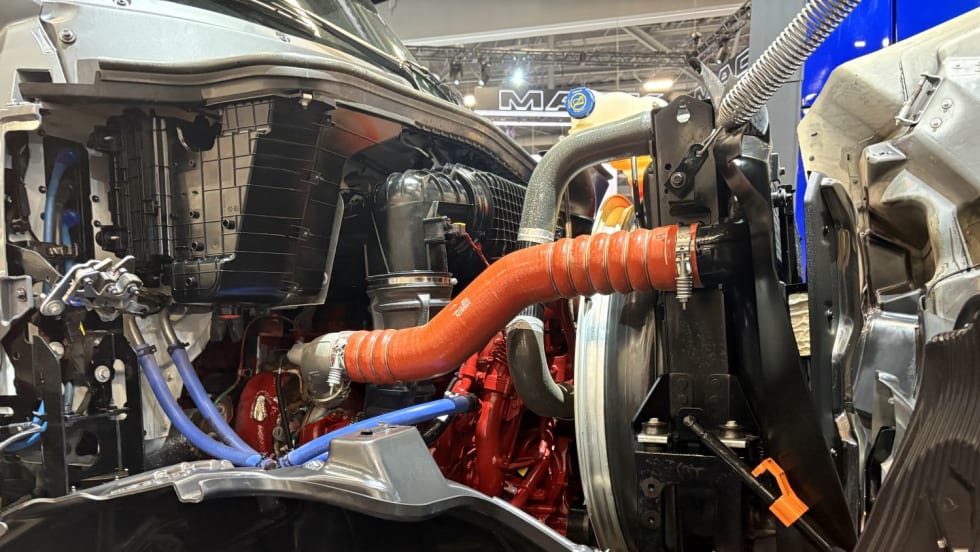
Mack Unveils EPA 2027-Compliant MP13 Engine With More Power, Better Fuel Economy
Along with unveiling its EPA 2027-compliant MP13 engine, Mack outlined powertrain changes across its Class 6-8 lineup, including new Cummins-based X10 engines.
Read More →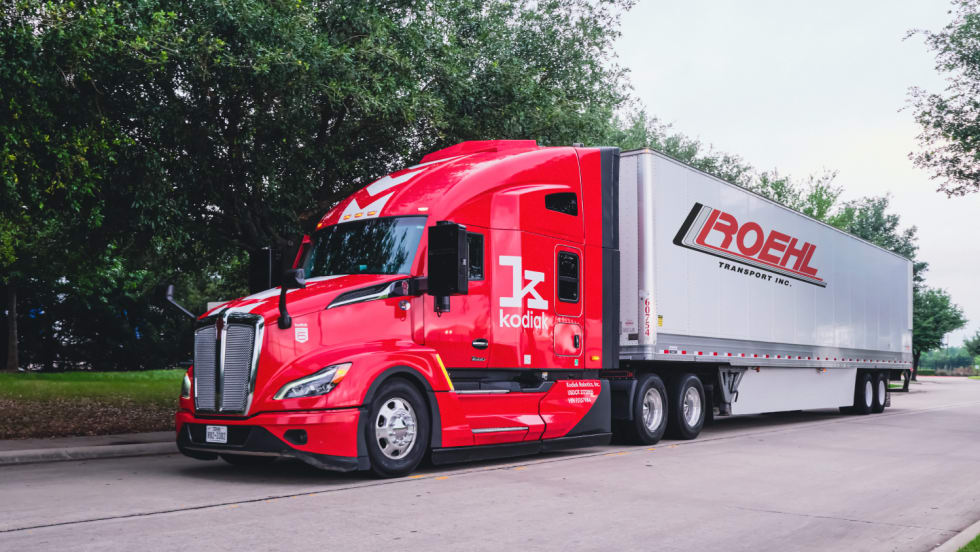
Kodiak and Roehl Transport Launch Autonomous Route Between Dallas and Houston
Kodiak AI and Roehl Transport have begun autonomous freight operations on a regular Dallas-Houston route, marking another step toward Kodiak’s planned driverless launch by the end of 2026.
Read More →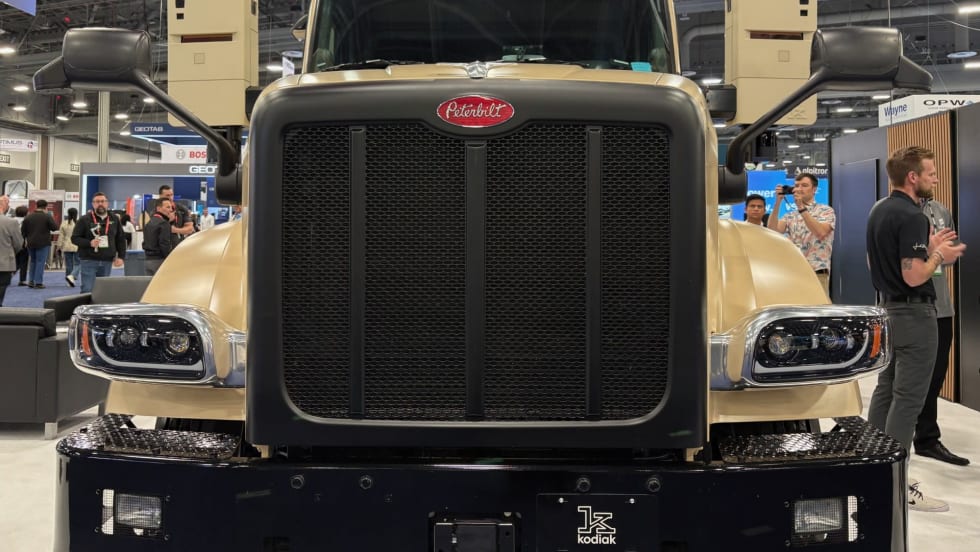
Autonomous Trucks at ACT Expo 2026
Autonomous trucks commanded a lot of attention from attendees at ACT Expo this year. Check out this photo gallery.
Read More →
How Volvo’s New D13 Engine Meets EPA 2027 Emissions Without Sacrificing Power or Fuel Efficiency
Volvo says advances in combustion and aftertreatment helped its new EPA 2027 D13 engine avoid the fuel-economy penalties many once expected from tighter NOx emissions limits.
Read More →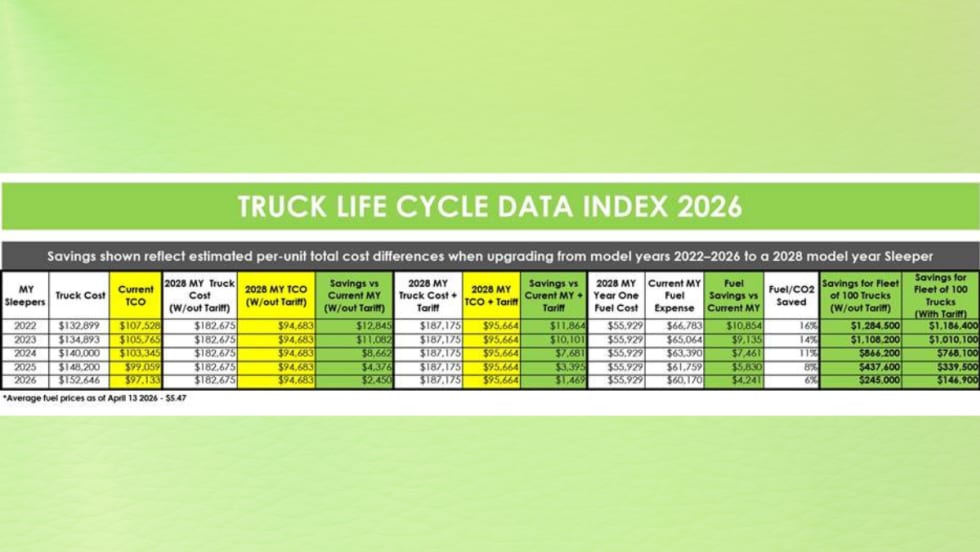
Fleet Advantage TLDI Highlights Rising Costs of Aging Fleet Equipment Amid Higher Diesel Prices
Fleet Advantage’s latest Truck Life Cycle Data Index shows fleets operating older Class 8 trucks could face significantly higher costs as diesel prices rise, while newer 2028 equipment may deliver savings of more than $12,000 per truck annually.
Read More →
'TCO’s Here.' Tesla Says Electric Semi Economics Are Ready for the Mainstream
Tesla’s Semi chief at ACT Expo outlined production growth, lower-cost models, charging expansion, and why the company believes fleets are leaving money on the table by waiting on electric trucks.
Read More →
Mack Trucks Debuts Mack ImpactShield Windshield Technology on All-new Mack Granite and Expanded New Truck Lineup
Mack Trucks is introducing ImpactShield, the first Class 8 truck windshield to use Corning Fusion5 Glass, designed to improve durability, reduce damage and help fleets minimize downtime.
Read More →
Volvo Autonomous Solutions and Aurora Begin Dallas - Oklahoma City Route
Volvo Autonomous Solutions and Aurora expand their freight network with a new Dallas–Oklahoma City route, moving closer to scaled driverless operations.
Read More →
New High-Horsepower Natural Gas Engine Could Expand Fleet Options
Westport and Volvo are demonstrating a 500-hp truck with diesel-like efficiency — one that also offers what Westport says is a better pathway to using hydrogen fuel in trucks.
Read More →
Hirschbach Announces Plan to Deploy 500 Aurora Autonomous Trucks
Hirschbach and Aurora Innovation have inked a non-binding deal outlining a path to deploy 500 Aurora Driver-powered trucks into fleet operations.
Read More →