





Related: Tanker Association Recognizes Carrier Safety Performance
How Carbon Express Did a 180 on Safety
When Steve Rush was an owner-operator, he would have laughed at the notion that one day he would be running a tanker fleet that would be recognized as the safest carrier by the National Tank Truck Council in the 15 million miles and under category.
October 20, 2016
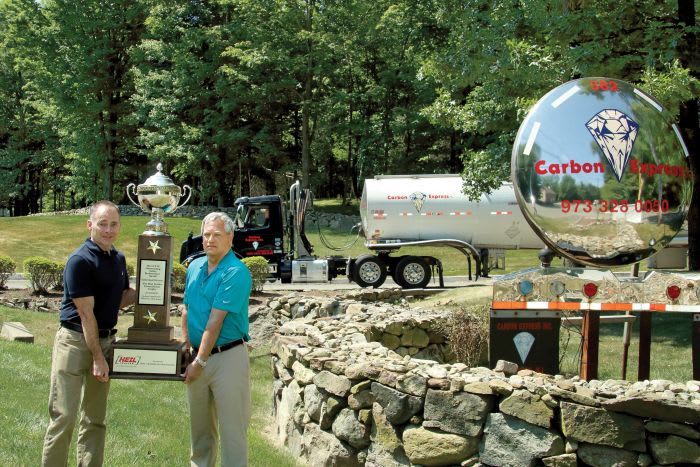
Controller Sean McAllister and Director of Safety John Bowlby hold the National Tank Truck Council Outstanding Safety Performance Trophy at the entrance to Carbon Express headquarters.
4 min to read

When Steve Rush was an owner-operator, he would have laughed at the notion that one day he would be running a tanker fleet that would be recognized as the safest carrier by the National Tank Truck Council in the 15 million miles and under category. A fleet with a safety director who was recognized by both New Jersey and NTTC as safety director of the year. A company whose drivers had been honored three years running as state Truck Driver of the Year.
Rush, president of Wharton, N.J.-based Carbon Express, was a driver for the better part of 19 years. On one of his first jobs, he worked some 20 hours a day hauling U.S. mail, and “had more accidents than you could shake a stick at.” He still had his share of accidents as an owner-operator. And even when he started building his own fleet in 1983, he says, he didn’t really pay attention to hours of service.
Then about 10 years ago, his then-safety director turned down an invitation to be chairman of safety for NTTC — and turned it down because “it would be a lie,” Rush recalls. That was a wakeup call for Rush, and he and Sean McAllister, today the company controller, set out to build a safety culture that would be worthy of the declined honor.
It wasn’t easy. A company that previously had rubber-stamped driver logs now had to get drivers to adhere to hours of service and fill out logs accurately. Two years later, they transitioned to electronic logs.
One of the drivers chosen to be the first to use e-logs “was a great driver who really struggled,” Rush says. Rush expected this driver to be one of the toughest sells for e-logs, but he was wrong. “He was always getting into trouble for his logbooks. Once we put in electronic logs, that went away. His wife told me that we had made her husband the happiest man on earth.”
In addition to the insight and compliance gained with electronic logs, Carbon Express started spec’ing only day cabs to save weight and putting drivers in hotel rooms at night (or changing routes to get them home). As a result, Rush says, the company has learned a great deal about driver fatigue and sleep patterns.
“The things we learn now are just incredible,” he says. “We now have such an understanding of sleep patterns that if we can’t push the load to fit our sleep patterns, then we turn that load down,” Rush says.
Respecting those sleep patterns, using electronic logs, and focusing on low driver turnover helped the company achieve no reportable accidents in its 55-truck fleet in 2015. And today, Steve Rush is an ardent supporter of electronic logs.
“Without question the electronic logs have made us safer,” he says.

A common argument among drivers and owner-operators who oppose electronic logs is that “we want to stop when we’re tired.” But Rush says since they started strictly adhering to HOS rules, his drivers have been able to follow their natural sleep patterns and get enough rest. “My guys find they don’t have that fatigue factor anymore.” Instead of needing to stop driving because they’re tired or sleepy, he says, “they may take that break, get a cup of coffee, walk around and then finish their trip.”
One place Rush thinks the new electronic logging device rules missed the mark is in not requiring them for local drivers who don’t stay out overnight.
“The biggest cheaters are those who run less than 100 miles,” he contends. And as a former cheater himself, he says he should know. In that U.S. mail job, he was home every night. But he would make a four-hour run, take a two-hour break, then do it all over again, all day long.
Not far from Carbon Express on I-287 in Mahwah, N.J., just south of the New York state line, there’s a big problem with trucks lining up and idling on the shoulder at night. While part of the problem is drivers who say they run out of hours and have nowhere to park, Rush believes at least some of them are just waiting there a few hours so they can head into the city early in the morning for deliveries.
He recently was talking to a customer with a small private fleet who was transitioning to e-logs. This customer’s drivers are pushing back because of exactly the scenario Rush painted — instead of following the hours of service rules and shutting down for the mandated 10 hours, the drivers want to be able to simply stop and nap for a few hours and get into Manhattan early to make their delivery. “I told him those days are gone,” Rush says.
Subscribe to Our Newsletter
More Safety & Compliance

How Waste Connections is Using Data, Telematics, and AI
How do you manage and maintain more than 18,000 connected trucks? Data. Lots of it.
Read More →
Fleet Advantage: Top Logistics Fleets Outperform National Safety Benchmarks
Fleet Advantage's latest TRUST Safety Index found leading logistics fleets maintained significantly lower out-of-service rates and stronger safety scores than national averages, while highlighting persistent challenges related to tires, brakes, and unsafe driving behaviors.
Read More →
Why Fleet Data Matters More Than Ever at Waste Connections [Watch]
Waste Connections' Chuck Palmer explains how telematics, predictive maintenance, safety analytics, and AI help keep vehicles on the road and drivers safe in this episode of HDT Talks Trucking.
Read More →
Short Takes: How K&B is Using AI
Fleets need to "get on board the train" with AI, says Lance Evans of K&B Transportation in this HDT Talks Trucking Short Takes episode.
Read More →
Short Takes: Inside K&B’s Truck Safety Tech
Listen to learn how K&B Transportation uses cellphone-blocking technology, speed management systems, weather geofencing, bridge avoidance tools, and more to improve driver safety.
Read More →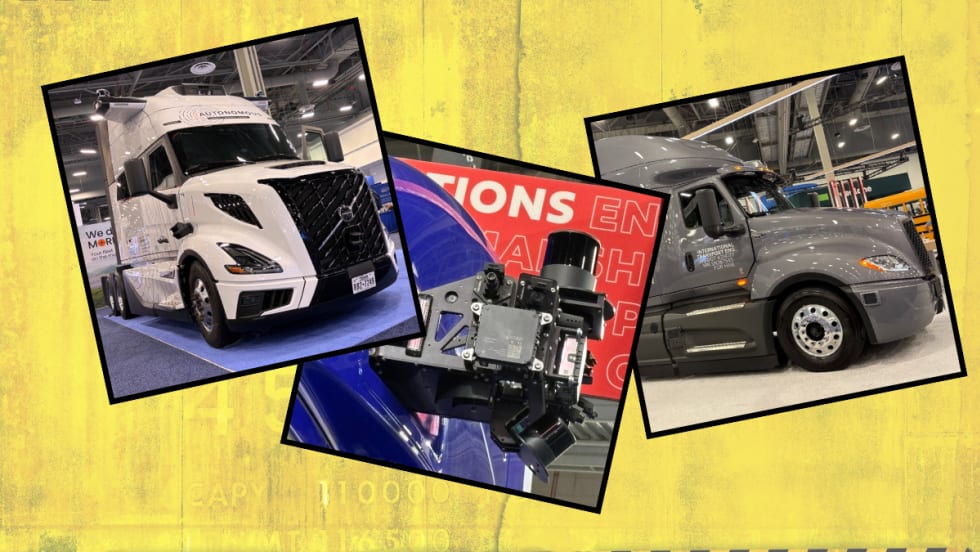
The Biggest Gap in Driverless Trucking Isn’t Tech. It’s Safety Validation
Nauto’s Stefan Heck says autonomous trucks are advancing quickly but proving they’re safe enough for large-scale deployment may be the industry’s hardest challenge.
Read More →
Truck Crash Rates Are Down. So Why Do Insurance Costs Keep Rising?
ATRI’s latest research points to litigation, social inflation, and soaring claims costs as key drivers behind record-high liability premiums for trucking fleets. But there are things motor carriers can do.
Read More →
FMCSA Removes More Than a Dozen ELDs from Registered List
The FMCSA continues its efforts to fight electronic logging devices that don't meet federal requirements, removing more than a dozen from the registered ELD list in May.
Read More →
How the Supreme Court Broker Liability Ruling Could Reshape Trucking’s Safety Landscape
The Supreme Court’s May 11 broker-liability ruling may not radically rewrite transportation law overnight. But industry experts say it will intensify pressure on brokers, carriers, and shippers to prove they are prioritizing safety.
Read More →
Recall of Fontaine Fusion Flatbeds Warns Owners Not to Use the Trailers
Some Fontaine Fusion flatbed trailer manufactured between February 2025, and March 2026 could have mainbeams weakened by hydrogen embrittlement because of a problem in the galvanizing process.
Read More →