




Related: Safety Board Calls for Action on Collision Avoidance Systems
The Price Tag for Violating Regulations Just Went Up
The Federal Motor Carrier Safety Administration has a mission statement of reducing the number of commercial motor vehicle crashes, and the injuries and fatalities associated with them.
by Kathy Close, J.J. Keller & Associates
June 16, 2015
3 min to read

The Federal Motor Carrier Safety Administration has a mission statement of reducing the number of commercial motor vehicle crashes, and the injuries and fatalities associated with them.
One way to achieve this goal is to identify high-risk motor carriers through FMCSA’s Compliance, Safety, Accountability enforcement program. Carriers that pose the greatest safety risk will find themselves subject to an FMCSA investigation, or audit, of their compliance records.
FMCSA issues fines and penalties as a result of these audits as further leverage to promote highway safety. Both motor carriers and their employees could face monetary penalties based on violations of the Federal Motor Carrier Safety Regulations or Hazardous Materials Regulations.
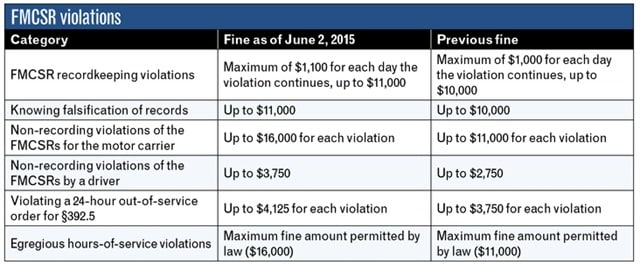
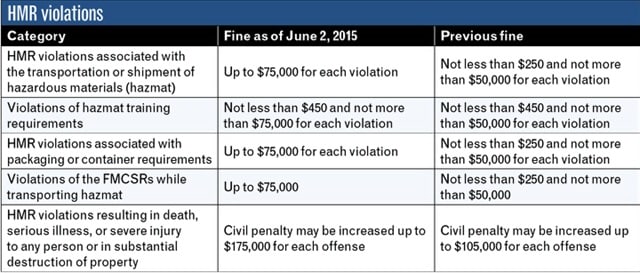
The minimum and maximum dollar amounts for these fines are routinely adjusted to reflect inflation, and the latest change became effective June 2. In some cases, it’s a hefty increase. The maximum fine has gone from $11,000 to $16,000 for egregious hours of service violations, for instance, and the maximum hazmat fine has gone up from $50,000 to $75,000.
Summary of changes
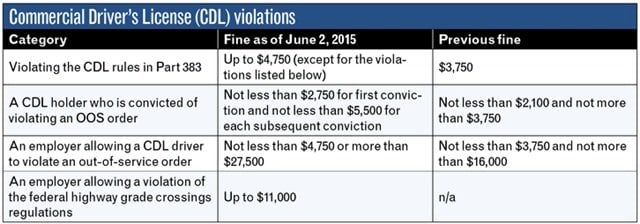
A few of the categories of fines appearing in Appendix B to Part 386 have been provided below. For a comprehensive look at all the affected violations, you’ll find the entire Federal Register notice at www.jjkeller.com/tmc.
Costs you can’t afford
Some in the transportation industry ask themselves, “How much is this going to cost me if we violate this regulation?” They may try to rationalize breaking rules based on the potential fines. However, the true cost often goes well beyond the check that is written to the federal government.
Once an enforcement case is settled, it becomes a matter of public record. The general public has access to the details of the case on FMCSA’s website — including the violations and fines paid by a motor carrier. This exposure may have a negative impact on a company’s brand. For example, in most cases, brokers and shippers will examine a motor carrier’s safety record before contracting with it. Most insurance providers are actively monitoring their customers’ safety records, and a motor carrier’s rates may be affected.
Another area of concern might be a carrier’s ability to attract qualified commercial drivers and truck technicians. With a tight labor market, quality applicants will probably go to organizations that have a corporate safety culture that is reflected in their safety rating. The fines associated with a past enforcement case might dissuade many from even applying to a motor carrier.
How a motor carrier fared during an audit and the amount it was penalized by the FMCSA is also available in the event of any lawsuits against the company. Just imagine an attorney calling into question the condition of your vehicles or the aptitude of your staff based on a fine from the FMCSA. Such actions could result in claims of negligent hiring or negligent entrustment for drivers, technicians, dispatchers, and the like.
It may not be a lost cause
Fines for violating the safety regulations have a range, and a motor carrier is not automatically penalized with the highest dollar amount in a Settlement Agreement with the FMCSA. One factor that is taken into consideration when assessing fines is a motor carrier’s “good faith efforts” to correct deficiencies. By applying new administrative procedures (i.e., safety management controls) going forward, you may be able to limit your monetary penalties and possibly reduce your liabilities.
Kathy Close is an editor in Transportation Publishing for J.J. Keller and Associates with expertise in transportation security, DOT drug and alcohol testing, driver qualification, and the Compliance, Safety, Accountability enforcement model.
Subscribe to Our Newsletter
More Safety & Compliance
Sponsored•October 6, 2026
A Camera Isn't a Safety Program. Here's What Brokers Are Screening for Now
Footage alone may not be enough to pass broker vetting processes. Here's what counts as a defensible safety program now.
Read More →
Marijuana and Trucking’s Drug-Testing Dilemma
Marijuana is getting stronger, laws are changing, and drug tests still can’t reliably establish impairment. What does that mean for truck drivers and the fleets that employ them?
Read More →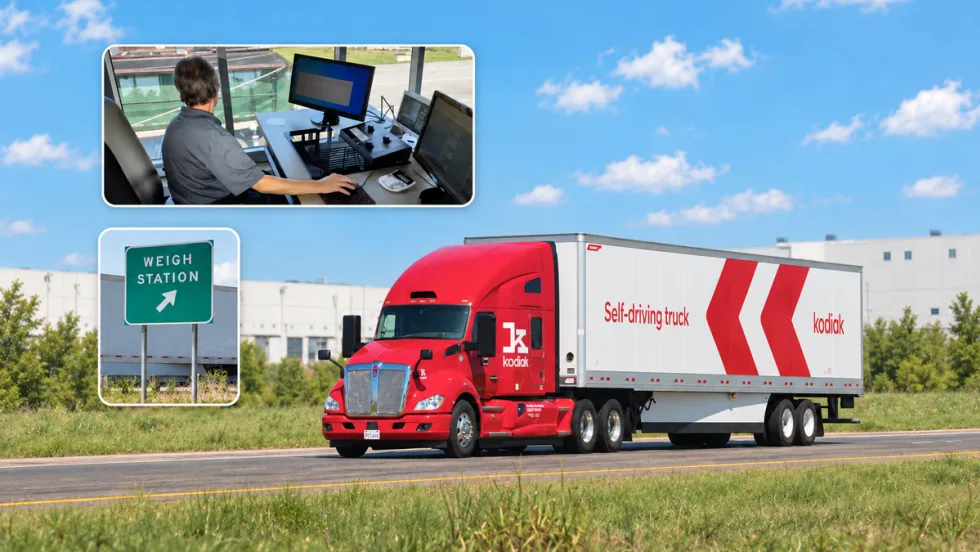
PrePass, Kodiak Connect Driverless Trucks to Roadside Enforcement
The system will allow enforcement agencies to verify Enhanced Inspection information and decide whether Kodiak’s autonomous trucks can bypass roadside screening sites.
Read More →

From One Generation to the Next: How Mentorship Builds Safer Truck Drivers
After three decades in trucking, Harold Perry shares what he's learned about driver safety, mentorship, and helping the next generation build confidence behind the wheel.
Read More →
FMCSA Pauses Biennial-Update Enforcement Amid Motus Transition
Carriers whose updates were due on or after June 1 have more time, while FMCSA works to stabilize its new registration system and warns of phishing sites impersonating its new carrier registration system, Motus.
Read More →
ZF Expands Commercial Vehicle Push in North America
ZF is expanding its North American commercial-vehicle presence with new transmission applications, electrification, trailer technology and autonomous-driving systems.
Read More →
Truck Drivers Need More Than Another Alert
Fleets have more visibility into truck health, safety events, and driver activity than ever. The next challenge is turning all that information into useful guidance for the person who has to decide what to do next.
Read More →
Tesla Wants a Self-Driving Semi. Are Cameras Enough?
Could Tesla’s camera-only autonomous driving technology work on an 80,000-pound Semi? In this commentary, HDT's Deborah Lockridge takes a look at Tesla, Cybercab, and how autonomous trucks see the road.
Read More →
What DOT’s Automated Vehicle Strategy Means for Trucking
The U.S. Department of Transportation issued a new automated-vehicle strategy that outlines plans for driverless-truck regulations, cross-state freight corridors, and federal safety standards.
Read More →
NYC Expands Speed, Pedestrian Safety Tech Across Fleet
New York City is expanding intelligent speed assistance and pedestrian-alert systems across its municipal fleet, moving the technologies from pilot programs into vehicle procurement and retrofit requirements.
Read More →