





Whether customers are Fortune 1000 companies or middle-market shippers, they all have one thing in common: “They’re tired of the excuses” for freight not getting there on time.
James Adams and Revolution Trucking Take Uncertainty Out of Shipments
Whether Revolution's customers are Fortune 1,000 or middle-market shippers, says HDT Truck Fleet Innovator James Adams, they all have one thing in common: “They’re tired of the excuses” for freight not getting there on time.
May 15, 2023
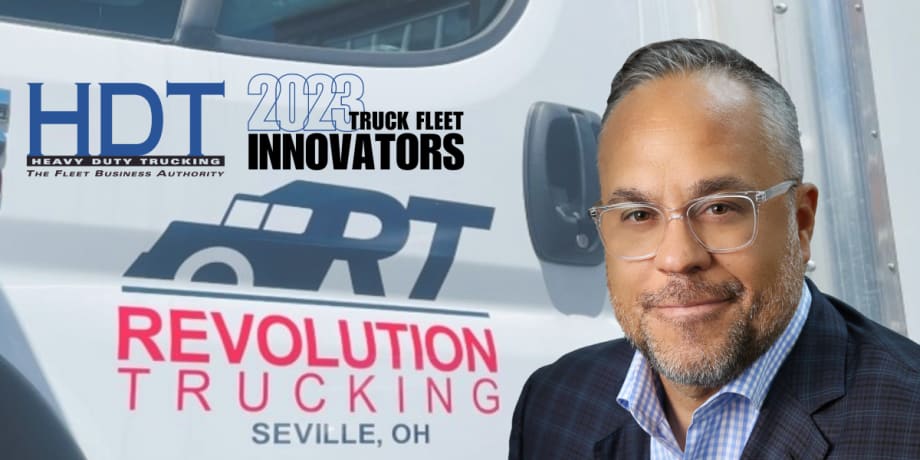
James Adams, CEO, Revolution Trucking, is an HDT 2023 Truck Fleet Innovator.
HDT Graphic from Revolution Images
6 min to read
After more than 30 years in supply chain, logistics, and transportation, James Adams wanted to “build a different mousetrap.” The result led HDT to name him a 2023 Truck Fleet Innovator.
In 2019, Adams and COO Brian Watson, co-founded a new trucking company, Revolution Trucking. The two had worked together for 15 years and believed that shippers and drivers were being short-changed by industry consolidation.
“As transportation providers have grown, their focus has shifted from customer service to cost-cutting in order to increase their own profits,” Adams, also CEO, said in an early company announcement. Revolution Trucking was founded with a mission of “providing shippers with multiple service options, improving overall customer service, and providing drivers with more money and a better quality of life.”
Revolution specializes in truckload and expedited freight for North American shipments, serving the manufacturing, automotive, consumer goods, technology, and life sciences industries.
Whether its customers are Fortune 1000 companies or middle-market shippers, Adams says, they all have one thing in common: “They’re tired of the excuses” for freight not getting there on time.
“I hate to use the word premium, because people always think price, but [we work in] that no-fail environment. Hair-on-fire, lines-down situations, end of the world, customers are going to cancel contracts if stuff doesn’t deliver when it’s supposed to. That’s where 90% of our business is.”
Adams explains that Revolution specializes in shipments that need to be there quickly and on time; are high value (they moved a $25 million satellite last year); and involve an element of risk.
“Risk comes in a lot of different flavors,” he says, such as hazardous materials, secure government loads for agencies such as the Defense Department and loads related to national security.
That type of freight only makes up about 5% of the total freight market landscape, he says. “But that’s kind of where I cut my teeth, in the premium segment.”
Adams notes that Revolution is not always the cheapest option. “And for mission-critical freight, I don’t want to be.”
Raising the Bar on Customer Service
Of course, to be successful in that segment, a company must deliver on its promises — and get the load there safely and on time. So how does Revolution do it?
“It’s the people, process, and the technology,” he says. All the technology in the world won’t help, he says, if you don’t have the people and process.
Adams says at Revolution, they don’t have salespeople, but focus on building relationships with customers. When you build those relationships, he explains, they may not need your services right away, but at some point, because you’ve built that relationship, they’ll turn to you.
The challenge, especially as a new company, he says: “When you go to buy a car you don’t buy it sight unseen,” he says. You kick the tires, get in and drive it around.
So when you get that first opportunity, “Then you’ve got to knock their socks off. So we focused on the onboarding and planning around the customers.”
To do that, he said, “80% of our success is planning.”
But how do you plan when 80% of Revolution’s business is expedited freight they’re picking up the same day?”
“We own it from beginning to end," Adams says. The company’s on-time pickup rate is always above 99%, he says, and at one point reached 99.8%, “because we manage the heck out of it.”

Kevin Bemiller, Revolutions' VP of Logistics, shows how Revolution uses a cutting-edge transportation management system to closely manage high-speed, high-value, high-risk shipments.
Photo: Revolution Trucking
Every company runs into problems with delivering freight, he says. The difference at Revolution “is how we solve those problems. We’ve had trucks break down and we tow them the whole way.”
Adams tells the tale of one employee who had limited trucking experience (he was actually in the commercial flooring business) and was surprised that the customers were so impressed.
“The bar is so low, it’s easy to surpass it," Adams says.
And he should know, because he started his career on the shipper side, with 3M. Then he joined PWC consulting around supply chain management, before getting into the trucking/ freight forwarding space.
Revolution's Secret Sauce
Adams wrote the business plan for Revolution several years earlier, 2014 or 2015, but he says the timing wasn’t right.
“In hindsight, the timing’s never right,” he says, noting that they ended up going into business right before the COVID-19 pandemic.
Yet even as many trucking companies struggled last year coming out of the pandemic freight boom, Revolution doubled its number of shipments from the previous year. In fact, Adams says the company has more than doubled revenues and clients every year.
“I always want to project an image and expectation that are much larger than we actually are,” Adams says, which is fewer than 50 trucks. “I get that all the time, ‘I thought you were a lot bigger.”
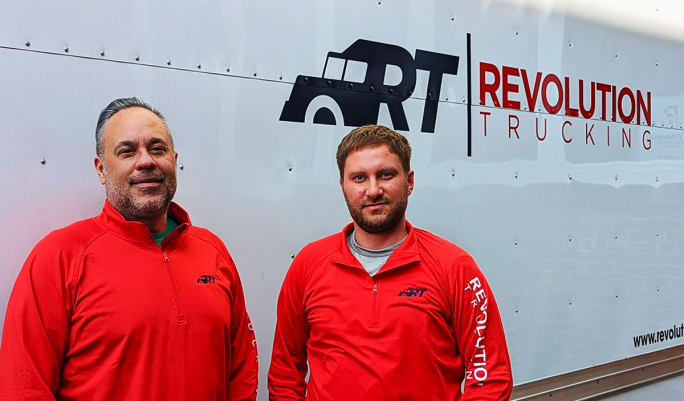
James Adams, CEO (left), and Steve Fracasso, VP of Transportation, for Revolution Trucking.
Photo: Revolution Trucking
What’s the secret sauce? Adams says it’s really not very secret — but who’s actually doing it?
“I would say on average, a shipment we’re offered is missing 25% of the necessary information to execute flawlessly,” he says. Revolution takes the information, fills in the blanks, and verifies what they’re told. That includes calling and confirming with an actual person at the shipper’s docks and warehouses to prevent surprises upon pickup. Reaching out to the consignee and confirming details such as what hours they are open to receive loads prevents surprises during delivery.
“All that time and money and frustration and stress … we remove all that stuff.”
If the company handles 50 shipments in a day, he says, “there may be 50 providers involved. Being able to track and manage that is crucial.”
In fact, Revolution boasts a 99.4% customer retention rate, and consistently exceeds 99% for on-time deliveries, according to the company.
Carriers and Drivers
Revolution consists of three businesses: Its asset-based fleet, a brokerage, and a managed transportation business. At the time we talked, the asset-based fleet was up to about 35 trucks; the goal is to get to 50 by the end of the year.
That means it relies on motor carriers to handle much of its freight.
“We’re easy to do business with, and we pay fast,” Adams says. But the company also has high expectations.
That carrier, he says is “an extension of our reputation.” Revolution has a carrier excellence program and if carriers don’t make the grade, “We hold their feet to the fire. We ask for a performance improvement plan and they hop to it.”
In addition, driver recruiting and retention for its own fleet are “absolutely critical,” Adams says, to maintain Revolution’s high level of performance.
It’s important to find the right person, “because it is a lifestyle,” he says. “We’re not turning Uber drivers into truck drivers.”
In addition, he says, drivers have to be managed on a person-by-person basis. Each one has their own preferences. “We don’t have forced dispatch, even for our own drivers.”
He admits that it has been a learning process. After developing a list of driver attributes associated with a higher likelihood of success, and hiring based on those, their driver turnover dropped dramatically.
“We do pay well and quickly. Our drivers get paid every Friday. If they’re in a pickle, we CashApp them some money. Some of these guys don’t come home for three weeks,” he says, and having that kind of back-office support drivers need is important.
Looking Ahead
Another key to Revolution’s success is understanding the industries it’s hauling for.
“Pharmaceuticals doesn’t look like automotive doesn’t look like construction,” he says. “There’s so many specifics for each industry. We’re moving to more thoughtful, strategic specialization.”
Adams says Revolution could grow even faster, “but that’s not the company we’re building.”
If there was one word Adams would use to describe how Revolution is “disrupting” trucking, he says, “I’d say it’s total transparency. We don’t play games, we do exactly what we say we’re going to do, and we tell you what we’re not going to do.”
Subscribe to Our Newsletter
More Fleet Management

How Innovative Trucking Leaders Turn Change Into an Advantage
As the pace of change accelerates in trucking, the fleets that adapt best have more than the latest technology. They have cultures that embrace improvement.
Read More →
Freight Broker Bonds Just Got Harder to Get. Here's What That Means for Your Fleet.
When it gets harder for a freight broker to prove they are financially sound, the ones who cannot clear that bar get pushed out of the market. And those are exactly the brokers who used to leave motor carriers holding the bag.
Read More →
Long-Awaited Canadian Border Bridge to Open in Detroit
For trucking, the bridge opening should offer immediate improvements in efficiency and reliability, with new customs facilities, expanded inspection capacity, and direct freeway-to-freeway connections.
Read More →
Aurora Rolls Out Next Generation of Driverless Trucks for Commercial Freight
Aurora's latest autonomous trucks it's rolling out with International feature lower-cost hardware designed for a million miles as the company expands commercial driverless freight operations across the U.S. Sun Belt.
Read More →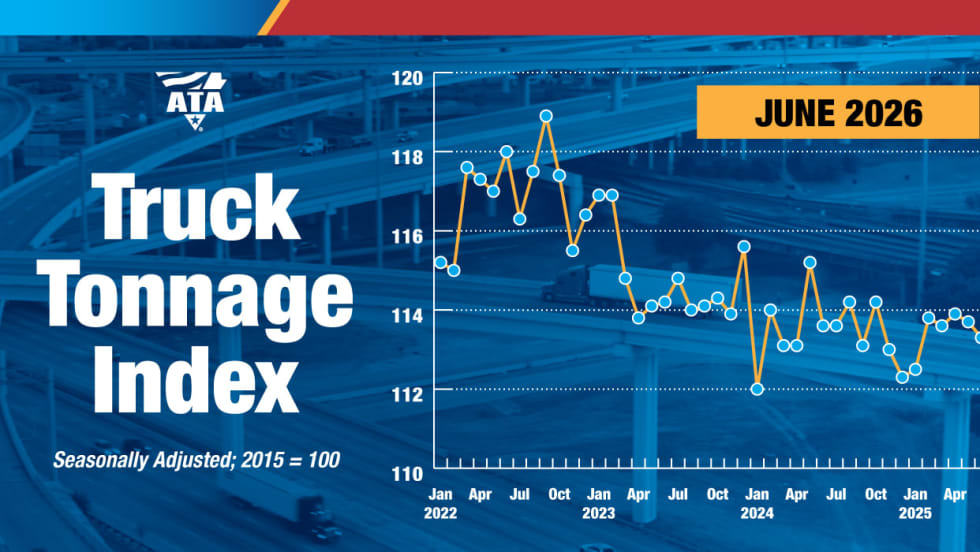
Freight Tonnage Down, Rates up, as Lower Capacity Powers Trucking Recovery
The recovery from the freight recession continues to be driven by reduction in capacity rather than by increased demand.
Read More →
Think Your Trucking Fleet Isn't Using Much AI? Think Again
Shadow AI — the use of unauthorized artificial intelligence tools at work — is becoming increasingly common, putting sensitive company data at risk. Learn how trucking fleets can protect sensitive data while embracing AI.
Read More →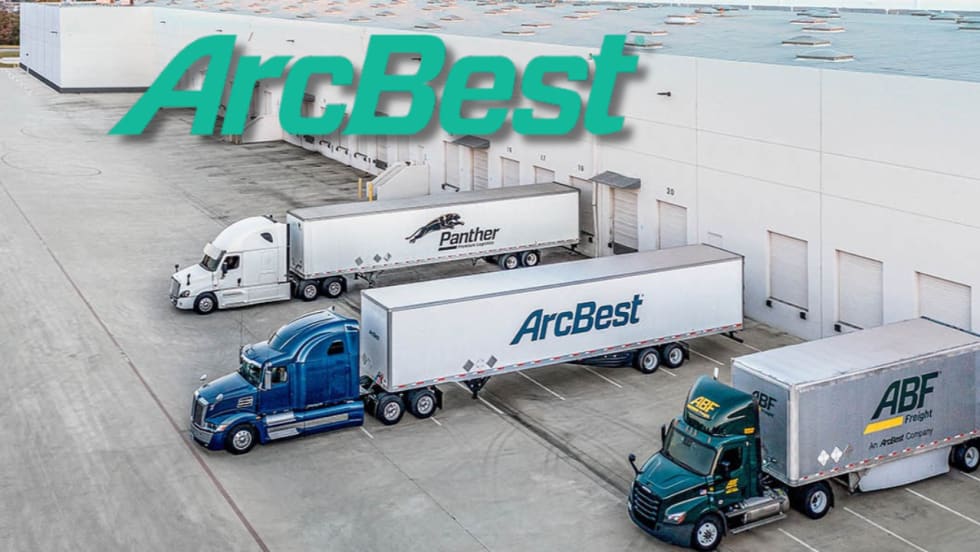
ArcBest Consolidates Brands, Cuts Workforce
The company will bring three business units under the ArcBest brand, eliminate about 2% of positions, and expects the changes to generate $40 million in annual savings.
Read More →
Trucking Fleets Faced Record Operating Costs During Third Year of Freight Recession
ATRI's annual operational cost report shows carriers trimmed fleets, delayed equipment purchases, and ran older trucks as expenses continued to outpace freight rates.
Read More →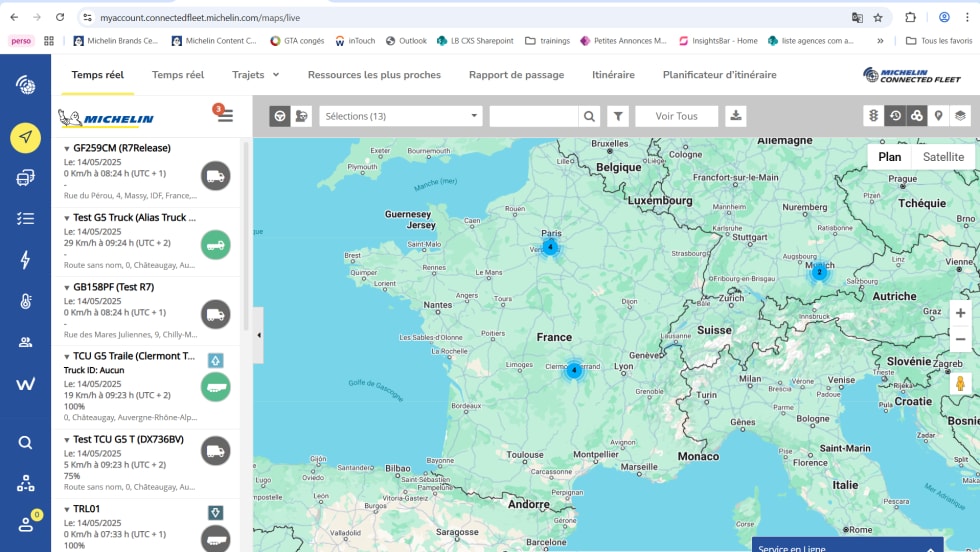
Michelin Adds AI Assistant to MyConnectedFleet Platform
Michelin’s new generative AI tool delivers instant fleet insights, helping managers analyze fuel use, tire maintenance, vehicle status, and operational performance without manually creating reports.
Read More →
LytxOne Platform Now Features AI, Compliance, and Asset Tracking Tools
New enhancements add AI-powered insights, asset tracking, compliance automation, and configurable privacy controls to Lytx's all-in-one fleet management platform.
Read More →